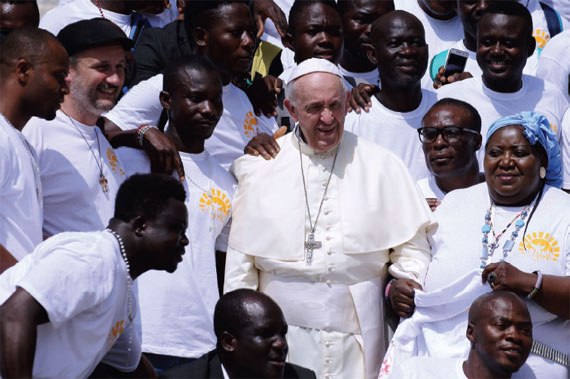
Pan-Amazon Synod: Church looking at role of women

The Church is being urged to find ways for women to be granted an “official ministry” in the Amazon region, a part of the world suffering from a shortage of priests and where Catholics are unable to attend Mass for long periods. A preparatory document ahead of the Synod of Bishops gathering on the Pan-Amazon region in 2019 says it is “necessary to identify the type of official ministry that can be conferred on women, taking into account the central role which women play today in the Amazonian church.”

Due to the scarcity of clergy, lay women have long been involved in coal face parish ministry in the region including conducting baptisms, weddings and bringing pre-consecrated communion to communities.

While the Vatican’s doctrine prefect, Archbishop Luis Ladaria, recently ruled that the Church’s teaching on an all-male priest-hood is “definitive,” a papal commission has been established to examine the question of female deacons.

The new consultation document, known as the “lineamenta” and released by the Vatican’s Synod Office, says there is an “urgent need to evaluate and rethink” ministries that respond to the needs of the Amazon.

“One priority is to specify the contents, methods, and attitudes necessary for an inculturated pastoral ministry capable of responding to the territory’s vast challenges,” says the text, titled “Amazon: new paths for the Church and an integral ecology.”

One bishop in the region, Erwin Kräutler, has argued this could include ordaining married men in the region, a topic he has raised with Pope Francis. In his province Xingu there are just 27 priests serving 800 local communities and 700,000 Catholics spread across a vast region. Pope Francis has indicated he is open to the idea.

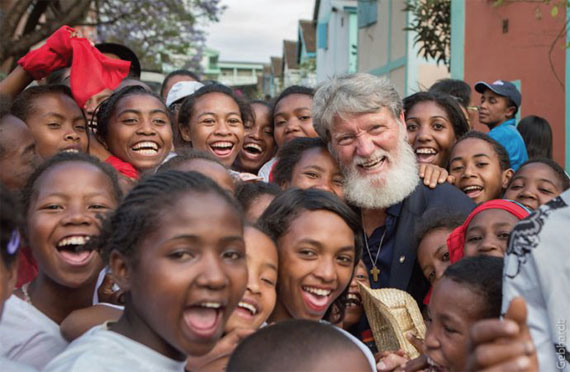
Madagascar’s ‘Mother Teresa in pants’ built a city for the poor

“God’s Mason,” “Mother Teresa with pants,” “God’s soldier,” “the apostle of garbage” and “the insurgent of Madagascar” are but a handful of the nick-names given to Father Pedro Opeka, nominated multiple times for the Nobel Peace Prize, who’s also a recipient of France’s Legion of Honour and several papal awards.

Born in Argentina in 1948 to Slovenian parents who fled Europe after World War II, Opeka is a missionary priest who’s been serving in Madagascar, the world’s ninth poorest country, for almost 50 years.

He’s in Rome because three countries Argentina, Slovenia and Monaco are throwing a dinner to raise funds for his foundation, “Akamasoa,” which means “good friends” in Malagasy.

On May 28, Opeka was received by Pope Francis.

“When we arrived, the doors opened and the Pope came to encounter us,” Opeka said. “He tells me ‘Pedro, how are you?’ Like a friend, a father, as if we’ve known each other for years.”

War, hunger, ‘cultural colonization’ are forms of persecution, pope says

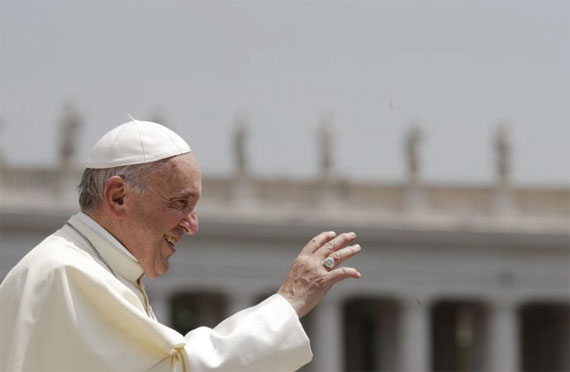
Persecution is the work of the devil, and while anti-Christian persecution is evident in many parts of the world, the devil also is attacking the image and likeness of God present in many other people as well, Pope Francis said.

“In the world today, Christians are not the only ones being persecuted; human beings, man and woman, are because the father of every persecution cannot tolerate that they are the image and likeness of God. So he attacks and destroys that image,” Francis said on June 1 during Mass in the Domus Sanctae Marthae.

“Cultural colonization,” or the pressure some nations place on others to accept practices that go against their own culture, is another form of persecution, the Pope said. Francis often has denounced the practice by which wealthy donor nations try to impose acceptance of abortion, contraception or liberal attitudes toward homosexuality and gay marriage on poorer countries as a condition for aid.

Analysis: rise in young Catholics attending Mass, survey suggests

With the youth Synod only a few months away, a major new survey of young Catholics in Britain has some startling findings. On the plus side, Complex Catholicism: The Lives and Faith of Young Catholics in England and Wales Today shows a strong increase in regular Mass attendance (at least monthly) from 25% of all respondents in 2009 to 36% in 2017. Irregular Mass attendance (less than monthly) has increased from 59% in 2009 to 75%.

But the survey also includes some unsettling findings about what young Catholics actually believe: well over half do not hold traditional Catholic beliefs on God, many believe that Jesus was only human and not the Son of God, and a large number are willing to ignore the Church’s moral teachings.

The study was conducted by Catholic research group Camino House and Cymfed, the Catholic Youth Ministry Federation, in September and October last year. A total of 1,005 Catholics in England and Wales, aged 15-25, were surveyed online. Just over half were 15-19, and 48% were 20-25; 68% were female and 32% male. Two-thirds of the respondents self-identified as Catholic; the remaining third did not, but came from a Catholic family or had attended a Catholic school. Unsurprisingly, many of these “non-identifiers” still held some Catholic beliefs and attitudes, but were less likely to hold strongly to the Church’s teachings.

The finding that should cause most concern to the Church is that half of the respondents who self-identify as Catholics don’t believe in a personal God. Only 38% hold to the Church’s teaching that God created the world and is involved in what happens to the world now. A further 12% believe. He created the world but is not involved in the world today.

One in five said they believed in a higher spiritual power but not a personal god, one in four said they weren’t sure whether they believed in God or a higher spiritual power and five percent of self-identifying Catholics said they didn’t believe in God or any higher spiritual power.

Philippine church leaders oppose pistol packing priests

Church leaders in the Philippines have criticized proposal to arms priests as a protection measure in the wake of recent attacks on members of the clergy.

Calls have come from several quarters for priests to take advantage of a 2014 law allowing journalists, priests, lawyers, doctors, nurses, accountants, and engineers to carry firearms outside their homes.

The calls come after three recent shooting incidents involving priests.

On June 6, Father Rey Urmeneta, a 64-year-old Catholic priest in Laguna province, survived a gun attack by two assailants.

He was the third priest to have been shot in the past six months.

In April, Father Mark Ventura from Gattaran town in the northern Philippines died after being shot by a lone gunman shortly after celebrating Sunday Mass.

On Dec. 4, 2017, Father Marcelito Paez was also shot dead in the town of Jaen, Nueva Ecija province. The Catholic Bishops’ Conference of the Philippines, however, expressed strong opposition to the idea of arming priests.

“Arming priests is not a solution to crimes against them,” said Father Jerome Secillano, executive secretary of the Public Affairs Committee of the bishops’ conference.

He said there is no need for priests to arm themselves because, like any ordinary citizen, they are also entitled to protection from the government. “If [priests] antagonize other people, killing them is unnecessarily excessive and brutal,” said Father Secillano, adding that priests should never be considered as “enemies.”

Bishop Arturo Bastes of Sorsogon said priests get their protection from “angels, not weapons.”

“I am for a gun-less society. We priests are not afraid of dangers. If the public, especially the poor, are exposed to dangers, we cannot be less,” said Archbishop Ramon Arguelles of Lipa.

Another priest slaying rocks Philippine Church

Another name was added to a growing Philippine Church casualty list on June 10 when a priest was shot dead as he was about to celebrate Mass in the northern province of Nueva Ecija. Father Richmond Villaflor Nilo of Cabanatuan Diocese was gunned down inside the Nuestra Senora dela Nieve chapel in Zara-goza town. Police said the priest was shot while he was putting on his alb to start the Mass. At least three shots were fired through the chapel’s window.

China plans to remove ‘foreign influence’ from Catholic Church

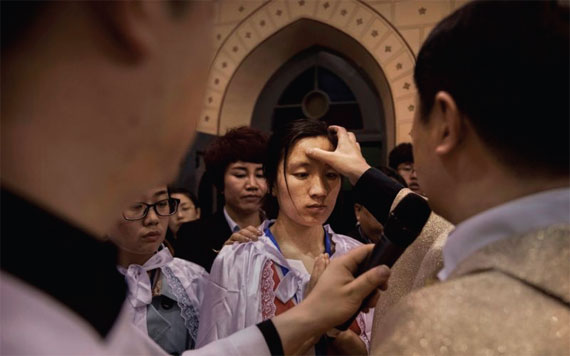
China has launched a five year plan for the “development” of the Catholic Church, aimed at altering religious principles and practices to coincide with Chinese communist ideals. This plan was approved by the Patriotic Association of Chinese Catholics and the Council of Chinese Bishops, neither of whom is recognised by the Holy See. The goal of this plan is to eliminate “foreign influence” and to ensure governmental control of all religious activities, including a submission of religious leaders to the Communist Party. The groups have not released any specific details, but the five year plan will include “understanding the history of the church” in China, driving theological research, and emphasising evangelism.

Chinese authorities demolish Way of the Cross in Henan

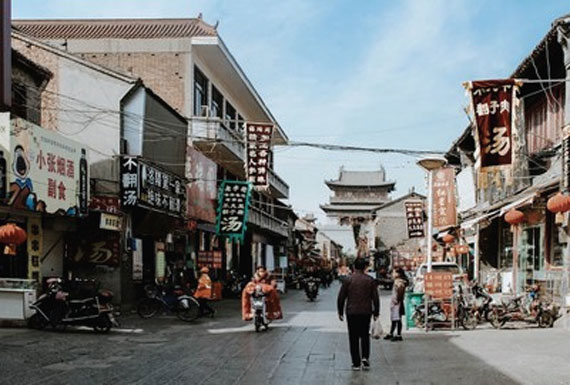
The Way of the Cross at a pilgrimage site in China’s Henan province has been forcibly demolished by authorities in the latest clampdown on religious freedom. Local government officials removed images of Jesus at the well-known Our Lady of Mount Carmel pilgrimage site in Tianjiajing village of Anyang Diocese at 8 pm on June 5.

A source said authorities sent personnel one month ago to tell Bishop Joseph Zhang Yinlin of Anyang that the Way of the Cross must be dismantled, but no specific reason was given.

Nuns living nearby took photographs and videos of the demolition and sent the evidence to chat groups.

A religious source said the Communist Party’s policy appeared to be to “allow Catholicism to exist but not develop.” In 1987, the local government sent troops and armored vehicles to the site after estimating there would be 50,000 pilgrims, the source said.

In 2009, Henan had about 2.4 million Christians, of whom 300,000 were Catholics. By the end of 2011, there were 2,525 Christian churches and 4,002 Christian premises in the province.

41 terrorists arrested over Surabaya church attacks

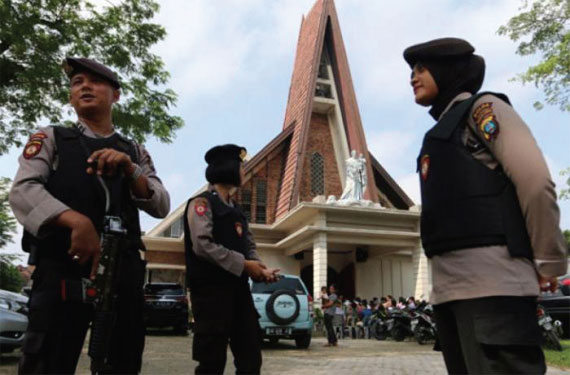
Jakarta Security Forces have arrested 41 suspected terrorists, linked to a series of bomb attacks in Surabaya, the capital of the province of East Java. Four others were killed during counter terrorist operations, reported local police chief Tito Karnavian last night to local media, adding that the victims had resisted arrest. “After the suicide bombings in Surabaya and Sidoarjo on May 13 and 14, we moved quickly and identified the culprits – he said – A suspected terrorist from Probolinggo (East Java) surrendered to the local police because he could not live in peace, as he was always on the run.” Tito Karnavian also revealed the final toll of the victims of the attacks carried out in Surabaya by two militant families of Jamaah Ansharud Daulah (Jad), a local terrorist group linked to the Islamic State (IS). Attacks on three Christian churches and the local police headquarters have killed 14 civilians and 13 terrorists. Over 40 people were injured.

Hindu leader in Nepal ‘faked assassination attempt’

A self-styled religious leader in Nepal linked to hard-line Hindu nationalists has been accused of faking an attempt on his life by instructing a bodyguard to shoot and wound him. Dinesh Pandit, 25, revered as “Acharya Shree Niwas” by Hindu devotees, was shot on April 8 in the country’s east shortly before he was scheduled to address a mass religious gathering.

Some devotees, seeking to fuel street protests, claimed that it was a premeditated attack by Christians.

The government said it would pay for Acharya’s medical treatment while the main opposition political party called for an upgrading of protection for religious leaders.

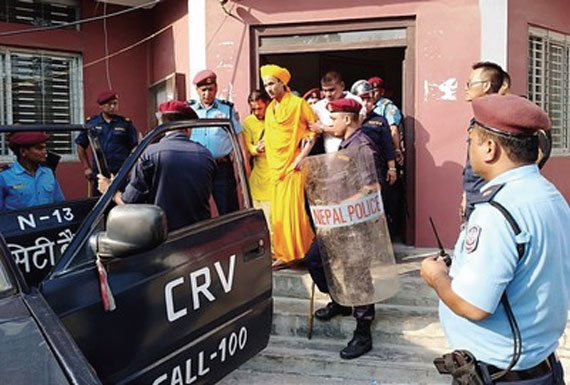
Acharya was discharged from hospital after 21 days, but on May 8 police detained him before he could board a flight to India. Subsequently, Acharya was charged with staging his own shooting and attempting to incite communal violence.

The initial investigation carried out by police indicated that Acharya had instructed his bodyguard, Madhav Chaudhary, to shoot him in one arm so that it would look like an assassination attempt. Chaudhary, who was arrested 26 days after the attack, reportedly confessed his role.

The administration office in Morang district remanded Acharya in custody. Some Christians suspect that Acharya’s shooting scam was part of a wider conspiracy to suppress religious freedom and spur attacks on non-Hindus.

BP Khanal, Nepal chapter coordinator of the International Panel of Parliamentarians for Freedom of Religion or Belief, said that despite Nepal being officially secular, the state still encouraged the notion that Nepalis had to be Hindu.

“Religious minorities are often persecuted and attacked,” he said. And in recent years Christians have been victimized over the alleged killing of cattle as well as the distribution of Bibles and conversion of non-Christians. Reverend Joseph Shrestha, chairperson of the Christian Society in Nepal’s Province 7, said that in December 2016 Hindu extremists organized mass protests following the deaths of cows in the Kailali district.