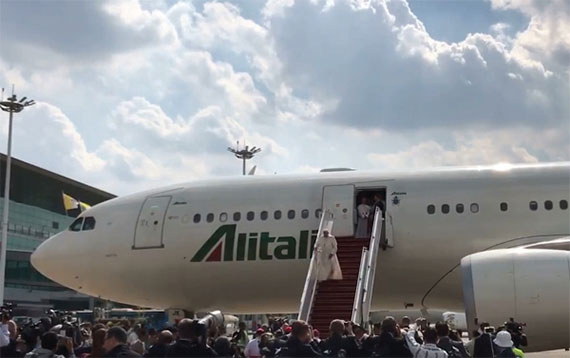
Sibi George to be new Indian envoy to Holy See

The Indian Foreign Service (IFS) officer of 1993 batch Sibi George will be the new amba-ssador of India to the Holy See, an announcement by the Ministry of External Affairs said here. He will replace Smita Purushottam.

Mr George is also presently Ambassador of India to Switzer-land. He will have his residence in Berne and is expected to take up the assignment shortly.

A native of Kottayam in Kerala, George has also served as deputy chief of mission of Indian embassy in Saudi Arabia and Iran. He has also worked in Egypt, Qatar, Pakistan and USA. He is also a recipient of S.K. Singh Award for excellence in IFS.

Blessed Rani Maria’s parish declared pilgrimage centre

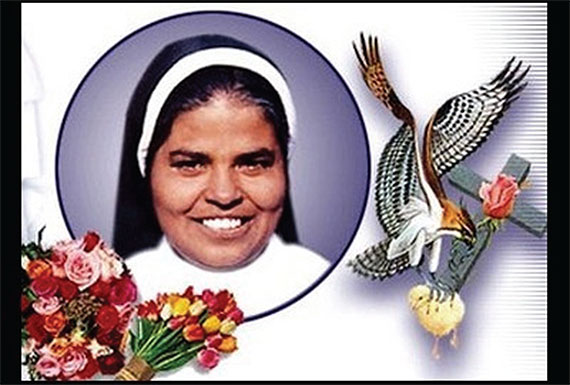
The beatifica-tion of Sr Rani Maria has seen the elevation of her home parish in Kerala as a pilgri-mage centre of the Syro-Malabar Church. The St Thomas Church at Pulluvazhi near Perumbavoor has been declared a pilgrimage centre by Syro-Malabar Major Archbishop Cardinal Mar George Alencherry on Nov 20.

Sr Rani Maria was beatified in Indore earlier this month. The nun was stabbed to death 23 years ago by a goon hired by landlords peeved at her work among landless labourers in a Madhya Pradesh village. In a rare act of forgiveness, her family accepted the assassin as a member of the family.

Sunday’s ceremony started with a procession carrying the blessed nun’s relics.

Cardinal Bo urges Pope Francis not to use the word ‘Rohingya’ during Myanmar visit

In 2006, while he was visiting Regensburg, Germany, Pope Emeritus Benedict XVI delivered an address in which he cited a 14th century dialogue between a Byzantine emperor and a Persian, unleashing a firestorm of protest across the Islamic world.

Benedict’s quote cited the emperor saying: “Show me just what Mohammad brought that was new, and there you will find things only evil and inhuman, such as his command to spread by the sword the faith he preached.”

The citation was shot out of a media cannon with deadly consequences. An Italian nun was shot to death in Somalia, churches were firebombed on the Gaza strip, and the pontiff was burned in effigy in the streets of Ankara.

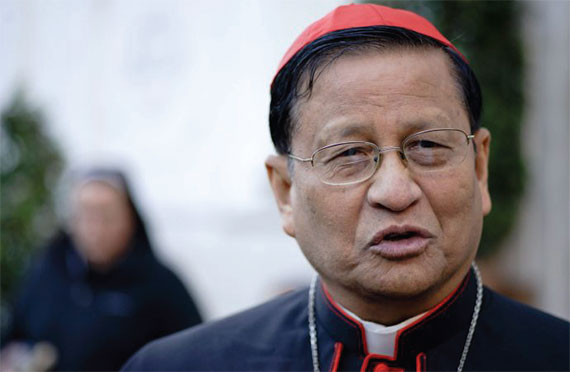
Myanmar’s first-ever cardinal, Charles Maung Bo, who will be hosting Pope Francis during his Nov. 27-30 visit to the Asian nation, fears that a similar situation could unfold, though this time Muslims wouldn’t be the protesters but the victims.

Bo, created cardinal by Francis in February 2015, spoke with Crux in Rome ahead of the papal visit to Myanmar, the first by a Pope, and Francis’s first to a Buddhist majority country.

During the 30-minute conversation with the pontiff, the cardinal acknowledged that if Francis chose to use the term ‘Rohingya,’ “there could be demonstrations at once, going after the Muslims.”

The “R” word, used by a Muslim minority in Myanmar to define themselves, is causing controversy ahead of the Pope’s visit.

The United Nations is accusing Myanmar’s military of carrying out ethnic cleansing against the Rohingya in Rakhine State, and the international community is concentrating its energy on the persecuted minority. Yet Bo is all but begging the Pope not to call the Rohingya by their name.

“If he doesn’t use it, the international community will say something,” Bo acknowledged. “If he does use it, then it could be very bad for the military, the government and the Buddhist community.”

By political connotation, Bo explained, he meant that the Pope wouldn’t be supporting the idea the estimated million Rohingya living in Myanmar – though it’s believed that half of them have fled to Bangladesh in recent months – should be given citizenship.

Muslims Are Converting to Christianity in Record Numbers

How are so many conversions taking place in oppressive countries where proselytizing can bring a death sentence?

“We are in a time of the first ever mass conversions of Muslims,” Father Mitch Pacwa SJ told me in a phone interview. “God is doing a mighty work among them.”

Pacwa is a host for EWTN radio and TV, a frequent pilgrim guide to the Holy Land and is fluent in 13 languages including Arabic. He is considered as an expert on the Middle East and produced the DVD ‘Christianity & Islam: Are We at War? and co-authored, ‘Inside Islam: A Guide for Catholics.’

Pacwa said he began hearing talk of conversions to Christianity around 2005 on Al Jazeera Television, the Arabic news satellite TV channel with 80 bureaus around the world. “They were reporting on the mass conversions of Muslims—as many as 6-8 million—in sub-Saharan, Africa, and they have repeated the warning every year,” he said. “I’ve confirmed it with Africans I know who have told me again and again about conversions in places like Nigeria, Uganda, Mali … that’s why Boko Haram has become so active. They are actually quite scared and trying to terrorize. But the very act of terrorizing people has ended up with people becoming more disgusted with Islam.”

Pacwa recalled hearing someone on African TV say: “Al-Qaida attacks Americans by blowing up our embassies but we Africans are the ones that die in the attacks.” He suspects that Islam is at the beginning of a collapse, likening increased terrorism to the supernova stage where stars burn brightest just before they burn out.

Pacwa gave recent examples of heinousness retribution for rejecting Islam. “Not long ago I read about a boy who was a slave that snuck out to pray on Good Friday and was crucified for it,” he said. “I also heard about two Filipino maids that were caught with the New Testament and beheaded.”

Americans caught practicing Christianity in Muslim countries are usually expelled. But according to Pacwa, it’s much different for citizens. “Fridays after the noon prayers is the day they cut off hands and heads from thieves, adulterers—women only—and people who commit blasphemy, and that would include converting to Christianity.”

Pope dodges Rohingya, focuses on tolerance, justice and peace in Myanmar

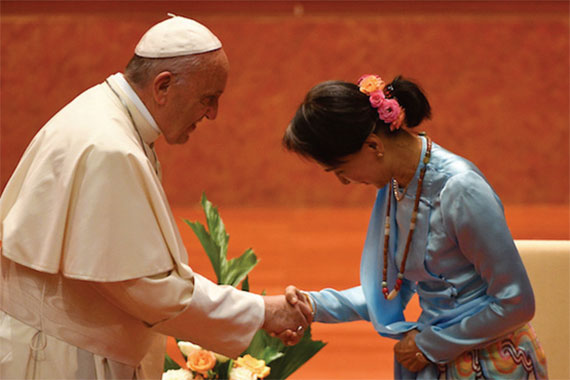
Pope Francis has avoided any specific mention of Myanmar’s multiple conflicts, including the Rohingya refugee crisis, during his Nov. 28 public address set piece at the national capital Nay Pyi Taw.

Instead, the first trip ever to a country by any Pope, he chose to broadly address the importance of peace, tolerance, respect for religious differences and the duty of current generations toward the young, when he spoke to diplomats, politicians and civil society representatives at the national parliament.

“The arduous process of peace-building and national reconciliation can only advance through a commitment to justice and respect for human rights,” Pope Francis said. “Religious differences need not be a source of division and distrust, but rather a force for unity, forgiveness, tolerance and wise nation-building.”

“The future of Myanmar must be peace, a peace based on respect for the dignity and rights of each member of society, respect for each ethnic group and its identity, respect for the rule of law, and respect for a democratic order that enables each individual and every group – none excluded – to offer its legitimate contribution to the common good.

“The future of Myanmar in a rapidly changing and interconnected world will depend on the training of its young, not only in technical fields, but above all in the ethical values of honesty, integrity and human solidarity that can ensure the consolidation of democracy and the growth of unity and peace at every level of society.”

Human rights groups expressed disappointment that the pontiff had remained silent about the Rohingya tragedy, which has seen 620,000 people flood into neighbouring Bangladesh with stories of murder, rape, pillage and property destruction by the Myanmar military.

But the pontiff had been begged by Cardinal Charles Bo of Yangon, the country’s only cardinal, as well as former UN chief Kofi Annan not to mention the group by their self–determined name of Rohingya, for fear of sparking sectarian violence.

Rohingya is a term that majority of Myanmar’s people now shun in favour of “Bengali” or as civilian leader Aung San Suu Kyi says, “Rakhine Muslims” while referring to their home state and religion.

Francis met earlier in the morning for about 30 minutes with about 20 other religious leaders, including several Buddhists, Muslims, and Hindus; and an Anglican, a Baptist, and a representative of the Jewish community.

Bangladesh author writes rhyming Bible stories

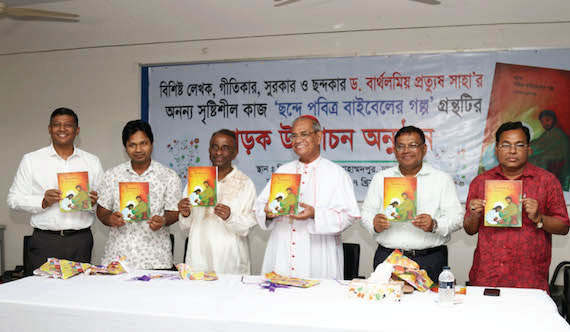
A prominent Bangladeshi Catholic musician has written a book containing Bible stories that rhyme to help Christian children read and understand the Bible better. Card Patrick D’Rozario of Dhaka launched the book called Chhonde Pobitro Bibeler Golpo (Selected Stories from the Holy Bible in Rhyme) written by Bartholomew Prottyush Shaha on Nov. 19 in Dhaka.

The 56-page Bengali language book is a collection of 25 stories from the Bible in verse form.

“Children like rhymes and they can easily memorize them. My intention is to offer children an opportunity to learn and grow an interest in the Bible at an early age. I hope this book will be use-ful for children in schools and at home,” Shaha, told.

The income from the book would go to Pratibeshi Prakashani, the publisher and publication wing of Catholic Bishops’ Christian Commu-nication centre, he said.

Over the years, he has composed over 100 religious songs and 45 have found place in Geetaboli (Songs), a popular Bengali Mass hymnal widely used in church liturgy.

Laos’ first cardinal aims for interfaith unity

In the Cathedral of the Sacred Heart in Vientiane a large banner is hard to miss.

The “17 Martyrs of Laos” banner hangs from the ceiling of Vientiane’s only Catholic Church and commemorates a group of Catholics, including several priests, who died between 1954 and 1970 in a crackdown on the religious by the communist government.

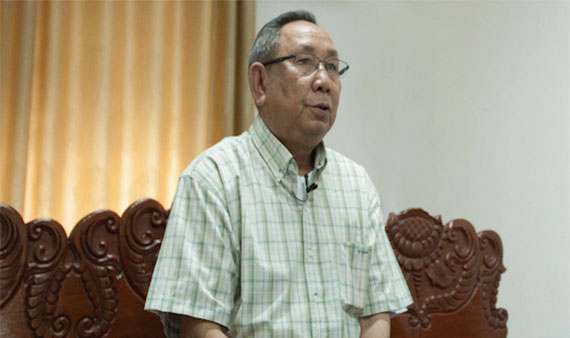
Each year, on Dec. 16, Louis-Marie Ling Mangkhanekhoun, 73, makes sure that the martyrs are not forgotten. “We remember them with a ceremony, because they were witness to the faith,” Ling said inside the cathedral.

Ling, who grew up in a poor family without a father and was raised with the Khmu ethnic minority in Laos’ mountainous Xiengkhouang province, can also be described as a “witness to the faith.” Ling, who became the first cardinal of Laos on June 28, was sent to prison in 1984. Not for committing a crime, but because of his work as a priest travelling around the country.

He spent three years behind bars. But the cardinal sees the jail time as a spiritual experience during which his faith was tested. “There were some difficulties when I was locked up, health diffi-culties for example,” he says. “But it didn’t trouble me a lot. It didn’t disturb me in my personal life. Because we can take it as a test; where is your faith?” The appointment of Cardinal Ling, who studied theology and philosophy in Canada, came as a surprise to many. Including the man himself, who was in the small southern Laotian city of Pakse – where he serves as a bishop – when he heard the news.

“I was walking around when somebody called me, and said: ‘grandfather, you are selected as a cardinal.’ I said ‘no, this is not a time to joke,’ because I didn’t believe it,” he says laughing. “Then it was confirmed, and I had to go to Rome.”

There are an estimated 45,000 Catholics in Laos, according to a 2007 US government report on international religious freedom. But Cardinal Ling believes the true number is closer to 50-60,000, as the Lao Catholic population has grown slowly but steadily. Some live in the main cities along the Mekong river. Others live in remote areas, often with no church nearby.

In the entire country, there are only four bishops and 20 priests. But the low number doesn’t bother Cardinal Ling too much. “For me it’s not the number of priests that count, but the quality. We have to do our best to make them qualified as a priest. And even with nothing we can still do something.”

UKRAINE MAKES CHRISTMAS A PUBLIC HOLIDAY IN DEFIANCE OF RUSSIA

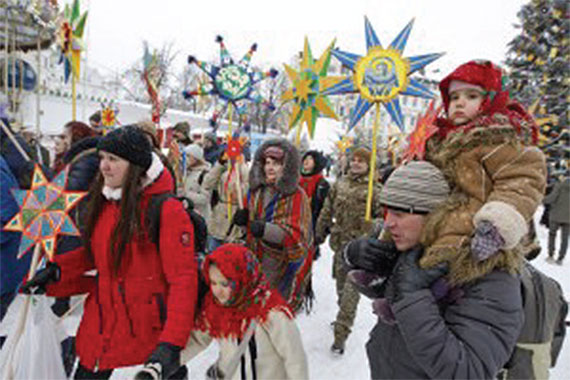
Ukraine’s Catholic Church has welcomed a vote by MPs to make the 25 December Western Christmas a public holiday for the first time, in addition to the 7 January Orthodox Christmas.

“We’re very grateful to the parliament – it’s a great joy for our faithful, who often had to go to work or school and will now be able to celebrate Christmas in full,” said Abp Mieczyslaw Mokrzycki of Lviv, the Bishops Conference president. “It will also be a huge practical conveni-ence, since they were only able to go to church up to now in the evening. Since many families are mixed, it will strengthen community bonds.”

The archbishop was reacting to an overwhelming decision by the Kiev-based Verkhovna Rada to amend the Labour Code by adding 25 December to the list of public holidays.”

However, it was condemned by Ukraine’s largest Orthodox Church, which is linked to Russia’s Moscow Patriarchate, whose information director, Archbishop Irpen Kliment, said the “overwhelming majority” of citizens celebrated the 7 January Orthodox Christmas. “Christ was born once, not twice,” Arch-bishop Kliment said in a statement. “By trying to convert Christmas from a religious event into a farce, the Verkhovna Rada clearly doesn’t care much about the views of Ukrainians.”

Poland to phase out Sunday shopping by 2020

The government and trade unions want workers to spend more time with their families

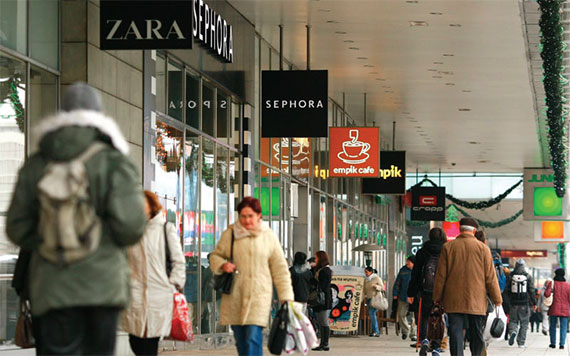
Polish MPs have approved a bill that will phase out Sunday shopping by 2020.

Initially proposed by trade unions, the idea received the support of the ruling conservative Law and Justice Party, who want to allow workers to spend more time with their families. The Sejm, the lower house of Poland’s parliament, passed the bill by 254 to 156 to restrict Sunday shopping to the first and last Sunday of the month until the end of 2018, only on the last Sunday in the month in 2019, and to ban it totally starting in 2020. It will still be permitted, however, on the Sundays before major holidays such as Christmas. Some bakeries and online shops will also be exempt.

The bill will now pass to the Senate, and then to President Andzrej Duda for approval.

In a statement, the Polish bishops’ conference said the bill did not go far enough, and that everyone should be free from work on Sundays.

The Pope meets the military leaders of Myanmar ahead of schedule

It was supposed to be a day of rest – Tuesday 28 November – with the planned institutional meetings and the speech before the political authorities of the country. But Francis accelerated the times and this afternoon in the palace of the Archbishopric of Yangon he met with the Burmese military leaders.

Commander-in-chief of defence,  General Aung Hlaing paid a courtesy visit to his guest. He was accompanied by a small delegation of Lieutenants: Tun Tun Tun Naung, Than Tun Oo and Soe Hut, all serving at the Bureau of Special Opera-tions. Colonel Aung Zaw Lin, as transcriber, and a translator of the Burmese Catholic Church were also present.

Defence, Interior and border control, three key ministries of the Government of Myanmar are in the hands of the military.

At the end of what the Vatican authorities have called “courtesy visit,” there was an exchange of gifts: the Pope gave a pontificate medal and the general gave a Burmese harp in the shape of a boat and a decorated rice bowl.