Indian president commends Church for work among poor

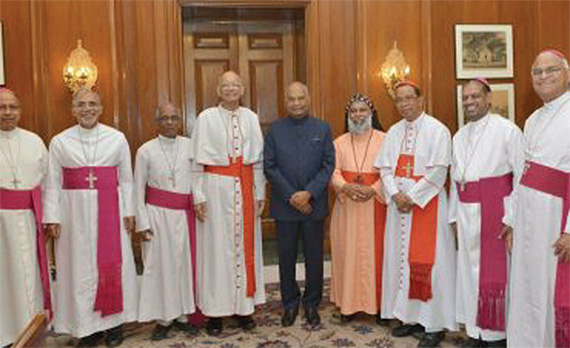
Indian President Ram Nath Kovind on August 24 told a delegation of Catholic prelates that the Church’s work for the poor and downtrodden was commendable.

While the whole world speaks of development, spirituality in this development is also important; the president told the eight-member delegation led by Cardinal Baselios Cleemis, president of the Catholic Bishops’ Conference of India (CBCI). The 14th head of the world’s largest democracy appealed to the bishops to continue the spiritual development, a CBCI press note said.

Besides Cardinal Cleemis, the Church team comprised Cardinals Oswald Gracias, archbishop of Bombay, and Telesphore P Toppo, archbishop of Ranchi and Archbishops Filipe Neri Ferrão of Goa, Abraham Viru-thakulangara of Nagpur, Albert D’Souza of Agra, Anil Couto of Delhi. CBCI secretary general Bishop Theodore Mascarenhas was also part of the team. The CBCI note explain-ed the prelates made a “courtesy call” on the president, who assumed office on July 25.

Cardinal Cleemis, who spoke for the team, conveyed the Catholic Church’s best wishes and prayers to the president. He said, India was a democratic, secular republic and “we live by the sacred book of the Country – the Indian Constitutions.”

Fr Uzhunnalil could be released soon: Sushma Swaraj

A Catholic priest kidnapped in Yemen last year is alive and could be released soon, a Salesians information service reported India’s foreign minister as saying.

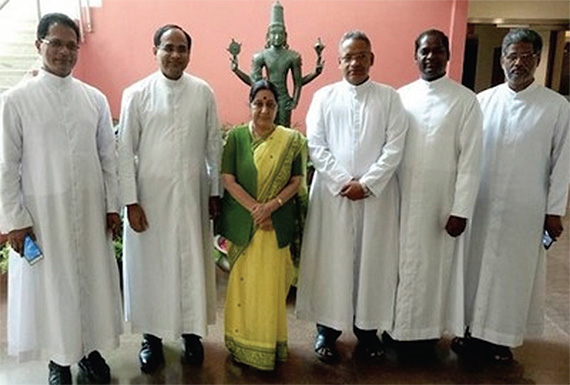
Sushma Swaraj made the comment during recent talks with a delegation from the Salesian religious order, which asked her to ensure the swift release of fellow Salesian Father Tom Uzhunnalil, who was kidnapped in Yemen more than a year ago.

The minister also reportedly told the group that securing his freedom was among the highest priorities of the government.

According to Indian Salesians’ news portal, Bosco Information Service, the minister said she felt for the “unimaginable trauma and suffering” Father Uzhunnalil has endured.

SC seeks Centre’s response on plea seeking Dalit Christian quota

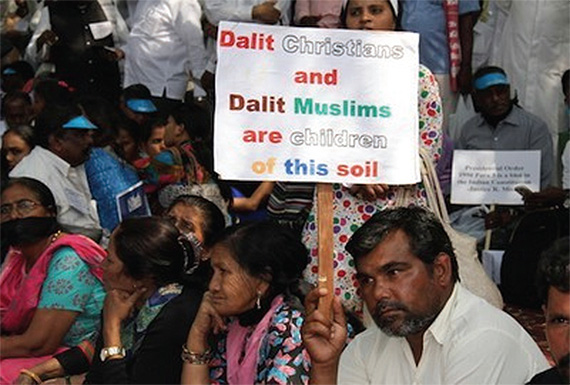
The Supreme Court has sought the Centre’s res-ponse on a plea by Dalit Christians seeking parity in quota with their counter-parts among the Hindu, Sikh and Buddhist com-munities. On Aug 21, a bench comprising Chief Justice J S Khehar and D Y Chandrachud issued that notice. The bench was hearing the plea filed by All India Catholic Union challenging the validity of paragraph 3 of the Constitution (Scheduled Caste) Order, 1950, which says no person who professes a religion different from Hindus, Sikhs or Buddhists shall be deemed to be a member of a Scheduled Caste. The plea has sought inclusion of Dalit Christians in the Scheduled Caste category for enabling them to get benefits of reservation under the Constitution.

Odisha Christians congratulate India’s “best administrator”

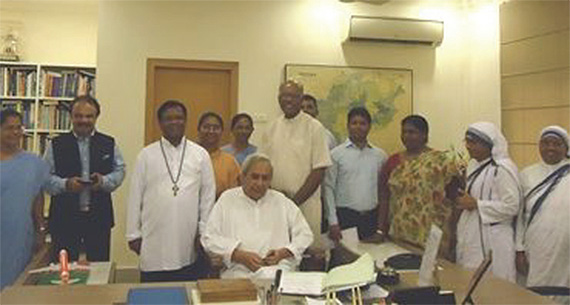
A 12-member Christian dele-gation on August 23 met Odisha Chief Minister Naveen Patnaik to congratulate him for becoming India’s best administrator.

Abp John Barwa of Cuttack Bhubaneswar led the delegation comprising priests, religious and lay people. They met the chief at his office on behalf of all Chri-stians in the eastern Indian state.
The “Outlook,” a weekly magazine published from New Delhi, chose Patnaik as the “Best Administrator of the Country.”

India’s immediate past President Pranab Mukherjee presented the award at a function in New Delhi on August 21. Patnaik dedicated the award to Odisha’s 45 million people.

Patnaik was chosen from six chief ministers — Nitish Kumar of Bihar, Manik Sarkar of Tripura, Mamata Banerjee of West Bengal, Devendra Fadnavis of Maharashtra and Siddaramaiah of Karnataka.

Nazareth Sisters bring relief to flood affected in Bihar 

The Sisters of Charity of Nazareth have come to the aid of people in ten villages reeling under flood fury in Bihar’s Madhepura district. Around 24,000 people live in 81 wards of 12 panchayats under the Goalpara block of the district reeling under the flood fury Goalpara block is around 290 km north of the State capital of Patna.

Two women were killed on Aug. 21 as they waded through water flowing over a small bridge in Fulaut village in Madhepura district. Bihar flood death toll continues to rise. As on August 21, the state reported 253 deaths in 20 districts. The water level in the catchment areas continues to rise in incessant rains.

“Although water seems to recede gradually, many houses are under water,” Sister Lilly Thomas, a trained nurse, told Matters India on August 20.

The worst affected districts are Araria, Sitamarhi, Kishan-ganj, Madhubani, East and West Champaran, Purnia, Katihar and Khagaria. Hundreds of thousands of people have been evacuated and many are left homeless and shelterless.

The Nazareth nun said local people are afraid that they would face a repeat of the 2008 tragedy when the entire area was submerged under water for days.

Goa’s Catholics not apprehensive about beef ban: Parrikar

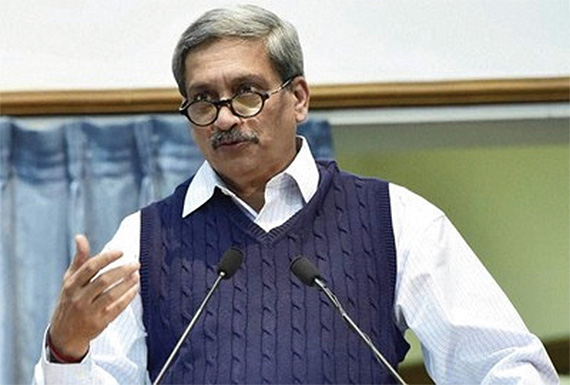
Goan Catholics are not apprehensive about the beef ban issue in the state’s context, Chief Minister Manohar Parrikar said. He was responding to a query if in course of his campaign for the Panaji by-poll, Catholic voters had expressed their grievances about the beef ban narrative at the national level. “Nothing is coming through. Those who have read and have knowledge, they know the situation vis-à-vis the Goan context,” Parrikar said on Aug 17. Catholics account for more than a quarter of the state’s 1.5 million population and are a sizeable votebank in the Panaji assembly constituency. The Goa Church has openly criticised the Bharatiya Janata Party regime, both at the Centre and the BJP-led coalition government in the state, accusing it of trying to clamp down on sale of beef, brazenly in the rest of India and subtly in the coastal state, where minorities and a sizeable chunk of the six million plus tourists who visit the state, eat it.

‘Democracy under threat from pseudo-nationalism, right-wing fanaticism’

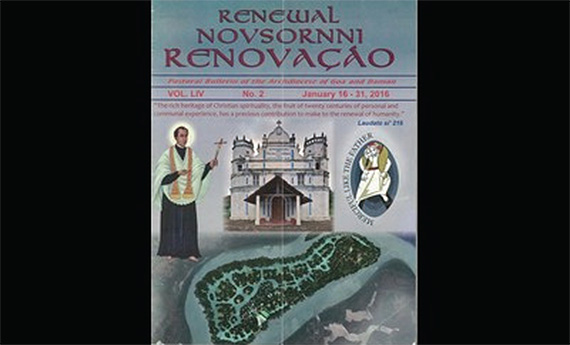
Indian democracy is under threat from “pseudo-nationalism” and “right-wing fanaticism mas-querading as nationalism,” a column published in Renovacao, a Goa Church periodical, has said.
“Quo Vadis India?” by Father Savio Fernandes in the latest edition of the pastoral bulletin of the Archdiocese of Goa and Daman, also bemoans efforts to make India a Hindu Rashtra by 2020 and rues the “political rhetoric” which is triggering hate crimes against dalits and members of the minority community.

“Competition for political and economic power has encouraged pseudo-nationalism, which uses religion as a tool to gain accept-ance,” Fernandes said in the column.

He heads the Council for Social Justice and Peace, the social arm of Goa’s influential Roman Catholic Church, which is the religious and spiritual leader of more than 26 percent of the state’s Catholic population.

“This is an important turning point in India’s politics, because after being dominated for several decades by Left-leaning policies, the political space is now being rapidly cornered by Rightwing fanaticism masquerading as anationalism.”

“From the much talked about pluralism and diversity being the hallmark of the Indian nation, there are attempts to impose one culture, one religion, one langu-age ideology – a Hindu Rashtra by 2020 which marks the 75th anniversary of our nation’s inde-pendence,” the column stated.

CSI pulls out of Kerala Council of Churches

The Church of South India (CSI) has decided to pull out from the Kerala Council of Churches (KCC), an ecumenical forum of non-Catholic Protestant Churches in Kerala, in protest against the KCC decision to provide membership to the Believers Church. The second largest Christian denomination after the Catholic Church, CSI is the largest Protestant denomination in India. The CSI Moderator, Bishop Thomas K. Oommen, said the CSI could never accept inclusion of the Believers Church in the KCC strictly on moral and ethical grounds.

Believer’s Church is the country’s top foreign-funded NGO. Its head K.P. Yohannan, who is also founder of Gospel for Asia, is facing a lawsuit in the US for fraud and misuse of charitable donations.

Bishop Oommen told The Hindu that the regional forum of the CSI Synod members had unanimously decided to disassociate with the KCC and its programmes. The latest development has to be viewed in the backdrop of the controversy over the episcopacy claims of the Believers Church that its head, K.P. Yohannan, was consecrated by then CSI Moderator Bishop K.J. Samuel in 2003.

The CSI has outright rejected this claim of the Believers Church, saying that the former has never done such a thing at any point of time.

According to Bishop Oommen, the CSI had never consecrated Yohannan and whatever news spread in this regard were baseless.

“The CSI never considers the Believers Church as an episcopal church or accept its leader, K.P. Yohannan, a bishop. As per the CSI view, K.P. Yohannan is a layman and the KCC decision, overlooking the CSI objection, was unfortunate,” he said. He said the bishop was the constitutional head of CSI. As per the constitution of the Church, the Synod executive has to authorise the Moderator to consecrate a clergy as a bishop. The CSI Synod executive never authorised the Moderator to consecrate K.P. Yohannan as a bishop, he said.

Christians protest Baptist-Catholic row in Manipur village

Christians in India are pro-testing the “inhuman behavi-our” of some villa-gers from north-eastern Manipur State for refusing the burial of a woman who left the Baptist Church to become a Catholic.

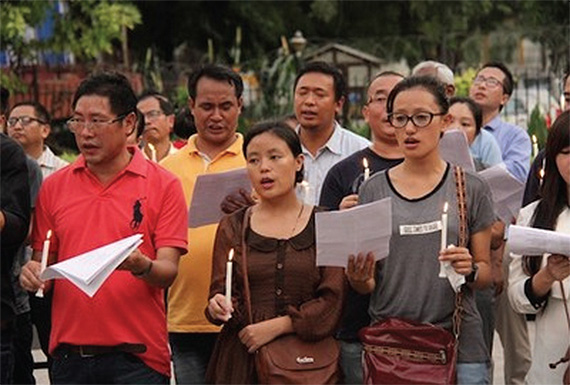
More than 200 Christians from various denominations gathered in front of the Catholic Sacred Heart Cathedral in New Delhi Aug. 17, holding candles, singing hymns and praying. They condemned the incident in a statement and sought help from the government to bury the woman who died Aug. 7. Leingangching villagers in Manipur state denied permission to bury the woman because the village council had excommunicated her family about seven years ago for leaving the Baptist Church and becoming Catholic.

Rita Haorei, the deceased is still not buried, according to Father Vialo Francis of Imphal Archdiocese, based in Manipur.

Fr Francis told ucanews. com that the predominantly Baptist village refused permission to five families, including that of Haorei, to become Catholic saying the village constitution holds that it “shall be a Baptist village.”

Manipur is a Christian strong-hold State. More than 40 percent of its 2.73 million people are Christians, mostly Baptists. Some pockets are almost entirely Christian. The Ukhrul district where Haorei hails from is 95% Christian.

Petition State Governor of India to Drop New Anti-Conversion Measure

The Governor of the State of Jharkhand in India has a big decision to make regarding the thousands of Christians and other religious minorities residing in her state.

Jharkhand Governor Drau-padi Murmu must decide on an anti-conversion Bill passed by the State Assembly earlier.

If Murmu allows the Bill to become law, she risks putting in harm’s way Christians and other religious minorities living in Jharkhand.

Only five states in India now have such laws. But of those five states, two are among the top three states in India where violence against Christians is highest.

Anti-conversion laws are supposed to stop people con-verting from Hinduism to Christianity. But, what they really do is infringe on the right of an Indian citizen to practise their religion as they see fit…and, to a right to privacy – both of which are guaranteed by India’s federal Constitution.

And, India’s federal Penal Code, Section 295(A), already deals with the issue of sectarian harmony, and the use of coercion and, or, “allurements” to entice people to convert from Hinduism to Christianity. These laws command stiff penalties, ranging from fines to imprison-ment.