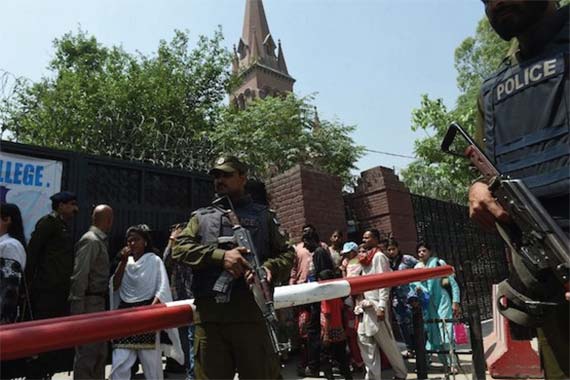
Pakistani official: ‘We have failed minorities’

An official from Pakistan’s most populous Punjab province has admitted that authorities have failed to protect religious minori-ties from hard-line Islamists.

“The intolerance, anger on religious matters and culture of lynching disturbs us,” said Malik Muhammad Ahmad Khan chief spokesman of the Punjab government speaking at the May 12 event titled “Securing Punjab’s Diversity” in Lahore, the capital of Punjab province where majority of Christians in the country reside. Punjab also has 60 percent of the country’s population.

As an example, Khan said four people from the Ahmadiyya sect were killed by hardliners during April. “The religious cleansing must stop,” said Khan who is also special assistant to the Punjab chief minister.

Ahmadis, who believe Prophet Mohammed was not the last prophet, have suffered harsh persecution since they were declared non-Muslims by Pakistan in 1974. “We have failed in protecting minorities from forced conversion,” Khan said at the event attended by more than 30 activists, journalists and edu-cationists. “Everybody knows it, why should we hide it?” he asked.

Out of 1,000 Christian and Hindu women forcibly converted to Islam and forcibly married each year in Pakistan, 700 of them are Punjabi Christians, according to the National Commission of Justice and Peace and the Pakistan Hindu Council. Rights group say many of these are under the age of 18 and are married off to Muslims, or forced into bonded labour.

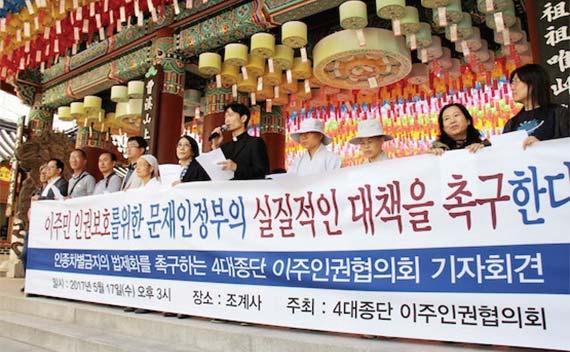
Four religions in Korea unite for migrants

An inter-religious group in Korea has asked the new government to ensure the protection of migrants and ban racial discrimination.

Solidarity of Four Religions for the Human Rights of Migrants held a press conference on May 17 in front of Jogye-sa Buddhist temple in Seoul. Composed of Buddhists, Catholics, Protestants and Won Buddhists, they have been campaigning against racial discrimination.

“Even during the presidential election campaign, the candidates did give any attention to the two million migrants in Korea. Given that even the basic human rights of migrants are not guaranteed, we should take care of them by establishing concrete policies,” they said in a statement.

The group called on people to raise awareness of the problem, report cases of rights infringe-ment and to pray for an improve-ment in the situation. “Any action based on racial discrimination should be banned and punished,” they added.

Catholic students press for radical cleric’s prosecution

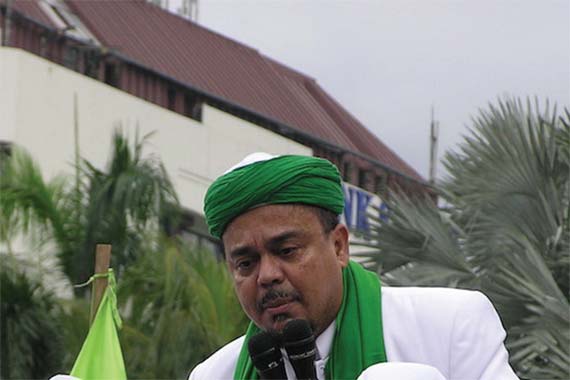
The Indonesian Catholic Students Association has called on police to process their blasphemy complaint against prominent Islamic cleric Muhammad Rizieq Syihab after Christian governor Basuki “Ahok” Tjahaja Purnama was jailed for the same crime. Angelo Wake Kako, the student’s chairman, said the government must ensure that the law is equally implemented. “Ahok has been imprisoned so Rizieq Syihab’s case should also be processed,” Kako said.

Catholics in Laos welcome first cardinal appointment

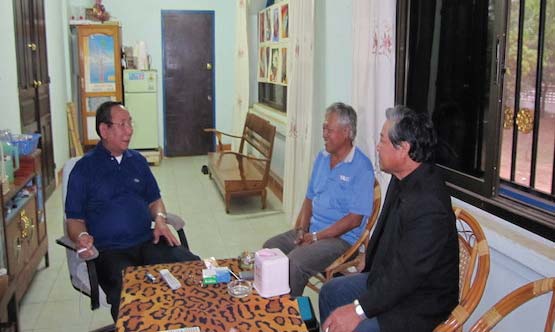
Catholics in Laos have welcomed their first cardinal appointment in anticipation of improved religious activities within the communist-run country. “We are extremely happy to hear that our Bishop Louis-Marie Ling Mangkhanekhoun has been named as the first ever cardinal in Laos,” Martha Le Thi Thuy Hanh from Sacred Heart Parish, in the southern province of Champasak, told ucanews.com.

The consistory is scheduled for June 28, the vigil of the Feast of Saints Peter and Paul. The church is treated very poorly in Laos — probably the worst in ASEAN save for Brunei,” a well-placed diplomatic source noted. “One reason is that most of the Catholics are of Vietnamese heritage or hill-tribes — not Lao Llum — the lowland Lao who rule the country. Catholics number some 45,000, about 1 percent of an estimated 7 million population, mostly Buddhist.  There are only 4 bishops, 2 of them retired.  The faithful are served by 21 Lao priests and deacons and a few dozen nuns.

Pope, President Trump speak of hopes for peace

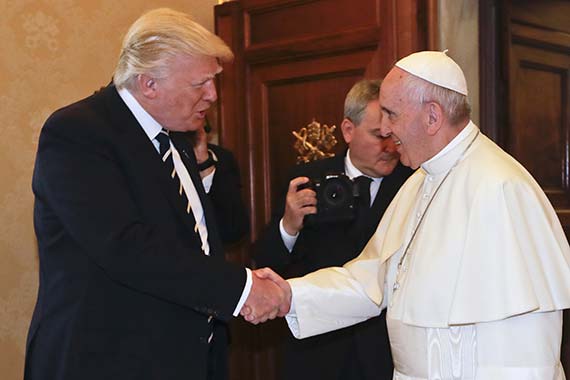
Pope Francis and U.S. President Donald Trump spent 30 minutes speaking privately in the library of the Apostolic Palace on May 24, and as the president left, he told the Pope, “I won’t forget what you said.”

The atmosphere at the beginning was formal and a bit stiff. However, the mood lightened when Pope Francis met the first lady, Melania Trump, and asked if she fed her husband “potica,” a traditional cake in Slovenia, her homeland. There were smiles all around. Pope Francis gave Trump a split medallion held together by an olive tree, which his interpreter told Trump is “a symbol of peace.” Speaking in Spanish, the Pope told Trump, “I am giving you this because I hope you may be this olive tree to make peace.”

The president responded, “We can use peace.”

Pope Francis also gave the president a copy of his message for World Peace Day 2017 and told him, “I signed it personally for you.” In addition, he gave Trump copies of three of his documents: “The Joy of the Gospel”; “Amoris Laetitia,” on the family; and “Laudato Si,’” on the environment.

Knowing that Pope Francis frequently has quoted the Rev. Martin Luther King Jr., Trump presented Pope Francis with a large gift box containing five of the slain civil rights leader’s books, including a signed copy of “The Strength to Love.”

“I think you will enjoy them,” Trump told the Pope. “I hope you do.”

After meeting the Pope, Trump went downstairs to meet Cardinal Pietro Parolin, Vatican secretary of state, and Archbishop Paul Gallagher, the Vatican foreign minister. He was accompanied by Rex Tillerson, U.S. secretary of state, and H.R. McMaster, his national security adviser. The meeting lasted 50 minutes.

“It is hoped that there may be serene collaboration between the state and the Catholic Church in the United States, engaged in service to the people in the fields of health care, education and assistance to immigrants,” the Vatican said.

The discussions also included “an exchange of views” on international affairs and on “the promotion of peace in the world through political negotiation and interreligious dialogue, with particular reference to the situation in the Middle East and the protection of Christian communities.”

US First Lady Melania Trump is Catholic, spokeswoman confirms

United States First Lady Melania Trump is a practising Catholic, her spokeswoman has confirmed.

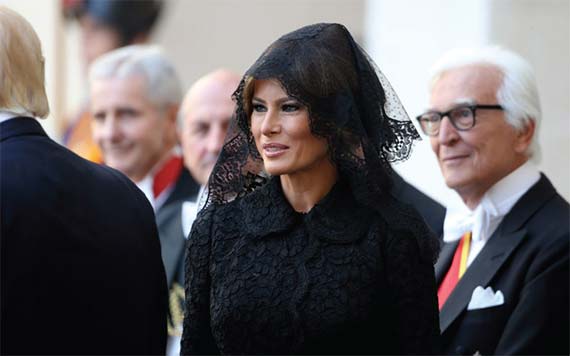
Following speculation over Mrs Trump’s faith during her visit to the Vatican on May 24th, her spokeswoman Stephanie Grisham confirmed to Daily Mail.com that the First Lady is indeed Catholic.

Mrs Trump placed flowers at the feet of a statue of the Virgin Mary and spent time praying at the Bambino Gesù Hospital during her visit. She also presented Pope Francis with rosary beads for the Pontiff to bless.

It is unclear when Melania Trump became Catholic. She was raised in a Communist-supporting family in Slovenia and was not baptised as a child. She married Donald Trump, a life-long Pres-byterian, in 2005 at an Episcopal church in Palm Beach, Florida.

Despite her husband being inaugurated US president in January, she is not due to move into the White House until the summer. When she does, she will be the first Catholic to live at 1600 Pennsylvania Avenue since President John F Kennedy and his wife Jackie in the early 1960s.

Masked gunmen kill 28 in attack on Christians in Egypt

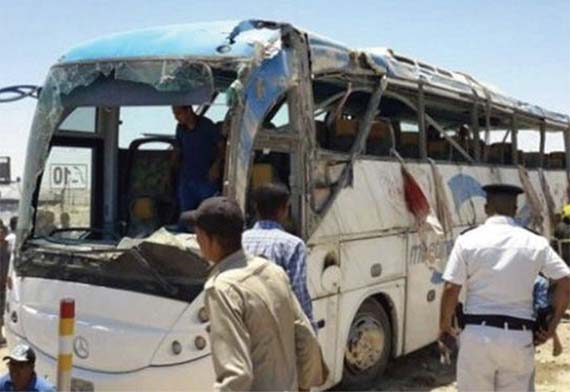
Gunmen attacked a group of Coptic Christians travelling to a monastery in central Egypt, killing 28 people and wounding 24, with many children among the victims, Health Ministry officials said.
There was no immediate claim of responsibility for the attack, which came on the eve of the holy month of Ramadan. It followed a series of church bombings claimed by Islamic State in a campaign of violence against the Copts.

Islamic State supporters reposted videos from earlier this year urging violence against the Copts in Egypt. Islamic State has claimed responsibility for the attack on a bus carrying Coptic Christians that killed 29.

Eyewitnesses said masked men opened fire after stopping the Christians, who were in a bus and other vehicles. Local TV channels showed a bus apparently raked by gunfire and smeared with blood.

Clothes and shoes could be seen lying in and around the bus, while the bodies of some of the victims lay in the sand nearby, covered with black sheets.

The attack, which Egypt’s Muslim leaders condemned, happened 15 km (10 miles) from the monastery, a security official on the scene told Reuters. Ambulance workers, monks and Muslim clerics were also present but declined to speak.

Police armed with assault rifles formed a security perimeter and officials from the public prosecutor’s office were gathering evidence and fingerprints. Heavily armed special forces arrived later wearing face masks and body armour.

Russians fight ransom ware virus with holy water

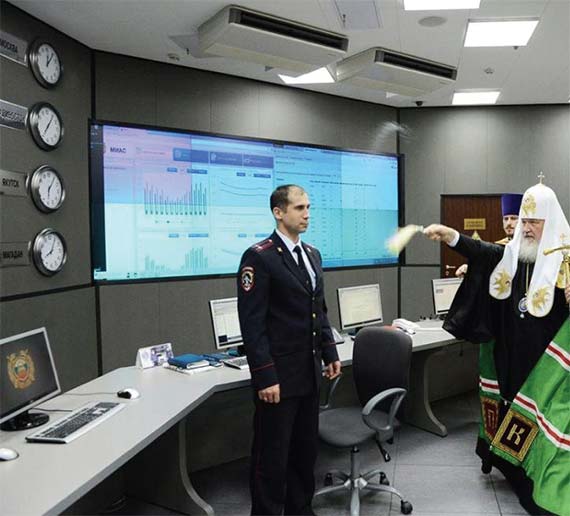
After malware hacked as many as 200,000 computers throughout the world, the Russians have an idea: Blessing the computers with holy water.

The most recent attacks have been through a form of ransomware called “Wanna-Cry,” which is malicious software that locks up a person’s data and demands, either through a pop-up window or e-mail, that a ransom be paid or else the data will be destroyed.

The cyber attacks have largely targeted hospitals, academic institutions and large businesses like blue chip companies or movie theatres in more than 150 countries throughout the world, including in China, Japan, India and the U.K.

Russia was among one of the worst-hit countries in the attack. Part of their solution? Invite Patriarch Kirill of the Russian Orthodox Church to bless computers and servers with holy water. Aside from prayer and holy water, tech experts recommend avoiding cyberattacks by keeping computer software up to date, installing anti-virus software, and avoiding suspicious e-mails or pop-ups.

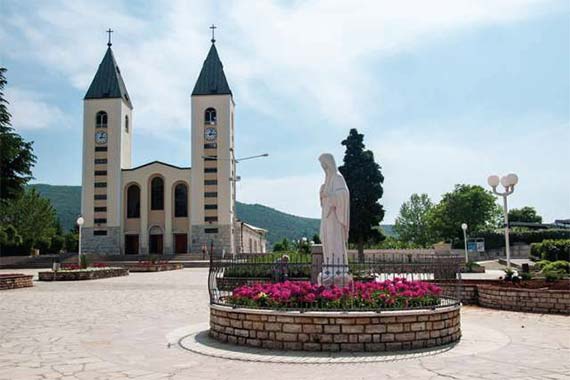
COMMISSION BELIEVES FIRST SEVEN MARIAN APPARITIONS AT MEDJUGORJE WERE REAL BUT DOUBTS AUTHENTICITY OF OTHERS

The commission that now-retired Pope Benedict XVI established to study the alleged apparitions of Mary at Medjugorje, Bosnia-Herzegovina, reportedly voted overwhelmi-ngly to recognise as supernatural the first seven appearances of Mary in 1981. However, according to a report published by the website Vatican Insider, the commission was much more doubtful about the thousands of alleged visions that have occurred since 4 July, 1981, and supposedly continue to this day.

Two of the 17 commission members and consultants thought the alleged visions after the period of June 24-July 3, 1981, were not supernatural, while the other members said it was not possible to make a judgment.

The commission said it was clear that the six alleged visionaries and a seventh who claims to have begun receiving messages from Mary in December 1982 were not given adequate spiritual support. Vatican Insider published its piece on the report on 16 May, three days after Pope Francis spoke about some details of the report to journalists travelling with him from Fatima, Portugal.
The Vatican press office declined to comment on the Vatican Insider piece today (17 May). Speaking to journalists on 13 May, Pope Francis said that, regarding the Medjugorje commission’s work, “three things need to be distinguished.”

“About the first apparitions, when (the ‘seers’) were young, the report more or less says that the investigation needs to continue,” the Pope said, according to the English translation posted on the Vatican website.

“Concerning the alleged current apparitions, the report expresses doubts,” he said. Furthermore, “personally, I am more ‘mischievous.’ I prefer Our Lady to be a mother, our mother, and not a telegraph operator who sends out a message every day at a certain time — this is not the mother of Jesus.” Pope Francis said his “personal opinion” is that “these alleged apparitions have no great value.”

Pope canonizes Fatima visionaries, giving Church new children saints

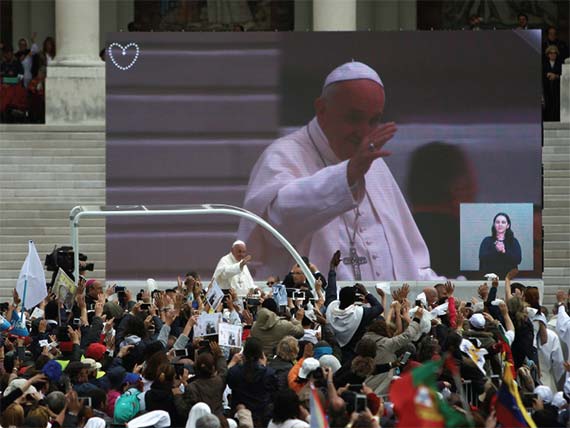
Pope Francis gave the Catholic Church two of its youngest saints, canonizing shepherd siblings believed to have seen the Mado-nna 100 years ago in a Portuguese town that is now a major pilgrimage site.

Hundreds of, thousands of, people, many of whom slept outdoors to hold their places, broke into applause as the leader of the world’s 1.2 billion Catholics proclaimed the siblings — Francisco and Jacinta Marto — the newest of the Church’s saints. The two died at the ages of 10 and 9 years old, within three years of the 1917 apparitions, making them the youngest saints of the Church who were not martyrs.

The Virgin of Fatima is venerated by Catholics around the world, a following underscored by the many national flags fluttering in the huge crowd, estimated at more than half a million. Marie Chantal, 57, a life-long devotee, travelled more than 9,000 km (5,600 miles) from the island of Reunion in the Indian Ocean to attend the ceremony.