SOUTH KOREAN CATHOLICS HOPE CATHOLIC PRESIDENT-ELECT CAN UNIFY NATION

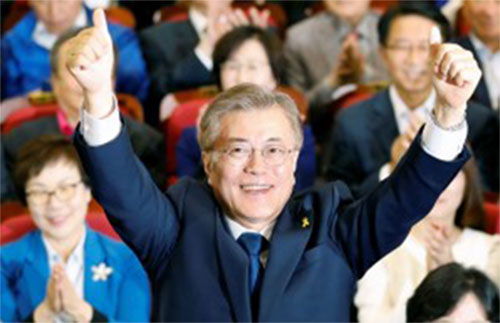
Catholics in South Korea have high expectations for unity, equality and an end to corruption under the country’s newly elected president, Moon Jae-in.

In a congratulatory message to Moon that also noted the national rift that led to the special election, the head of the Korean bishops’ conference, Archbishop Hyginus Kim Hee-joong of Gwangju, said the country needed “a credible leader who keeps principles and steps toward true peace and justice beyond today’s conflicts and confrontations.”

“May the new president be a great leader who can make democracy take root in this country and bring peace and prosperity to the Korean people,” Archbishop Kim said in his statement.
Moon, a Catholic and member of South Korea’s Democratic Party, won the election on 9 May with 41% of the vote among a slate of 13 candidates. Moon, 64, was buoyed by the growing dissatisfaction of ordinary citizens whose anger over corruption was years in the making under Park. From late 2016 to early 2017, tens of thousands of South Koreans filled the streets of Seoul every week calling for Park’s removal.

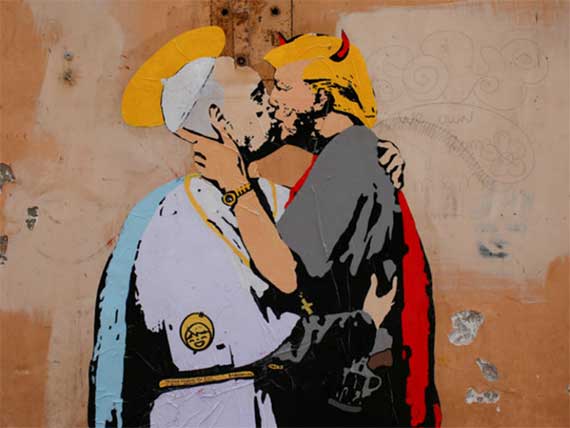
Mural of saintly pope kissing devilish Trump appears in Rome

A life-size mural depicting Pope Francis with a saintly halo kissing U.S. President Donald Trump sprouting devil’s horns appeared on a wall near the Vatican on May 11 , less than two weeks before they are due to meet. The mural, which was painted on paper and pasted on to the wall during the night, was the latest work by street artists depicting the pope to appear in Rome in recent months.

This one shows Francis, wearing a simple crucifix around his neck, embracing Trump, who wears a gold watch and sports a pistol in a holster. The pope’s halo is the same bright yellow colour as Trump’s hair. The two are locked in a mouth-to-mouth kiss.

The caption written on the sash of the pope’s cassock reads “The Good Forgives the Evil.” It is signed “TVBoy,” who is believed to be Italian street artist Salvatore Benintende.

Vatican hosts cosmology conference to dispel faith-science conflict

Scientists from around the world are meeting at the Vatican Observatory in Castel Gandolfo for a conference that seeks to bring together science and religion in the continuing search for truth in understanding the mysteries of the universe.

The scientific conference titled, “Black Holes, Gravitation-al Waves and Space-Time Singularities,” is an opportunity to show that “the church supports good science,” said Jesuit Brother Guy Consolmagno, director of the Vatican Observatory.

“We are hoping that this meeting will also be an encounter of people with very different opinions but very close friendships that come from having the same common desire to understand the truth of the universe and how we can understand that truth,” he said. The 2016 discovery of the existence of gravitational waves, predicted nearly 100 years ago by Albert Einstein in his general theory of relativity, was to be one of the topics of discussion. The discovery could open a new chapter in understanding celestial events and black hole regions in the universe, something that previously could only be hypothesised.

The conference will also celebrate the scientific legacy of Msgr. George Lemaitre, one of the fathers of the theory that the expanding universe could be traced to an origin point, also known as the “Big Bang theory.” The conference will also celebrate the scientific legacy of Msgr George Lemaitre, one of the fathers of the ‘Big Bang theory’

Syrian Refugees Not Welcome in Eastern Europe

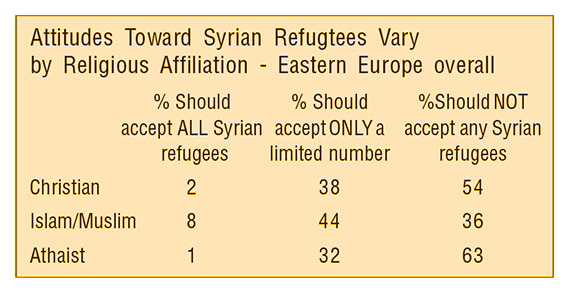
Though the flow of Syrian refugees into Europe has slowed since 2015, hundreds of thousands of Syrians were still seeking asylum there last year. If many in Eastern Europe had their way, however, the number would be zero. In nine out of 15 Eastern European countries and areas surveyed in 2016, at least half the population believed their country should not accept any Syrian refugees. Many of the countries with the strongest opposition to allowing Syrian refugees are located along the Balkan route that once channelled asylum seekers from Greece to Germany.

European leaders effectively closed the route last March and signed a deal with Turkey to send migrants back if they did not apply for asylum or if their claim was rejected. All of Gallup’s surveys in Eastern Europe took place after the agreement with Turkey.

Anti-refugee sentiment is highest in EU member states such as Hungary, which has erected border fences to keep migrants out and, just last month, passed new controversial laws that would confine asylum seekers to camps constructed from shipping containers. Seven in 10 Hungarians in 2016 said their country should not accept any Syrian refugees. Sentiment was similarly high (66%) in non-EU member state Macedonia, which was on the front lines of the migrant wave in 2015 and sealed its border with Greece to keep them out.

The surprising connection between Our Lady of Fatima and Islam

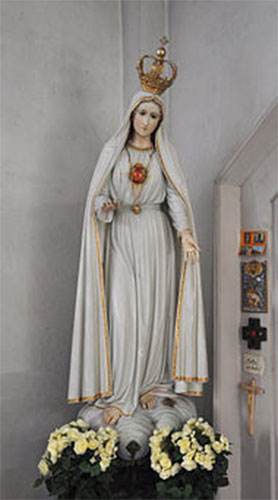
As we approach the 100th anniversary of the apparitions of Our Lady of Fatima, one aspect that often goes unnoticed is the subtle connection with Islam – Aleteia new service reports. The Blessed Virgin Mary appeared to the three shepherd children near the city of Fatima, Portugal, a place named after both a Muslim princess and the daughter of Mohammed. Some stories say that after her capture, Fatima fell in love with Goncalo and the two were soon after betrothed. Before their marriage Fatima was baptized into the Catholic faith and took the name Oureana. The Portuguese cities of Fatima and Ourem are said to be named after this Muslim princess.

Franklin Graham calls persecution of Christians ‘genocide’

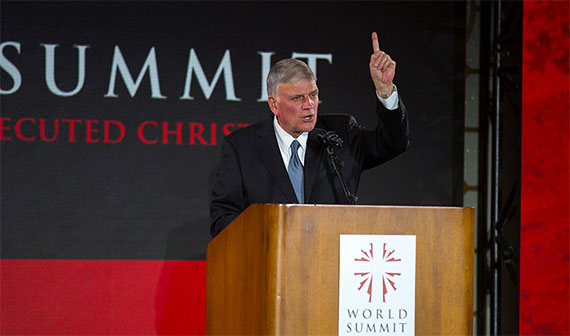
Franklin Graham, son of the famed evangelical preacher Billy Graham, urged fellow Christians to struggle against a “Christian genocide” that he says has killed in greater numbers than most believers can fathom. Graham, who has been criticized by some evangelicals for calling Islam “evil” and for portraying Presi-dent Trump as aligned with the Christian church, spoke at a conference aimed at highlighting an issue many feel is ignored by politicians and the media.

“I am sure the number of Christians who are in prison or martyred each year would stagger our mind if we really knew what the total number really was. And it would send us to our knees in sorrow and in prayer.”

It’s not clear on what Graham’s numbers are based.

The nonprofit Christian organization Open Doors — which tracks Christian persecu-tion globally, and the increasing number of Middle Eastern Chri-stians who seek safety outside their homelands — estimates that every year around 4,000 Chri-stians are killed because of their faith worldwide.

Pope accepts resignation of Melkite patriarch

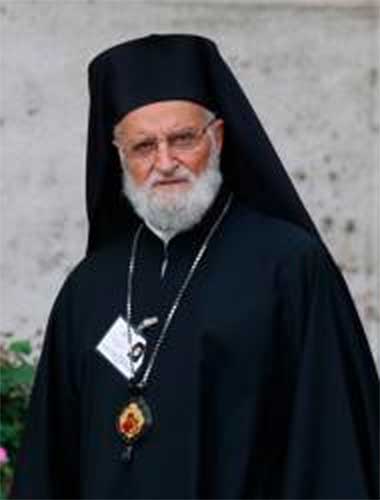
Two months after bishops of the Melkite Catholic Church declared they had reconciled with each other and found a way to move for-ward together, the Vatican announced Pope Francis had accepted the resignation of Melkite Patriarch Gregoire III Laham. In a letter released by the Vatican May 6, Pope Francis said that in February, the 84-year-old Syrian-born patriarch “spontaneously presented me with his renun-ciation of the patriarchal office, asking me to decide the most favourable moment to accept it.”

“After praying and reflecting attentively, I consider it opportune and necessary for the good of the Greek Melkite Church to accept his resignation today,” said the letter addressed to Patriarch Laham and all the bishops of the Melkite Church.

Pope Francis thanked the patriarch for his service and, especially, for his work to keep the suffering and the needs of the people of Syria in the public eye.

Patriarch Laham had convoked a synod of the Melkite bishops in June 2016, but the meeting was postponed because half the Melkite bishops boycotted the gathering and called for the patriarch’s resignation. At the time, the patriarch called the bishops’ absence a “case of open rebellion.” After eight months, the synod met in February at the patriarchate in Rebweh, Lebanon.

Belgian Catholic psychiatric hospitals ‘adjust’ their view of euthanasia

One of the last substantial barriers to increasing the number of euthanasia cases for non-terminally-ill psychiatric patients in Belgium seems to have crumbled. A religious order in the Catholic Church, the Brothers of Charity, is responsible for a large proportion of beds for psychiatric patients in Belgium – about 5,000 of them. The international head of the order, Brother René Stockman, is a Belgian who has been one of the leading opponents of euthanasia in recent years.

Nonetheless, in a surprise move this week, the board controlling the institutions of the Brothers of Charity announced that from now on, it will allow euthanasia to take place in their psychiatric hospitals.

In a statement posted on their website the Brothers of Charity explain the policy shift. “We take seriously unbearable and hopeless suffering and patients’ request for euthanasia. On the other hand, we do want to protect lives and ensure that euthanasia is performed only if there is no more possibility to provide a reasonable perspective to treat the patient.”

Euthanasia for psychiatric patients has already happened dozens of times in Belgium. But from now on it will probably be easier for people suffering from schizo-phrenia, personality disorders, depression, autism, or loneliness to access it. In fact, it will be hard to find an institution in Belgium where euthanasia is not being offered as an option.
Brother Stockman was stunned. “We deplore this new vision,” he told the media.

Nursing homes and hospitals opposing euthanasia have been under even more pressure after acourt fined a Catholic nursing home a total of €6,000 last year for blocking a resident from accessing euthanasia.

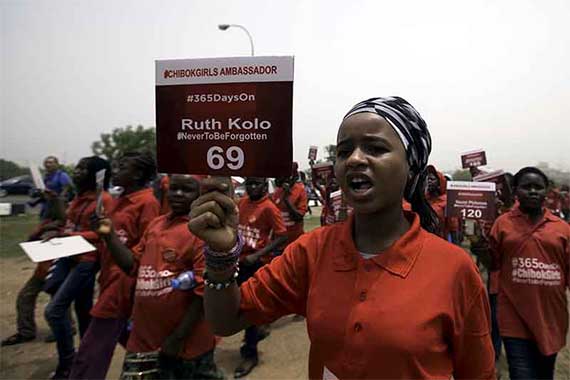
Nigeria exchanges 82 Chibok girls kidnapped by Boko Haram for prisoners

Boko Haram militants have released 82 schoolgirls out of a group of more than 200 whom they kidnapped from the north-eastern town of Chibok in April 2014 in exchange for prisoners. Switzer-land and the International Commi-ttee of the Red Cross helped secure the 82 girls in “lengthy negotiations,” the presidency said on its Twitter account on May 6.

President Muhammadu Buhari will receive the girls on Sunday in the capital, Abuja, it said, without saying how many Boko Haram suspects had been exchanged or disclosing other details. A military source said the girls were currently in Banki near the Cameroon border for medical checks before being airlifted to Maiduguri, the capital of Borno state. From there they will be flown to Abuja.

The kidnapping was one of the high-profile incidents of Boko Haram’s insurgency in Nigeria’s northeast, now in its eighth year and with little sign of ending. About 220 girls were abducted from their school in a night-time attack. More than 20 girls were released last October in a deal brokered by the International Committee of the Red Cross. Others have escaped or been rescued, but 195 were believed to be still in captivity before this release.

Nuns help expand coverage and care in Rwanda’s health system

The dense darkness of night-time in rural northern Rwanda completely obliterates the immense hills that surround the village of Muyanza. But piercing this complete darkness a few times a week are two pinpricks of light, from the headlights of the village’s lone ambulance. When someone needs immediate evacuation to the hospital, the ambulance races up out of the valley, bumping over a poorly maintained dirt road. Faustin Musabyimana, the driver, prays that heavy rains haven’t washed away the makeshift bridges made of wooden planks laid over deep ravines.

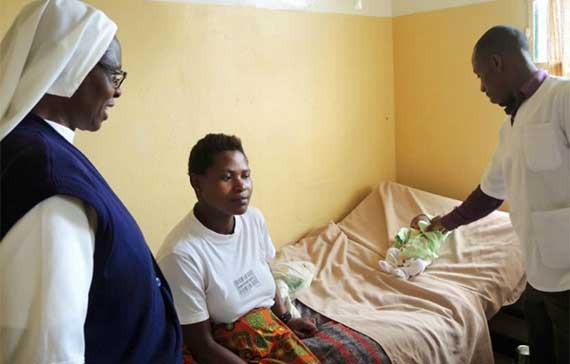
This ambulance is the strongest link between the isolated villages scattered across the green hills and the government regional hospital on the main road. Four Kenyan sisters from the Little Daughters of St Joseph Congregation run the Muyanza Health Centre for the Catholic Diocese of Byomba.

Sr Margaret Ekali Londung’a manages the health centre, along with Sr Margaret Wanjiku Njuguna, a nurse, and Sr Rose Wanjiru Kimani, a pharmacist, while Sr Martha Chebon Jeptarus runs a Catholic nursery school. Raising funds to buy the ambulance from their international congregation was one of their first projects when they took over management of the health center in 2001. “There are regions [of Rwanda] where there is good communications and fertile areas, and they are easy to reach, and there are also difficult areas,” said Londung’a, a nurse who is also the community animator, or community director. “Our spirituality as the Little Daughters of St. Joseph is going to the needy, the poorest of the poor, the marginalized. After Mother [Superior Licia Rebonato] visited many places, she chose the hardest, the most difficult, the most marginalized, and that’s why we ended up in Muyanza.”