London Dalit Conference: discrimination is a “disgrace” for society

“Discrimination against any human being is a disgrace for society everywhere,” Fr Z Devasagayaraj, secretary of the Office for Dalits and backward classes of the Catholic Bishops’ Conference of India (CBCI), told AsiaNews. The clergyman spoke on the sidelines of “‘Christian Responsibility to Dalits and Caste Discrimination’, a conference held in St George’s Cathedral, Southwark (London). In his view, “the whole world must condemn racism, xenophobia and apartheid. We cannot keep quiet when such practices occur somewhere in the world.”

The Christian Network against Caste Discrimination (CNACD) organised the two-day gathering, which began yesterday, with Card Peter Turkson, head of the Vatican Dicastery for Promoting Integral Human Development, as the guest of honour.

Caste discrimination, especially against the Dalits, aka untouchables, remains a major problem in India, as well as within the Catholic Church. This is why the bishops launched an action plan for the first time last year to counter marginalisation and promote integration. Dalits represent a majority of India’s Catholics, 12 million out of 19.

“We must condemn the caste system and discriminatory practices in the workplace as well,” Fr Devasagayaraj said. “The caste problem is not just a problem in India, but it is widespread in South Asian countries, and where they (Dalits) emigrate.”

“We are sorry that these people still carry with them caste discrimination,” the clergyman added. For this reason, it is important to organise “international seminars on the issue, so that we can shed light on their discrimination in the country, but also in the Christian community.”

According to Mgr Sarat Chandra Nayak, bishop of Berhampur, “the problem is so pervasive that it is not possible to eradicate this evil without the collaboration of the international community. It is vitally important for international institutions to pay greater attention to this issue.” “Caste discrimination continues to be widespread and persistent,” he explained. In fact, “with globalisation, the problem has been exported and with it, the challenges to solve it. At present, it has become a global phenomenon.”

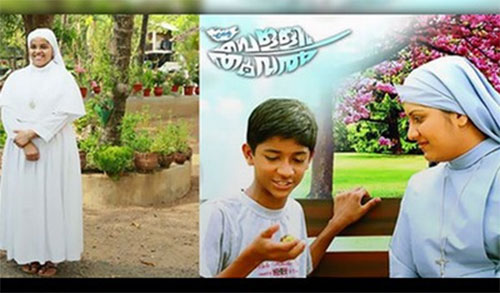
Kerala nun directs a full-length Malayalam feature film

Sister Jiya, a member of the Medical Sisters of St Joseph (MSJ) order in Kerala, has become the first nun in India to direct a feature film.

Cinema was not exactly Sr Jiya’s field of expertise. She never learnt the craft of filmmaking, didn’t plan to be associated with the industry or even bothered to spend much time watching films. Yet she is now the writer-director of a full-length Malayalam feature film.

‘Ente Vellithooval’, the two-and-a-half hour long film which is all set to hit the screens, stands proof of Sr Jiya’s immense dedication and relentless hard work for over a year. The nun, who hails from Palakkad, is the in-charge of the lab at St Seba-stian’s Hospital in Cherupuzha, Kannur.

It all started when the Catholic Church observed 2015 as the Year for Consecrated Life. Sr Jiya wanted to make a short film on the people in the service of the church. She brushed up a story that she had written years ago and developed a screenplay with the help of some friends.

Sr Jiya got her work approved by her superiors in the church. Actress Sarayu was roped in to play the lead role of Sr Merina. The shoot started with the bless-ings of Archbishop George Njaralakatt of Thalassery.

Assam creates ‘silent zones’ around religious venues

The north-eastern Indian city of Guwahati city India has proclaimed “silence zones” around all religious paces in what many say is a bid to stop mosques using loudspeakers to call Muslims to prayer.

The district administration of Guwahati, the business capital of Assam state, following state government directions, issued an official notification declaring a radius of 100 meters around all religious places, including temples, mosques and churches, to be “silent zones.”

The pro Hindu Bharatiya Janata Party is currently ruling the state with its local alliance, having won a majority in elections last year. The win is seen as historic as it is the first time for ethnically diverse Assam and the north-eastern region for the party to form a state government.

The Bharatiya Janata Party has often been accused of being biased against religious minorities in the country ever since the party swept the national polls in 2014.

Assam has 31 million people, but Hindus are about 60 percent against the national average of 80 percent. Muslims make up about 35 percent, much higher than the 15 percent national figure. Christians are a minority forming 1.1 million or 3.7 percent of the total population.

Historic “plague cross” destroyed by officials in India

City officials in Mumbai, formerly Bombay, have destroyed a century-old roadside cross, despite the strong opposition of the local Catholic community.

The cross was built on or around 1895 in the western Bandra neighborhood of the city.

“The religious structure is constructed on a private property,” said  Godfrey Pimenta, of the Watchdog Foundation. “The owner of the property had replied to the said notice and met Ughade wherein documentary evidence, including a Revenue Plan/Property Card, was submitted to explain the legal position of the structure,” Pimenta said, “Despite this, the ward officials demolished the structure.”

Cardinal Oswald Gracias, the Archbishop of Bombay, called the destruction of the cross “deeply disturbing.”

“The concerned [city official] must be held respon-sible and accountable for the action, which was illegal,” Gracias told Crux.

Manual scavenging a sin: Christian bodies 

Manuel scavenging is the worst surviving symbol of caste-based discrimination and a sin against God and God’s people, asserts a joint meeting of top Christian bodies in Asia.

The participants of April 24-26 meeting urged Churches to take the lead to ensure the effective implementation of a law passed by the Indian parliament in 2013 to end manual scavenging practices in the country.

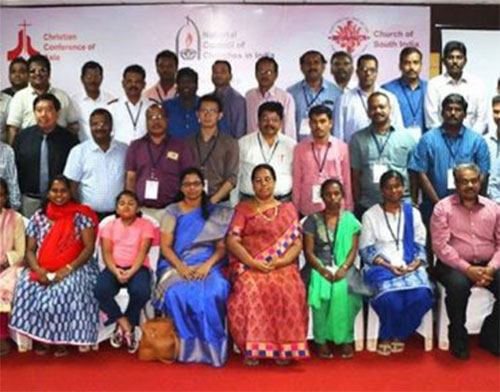
The “Abolition of Manual Scavenging in India: An Ecumenical Accompaniment and Advocacy Consultation” was organized by the Christian Conference of Asia (CCA), National Council of Churches in India (NCCI) and the Church of South India (CSI).

The meet wants Churches in the country to acknowledge manual scavenging as a sin and to work for its abolishment in all forms at all levels.

The consultation opened jointly by NCCI general secretary Reverend Roger Gaikwad and CSI General Secretary Reverend Ratnakar Sadanand.

The keynote was delivered by Bezwada Wilson, Magsaysay Award Winner of 2016 and founder of the Safai Karmachari Aandolon, a movement to eradicate manual scavenging.

Although the Church’s mission is to find the lost, it has refocus its attention from the center to the margins with relevant strategies, he told the gathering. “The bottom line of the mission mandate is to defend and advocate for human rights, and affirm the life of every human with respect and dignity,” he explained.

The Church, he noted, has infrastructure and human and financial resources that should be used to help abolish inhuman and un-Christian ideologies such as casteism and practices like manual scavenging.

Jakarta’s Christian governor found guilty of blasphemy against Islam

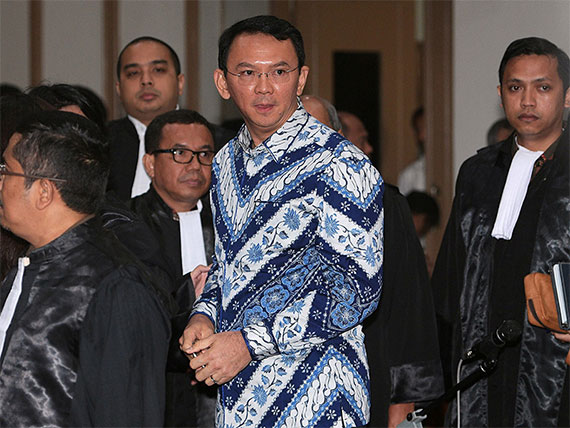
Jakarta’s Christian governor was sentenced to two years in jail for blasphemy against Islam on May 9, a harsher than expected ruling that is being seen as a blow to religious tolerance in Indonesia, the world’s largest Muslim-majority nation.

The guilty verdict comes amid concern about the growing influence of Islamist groups, who organized mass demonstrations during a tumultuous election campaign that ended with Basuki Tjahaja Purnama losing his bid for another term as governor.

President Joko Widodo was an ally of Purnama, an ethnic-Chinese Christian who is popularly known as “Ahok,” and the verdict will be a setback for a government that has sought to quell radical groups and soothe investors’ concerns that the country’s secular values were at risk.

As thousands of supporters and opponents waited outside, the head judge of the Jakarta court, Dwiarso Budi Santiarto, said Purnama was “found to have legitimately and convincingly conducted a criminal act of blasphemy, and because of that we have imposed two years of imprisonment.”

Andreas Harsono of Human Rights Watch described the verdict as “a huge setback” for Indonesia’s record of tolerance and for minorities. “If someone like Ahok, the governor of the capital, backed by the country’s largest political party, ally of the president, can be jailed on groundless accusations, what will others do?” Harsono said.

Purnama told the court he would appeal the ruling.The governor was taken to an East Jakarta prison after the verdict, and his lawyer Tommy Sihotang said Purnama would remain there despite his appeal process unless a higher court suspended it.

Shocked and angry supporters, some weeping openly, gathered outside the prison, vowing not to leave the area until he was released, while others vented their shock on social media.

Time to re-erect crosses in Zhejiang, say Chinese Christians 

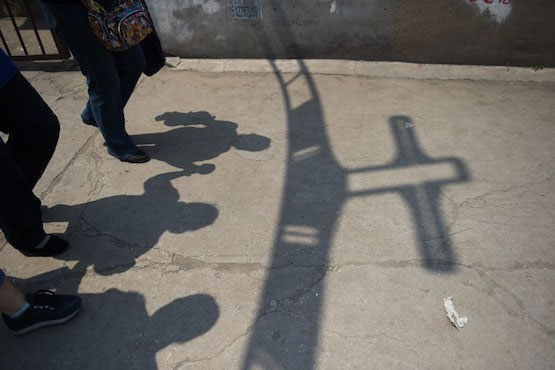
Chinese Christians in the eastern province of Zhejiang are proposing that crosses taken down from churches during a government cross removal campaign be re-erected as way of celebrating the departure of an official responsible for their removal. The proposal — made by some Protestants in the area — was sent out via social media not long after it was known that Xia Baolong, Communist Party secretary of Zhejiang, was being reassigned to Beijing. The proposition to re-erect the church crosses was a way to “bid farewell” to Xia who local Christians hold responsible for the removal of 1,700 plus church crosses in Zhejiang since late 2013.

Gender-based abortions threaten Nepalese society

Since Nepal legalized abortion in 2002 there has been an epidemic of gender-based abortions. At least 50,000 abortions a year are performed after parents find out their unborn child is a girl. Gender identifi-cation of fetuses is illegal but many clinics do not follow the 11th amendment to the country’s civil code that details how abortions can be performed.

In Section 28C, the code prohibits the termination of a pregnancy for the sole purpose of sex-selection with a maximum punishment of two years in prison.

However, the law is flouted so much that there was a marked decrease in the female birth rate. A study in 2013 by British researcher Melanie Dawn Frost and her team found there were 742 girls per 1,000 boys in 2007-2010, down from 1,021 girls per 1,000 boys in 1998-2000.

Many married couples prefer male children is because tradi-tionally, girls leave the family when they are married to serve their in-laws. They are also an economic burden due to the dowry system. Few people question the misogyny that underlies these cultural beliefs.

The desire for boys is higher in urban areas. The Nepal demographic health survey in 2011 found that the number of gender-based abortions in towns was twice as high as in rural areas.

The practice may be higher in educated and wealthy families given that the proportion of pregnancies ending in abortion rises proportionally with household wealth. It ranges from three percent in the poorest households to 18 percent in the wealthiest.

The Nepal medical council once suspended a reputable gynecologist for three months on the charge of sex-selective abortion in Patan city in 2015. Half of induced abortions are estimated to be unsafe. It’s a worldwide problem. According to the World Health Organization, about 22 million unsafe abortions are performed every year resulting in the deaths of 47,000 women and maiming an additional 5 million internationally.

Indonesian bishop criticizes mega Jesus statue project

A Catholic bishop in Indonesia’s Papua province has criticized a plan by local authorities in Jayapura to build “the world’s tallest statue of Jesus,” calling the move a waste of much-needed money. Djuli Mambaya, head of Papua’s public work agency, told reporters last week that construction would cost 300 billion rupia (US$23 million) and begin sometime next year. Planners say the statue at 73 meters high would dwarf the Christ the Redeemer statue in Rio de Janeiro, Brazil, which is 38 meters high.

Three ‘stubborn’ Chinese priests held, as bishop goes free

Three underground priests from Mindong Diocese in eastern China were briefly detained the same day Bishop Vincent Guo Xijin was freed on May 6 after one month’s detention. Fathers Zhu Ruci, Xu Wenmin and Peng Zhenshen, vicar general, chancellor and procurator of the diocese respectively, were summoned to a so-called learning class to study religious regulations the same day Bishop Guo returned to Luojiang village, the head-quarters of the diocese. The three priests were supposed to undergo a class lasting just over a week.

“The brainwashing class was meant to run for 10 days but the three priests returned after three days because officials found them too stubborn,” a church source told ucanews.com.

Officials had earlier informed the diocese that the underground bishop – who is not recognized by the Chinese government and who was released the same day the three priests were detained – had to attend a similar class for 20 days. They took him away before the start of Holy Week, the source said.