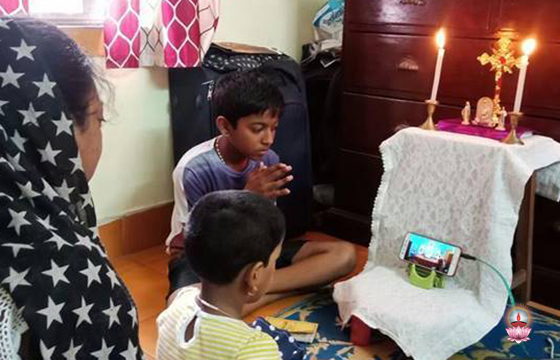
A rumor goes on saying that the lack of enthusiasm on the part of laity to come to the Church even after the State removing the ban is a consequence of pandemic. It may be partly true in the sense that a long break in the routine may change the human habits. The pause in going to the Church for a few months might have removed in the adepts the appetite for common worship. Yet there remains the question: Shall a praxis done out of conviction be died out just because of an interval? It is less probable. It is in this respect we become aware of the cultural mutations that have been taking place in the society in the recent decades. A close observation of the social opinion on religious living shows that indifference to structured religions has already been in swing since the influx of modern and postmodern thoughts into Kerala context. But it was at a low degree because of the given religious background of people in the country. The social distancing caused by the epidemic has just quickened the process of secularization in the state.
One of the major components of postmodern culture is pragmatism, a school of thought developed in America by Charles Sander Peirce, William James and others in 1870 and later by Dewey, Mead and Adams. Richard Rorty was one of its significant protagonist till the last decade. To these philosophers, the truth of a proposition consists not in its logical coherence but in its usefulness, success and its capacity to render satisfaction. Truth can never be fixed in reference to any transcendental property. What makes something true is agreement of majority attained through a democratic process of circularity of conversation. Due to the influence of pragmatic thinking, people have begun to slowly neglect the authority of the so called “holy hierarchy” and to form their own codes and systems for religious living. Consequently, the discourse of the clergy is less heard and trusted by the faithful.
Similarly, the communicative capital of religions, which the hierarchy was controlling through their pastoral letters, is weakened by the “multiple value-making centres” that are proliferated with the rise of social media. At present, the Church discourse is as such accepted only by a minority who sees parish as their main centre of salvation. Others consider the Church discourse as only one among many other discourses. In addition to the multiplication of meaning making agents, the appeal for Jacque Derrida’s deconstructive reading- letting the reader free from the traditional explanations of the texts, which were fabricated with the vested interests – has influenced at large the elite class, and on account of their influence, even the ordinary faithful have begun to give their own meanings to the revealed passages.
In fact, the “social distancing” during the pandemic, has given laity the opportunity to actualize what they had really in mind regarding the religious practices. The interesting factor is that in the context of the Covid-19 virus, the hierarchy itself gave them orders not to come to the churches following the directive of the secular state. This has, no doubt, given legitimation to privatization of religious living. And the experience of living a few months without religious practices has created in the faithful the false feeling that they can live without the organized religions.
The growing appetite for privatized religious living has to be therefore confronted not merely as a phenomenon that arose with the pandemic. Church has to look at the present aversenessabout the religious indifference from the very context of postmodern culture. This is a golden opportunity for us to take seriously the constructive ways many theologians are developing in response to postmodern culture. A defensive attitude will produce no result except the consolidation of fundamentalism in the Church.
kundu1962@gmail.com