Kuruvilla Pandikattu
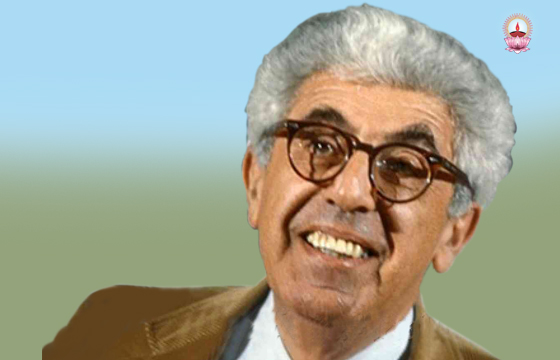
Barry Commoner (1917-2013) was an American biologist, professor, and politician. He was a leading ecologist and among the founders of the modern environmental movement. He was born in Brooklyn, New York, in 1917, as the son of Jewish immigrants from Russia.
After serving as a lieutenant in the United States Navy during World War II, Commoner became a professor of plant physiology at Washington University. He taught there for 34 years and during this period, in 1966, he founded the Centre for the Biology of Natural Systems to study “the science of the total environment.”
In the late 1950s, Commoner became well known for his opposition to nuclear weapons testing. He produced inspirational books about the negative ecological effects of atmospheric nuclear testing. In his bestselling book “The Closing Circle” (1971), Commoner suggested that the American economy should be restructured to conform to the unbending laws of ecology. For example, he argued that polluting products (like detergents or synthetic textiles) should be replaced with natural products (like soap or cotton and wool). This book was one of the first to bring the idea of sustainability to a mass audience. Commoner suggested a left-wing, eco-socialist response to the limits to growth thesis, postulating that capitalist technologies were chiefly responsible for environmental degradation, as opposed to population growth.
One of Commoner’s lasting legacies is his four laws of ecology, as written in “The Closing Circle” (1971). The four laws are:
1. Everything is connected to everything else. There is one ecosphere for all living organisms and what affects one, affects all.
2. Everything must go somewhere. There is no “waste” in nature and there is no “away” to which things can be thrown.
3. Nature knows best. Humankind has fashioned technology to improve upon nature, but such change in a natural system is “likely to be detrimental to that system.”
4. There is no such thing as a free lunch. Exploitation of nature will inevitably involve the conversion of resources from useful to useless forms.
Commoner examined the relationship between poverty and population growth, very different from our common notion. He noted that it is in fact poverty that “initiates the rise in population,” not the other way around. Commoner continues to hold that the reason developing countries are still “forgotten” is because of colonialism. Commoner published another bestseller, “The Poverty of Power” (1976).
Though a committed scientist he is convinced that “the age of innocent faith in science and technology may be over.” He adds: “Despite the dazzling successes of modern technology and the unprecedented power of modern military systems, they suffer from a common and catastrophic fault. While providing us with a bountiful supply of food, with great industrial plants, with high-speed transportation, and with military weapons of unprecedented power, they threaten our very survival.”
In another context, he remarks: “God is Not Dead; He is Polluted on Earth.” His passion for the earth, his commitment to ecology and his dedication to the poor have ushered in a new and hopeful approach to both science and religion. He could be called the forerunner to Pope Francis and his Laudato Si:’ on care for our common home, due to his scholarly research, committed action and passionate devotion, especially to the cause of the environment and the poor.