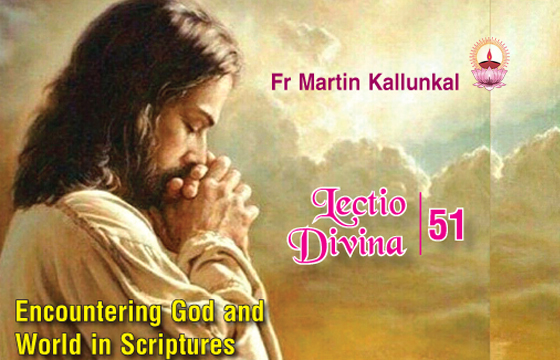
Fr Martin Kallunkal

READING : “When Jesus came to the area of Caesarea Philippi, he asked his disciples, “Who do people say that the Son of Man is?” They answered, “Some say John the Baptist, others Elijah, and others Jeremiah or one of the prophets.” He said to them, “But who do you say that I am?” Simon Peter answered, “You are the Christ, the Son of the living God” (Mt 16:13-16).
REFLECTION : “Who am I to you?” is the most important question in a relationship. The answer to this question will determine the life span and quality of human relationships. Jesus poses this question to His disciples at Caesarea Philippi, a city that is twenty-five miles north of Galilee, and is known for its pagan temples and gods. As scholars rightly observe, Jesus’ choice of this place for asking this most pertinent question, as far as His disciples’ relationship with Him is concerned, has two reasons: disciples are far away from the centres of Judaism, and they are placed right at the centre of a religiously pluralistic space. Jesus, then, poses the question twice: first, in very general terms – “Who do people say that the Son of Man is?” And, second, in a very deeply personal manner –“Who do you say that I am?” In answer to the first question, the disciples report that people regard Jesus as a prophet, especially, as one of the most persecuted prophets in the history of Judaism – Elijah, Jeremiah and John the Baptist. When Jesus zooms in and directs the question towards His disciples – “who do you say that I am? – Peter represents the twelve and states that Jesus is the Son of the living God. A couple of things are noteworthy here: First, like the public, Peter does not classify Jesus as a prophet. Second, stating that Jesus is the Son of the living God, Peter refuses to classify Jesus as one among many gods in the religiously pluralistic world. Indeed, the most important thing in Christianity is Christ, and therefore ‘who and what Christ is’ is the most crucial question in the life of Christ’s followers. Christ is beyond religious classifications, and so too His Church. What is unique and original cannot be classified. There is nothing more original than Jesus Christ who is truly and fully divine and truly and fully human at the same time. One might see similarities in the practices (in both thinking and doing) of Christianity as well as world religions, and as such, one might rightly classify them as ascetical, mystical, etc. But, the moment, Christ enters the scene, all comparisons end. Christianity is not a set of special beliefs and practices; rather, it is a person to whom everything is drawn.
PRAYER: Lord Jesus Christ, I hardly understood who you have been to me. For long, I have been trying to understand you through comparative thinking. Thank you, Lord, for opening my heart and mind to the uniqueness of your personality. You are not a hero of a fiction and the founder of a movement, and the evangelists are not myth men. You are the Son of the living God. Lord, this is not something that I can know, understand and register in my memory. There is infinitely more than what I know about you and your Church. My love for you is not born of my knowledge and understanding. When I listen to the conversation at Caesarea Philippi, a light flashes in my little heart, which fills me with wonderment.
Contemplation Wonderment is the means of true and lasting knowledge. Approach Christ with wonder, for He is wonderful. Learn the art of admiration.
ACTION: Read the Gospels with a focus on finding the personality of Christ.