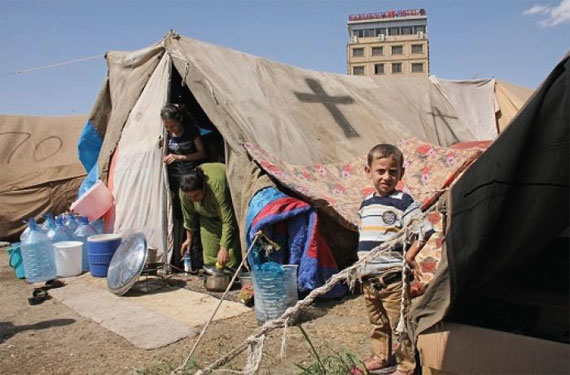
After four years “there is still a climate of uncertainty” among the refugees from Mosul and the Nineveh Plain, because the reconstruction work “continues but slowly.” In addition to the houses “we must guarantee a future through work,” said Fr Paul Thabit Mekko who spoke to AsiaNews about the slow rebirth of Mosul and the Nineveh Plain a year after the military victory against the Islamic State (IS) group that had turned Iraq’s northern metropolis into one of its stronghold.
“The general situation of uncertainty in the country has been made worse by the stalemate over the formation of Iraq’s new government and the accusations of electoral fraud,” said the clergyman, “and this has further complicated the situation and generated fear.”
After years of violence and terror by the Islamic State, life is getting back to normal in East Mosul, and it is easier now to move inside the city’s western neighbourhoods.
The rebirth of the northern metropolis is taking place thanks to the reopening of schools, factories and small businesses, as well as the opening of new commercial spaces, unthinkable under the “caliphate.” This renaissance includes a literary café as a place of reading and exchanges.
In recent weeks, said Fr Paul, “at least 100 Christian families” have returned to the eastern sector of Mosul, on the left bank of the Tigris River, which suffered less from the Islamic State.