French president and pope meet for first time:”No fight against religion”

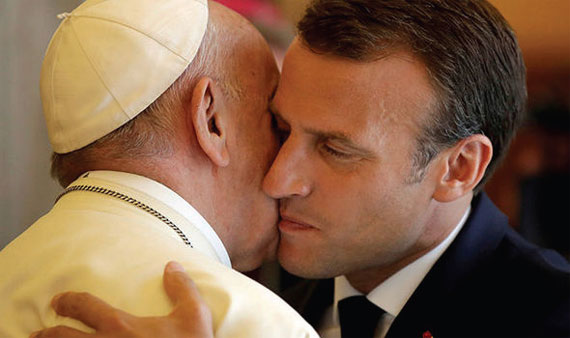
In a closely monitored meeting on June 26, Pope Francis met for the first time with French President Emmanuel Macron.

In what is believed to be one of Francis’s longest private meetings with a head of state to date, lasting nearly one hour, the meeting comes at a moment in which Macron has emerged a leading player on the global stage and a potentially critical interlocutor with the Vatican for European relations.

“Attention then turned to global issues of shared interest, such as the protection of the environment, migration, and multilateral commitment to conflict prevention and resolution, especially in relation to disarmament,” said the statement.

Macron’s visit comes at a time when he is at odds with the new populist government of Italy over migration policy – resulting in his decision to forgo a meeting with any government officials during his time in Rome.

More recently he has condemned the “leprosy” of populism within the European Union.

The Vatican communiqué also noted that the French president and the Pope discussed global conflicts in Africa and the Middle East, along with “a joint reflection on the prospects of the European project.” Before leaving his meeting with Francis, Macron gave the pontiff the typical French bisous, a kiss on both cheeks. He was also made the “First and Only Honorary Canon” of the Rome Basilica of St John’s in Lateran, which is the Pope’s cathedral in his capacity as Bishop of Rome.

A Vatican statement said the two discussed “protection of the environment, migration, and multilateral commitment to conflict prevention and resolution, especially in relation to disarmament.” It was also revealed that the pair discussed the prospects for resolving conflicts in the Middle East and Africa as well as the future of Europe. Government spokesperson Benjamin Griveaux told RTL later that day that the title of “First and Only Honorary Canon” was “totally secular,” as he denounced the “unnecessary controversy.”

Addressing a crowd of Catholics in Rome hours after the ceremony, Mr Macron said that French secularism, or laïcité, was “not a fight against religion.” At 39-years-old, he is one of the youngest to assume the position of the French head of state after Napoleon. He once worked as a banker and has promised to unite people from various backgrounds. One of his main promises during his election days was that he would spearhead a “democratic revolution” by opposing the French “vacuous” political system. “No Religion Is a Problem in France” Says French President Emmanuel Macron TWEET THIS Emmanuel Macron said “No religion is a problem in France.”

Pope criticizes Trump administration policy on migrant family separation

Pope Francis has criticized the Trump administration’s policy of separating migrant families at the Mexican border, saying populism is not the answer to the world’s immigration problems.

Speaking to Reuters, the Pope said he supported recent statements by U.S. Catholic bishops who called the separation of children from their parents “contrary to our Catholic values” and “immoral.”

“It’s not easy, but populism is not the solution,” Francis said on June 17 Sunday night.

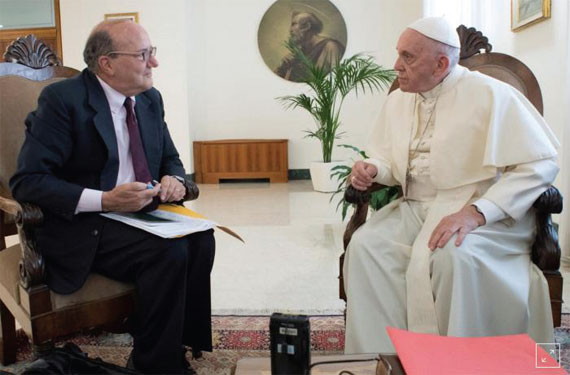
In a rare, wide-ranging interview, the Pope said he was optimistic about talks that may lead to a historic agreement over the appointment of bishops in China, and said he may accept more bishops’ resignations over a sexual abuse scandal in Chile.

Reflecting at his Vatican residence on his five years as Pope, he defended his leadership of the Roman Catholic Church against criticism by conservatives inside and outside the Church who say his interpretation of its teachings is too liberal.

He also said he wanted to appoint more women to top positions in the Vatican administration.

One of his most pointed messages concerned President Donald Trump’s zero-tolerance immigration policy, in which U.S. authorities plan to criminally prosecute all immigrants caught crossing the Mexican border illegally, holding adults in jail while their children are sent to government shelters.

U.S. Catholic bishops have joined other religious leaders in the United States in condemning the policy. “I am on the side of the bishops’ conference,” the Pope said, referring to two statements from U.S. bishops this month. “Let it be clear that in these things, I respect (the position of) the bishops conference.” Francis’ comments add to the pressure on Trump over immigration policy. The Pope heads a church which has 1.3 billion members worldwide and is the largest Christian denomination in the United States.

Dictatorships begin with taking over media to spread lies, pope says

All dictatorships begin the same way: media outlets are put in the hands of “unscrupulous” people who spread lies and weaken democracy, Pope Francis said. Typical standards, norms and laws in regard to communications are first eliminated, the Pope said in his homily on June 18 during morning Mass at Domus Sanctae Marthae. Then an entire media or communication outlet is handed over “to a firm, a business that slanders, tells lies, weakens democracy, and then the judges come to judge these weakened institutions, these destroyed, condemned people and a dictatorship makes progress this way,” he said. “All dictatorships, all of them, began like this, by adulterating communication, by putting communications in the hands of people without scruples, of governments without scruples,” he added. The Pope’s homily focused on the day’s first reading in which Jezebel succeeds in her a plot to help her husband, King Ahab, take possession of their neighbour’s land; the neighbour, Naboth, refused to sell what had belonged to his family for generations. Jezebel arranged for two men to accuse Naboth of cursing God and the king, for which Naboth was stoned to death.

Pope Francis: clergy in the Middle East should not be living in luxury

The Catholic Church must bear in mind its sins in the Middle East, Pope Francis has said. Although the sin of war committed by nations has caused great suffering to Christians in the Middle East, the Pope said, “there is also our sin in the Middle East: the sin of incoherence between life and faith.”

“There are perhaps – not many – some priest[s], bishop[s], religious congregation who professes poverty yet lives like a rich person,” the Pope said in off-the-cuff remarks during a meeting with a coalition of funding agencies coordinated by the Congregation for Eastern Churches.

“I would like these religious men and women, Christians, some bishops or some religious congregation to strip themselves more [of riches] for their brothers and their sisters,” he said.

The Pope spoke on June 22 during a meeting with members of a Vatican coordinating body, known by its Italian acronym ROACO, which operates under the auspices of the Congregation for Eastern Churches, and unites funding agencies to provide assistance to the faithful in the region. Funding agencies include the US-based Catholic Near East Welfare Association.

The Bishops and the Nuncio rush to Masaya to stop a new massacre

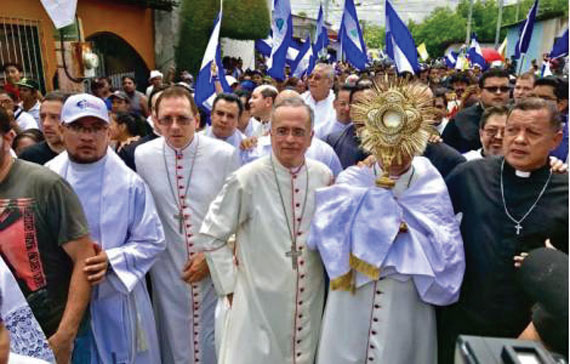
The church bells of the city of Masaya in Nicaraguarang without stopping, not to warn of the arrival of death squads, form-ed by police and paramilitaries, but this time with a reason for hope: the arrival of some members of the Episcopal Conference and of the Apostolic Nuncio who on June 25, after learning that Masaya had been attacked once again at 5 am, arrived almost immediately on the spot, to stop the massacre. It was very risky, but seeing the Bishops march down the street, the whole population came out of their houses and joined them. All together, in silence, made the police move away from the streets hastily. After greeting the people, the Bishops made a short procession with the Blessed Sacrament together with the clergy of Managua and Masaya. Then the Bishops went to the police station from where the attacks on civilians were ordered, commanded by Commissioner Ramón Avellán, accused by the population of being responsible for the massacres in recent weeks. After more than an hour, Cardinal Leopoldo Brenes, Archbishop of Managua, wanted to inform the population: “Commissioner Avellán has committed himself to stop all violence, I told him that if this does not happen, I will call him later.”

Individual bishops should decide about Communion in mixed marriages, Pope says

The question of allowing Protestants married to Catholics to receive Communion at Mass in special cases has to be decided by each individual bishop and cannot be decided by a bishops’ conference, Pope Francis told reporters after a one-day ecumenical journey to Geneva.

During an inflight news conference on June 21, the Pope was asked about his recent decision requesting the Catholic bishops’ conference of Germany not to publish nationwide guidelines for allowing Communion for such couples.

He said the guidelines went beyond what is foreseen by the Code of Canon law “and there is the problem.” The code does not provide for nationwide policies, he said, but “provides for the bishop of the diocese (to make a decision on each case), not the bishops’ conference.”

“This was the difficulty of the debate. Not the content,” he said.

Cardinal-designate Luis Ladaria, Prefect of the Congregation for the Doctrine of the Faith, had written to the bishops saying that “the Holy Father has reached the conclusion that the document has not matured enough to be published.”

Towards the Synod: Young people are less religious than older adults

A study by the Pew Research Centre shows that in almost all countries there are differences between young people and older people regarding the importance given to religion; belonging to a group and daily prayer. The influence of economic development, of education, of danger, of age. The cases of Muslim countries, South Korea and Japan.

But even with secularization, the world is becoming more religious. Young people (up to 40 years of age) are less religious than older adults (over forty): this is the conclusion – in some respects obvious – of a long study published by the Pew Research Centre a few days ago. What gives great relevance to this detailed study is the discovery that this difference between young people and adults involves all religions, even if there are some rare exceptions, and is visible in developed and developing countries. Young people’s attitudes are influenced by the greater well-being, greater access to study, changing mentalities throughout the course of life. Such a report is highly useful in preparation for the October Synod, which will focus on the situation of young people in terms of faith and vocation.

The Pew Reserch Centre study covers 106 countries in the world, over a research period of 10 years. In 46 countries, young people (aged 18 to 39) differnegativley to the elderly (40 and over) in saying that “religion is very important;” in 56 countries there are no differences between the two groups. Only in two countries, Georgia and Ghana, young people are more religious than the elderly.

Similar data is reported on other issues such as belonging to a religious group, daily prayer, participation in a weekly religious service. Young people identify themselves less as belonging to a religious group than the older generation in 41 countries; in 63 countries there is no significant difference. Young people pray less than their elders in 71 countries out of 105, and participate less in weekly religious services in 53 countries out of 102.

It must be said that in many countries, the percentage difference between the two groups is not very high: the global average reveals a difference of 5% for affiliation to a particular religious group; 6% for the importance given to religion; 6% for participation in a weekly service; 9% for daily prayer. But there are countries where this difference is very large. The record is in Canada, where this difference is 28 points. In Asia, the figure of South Korea should be noted: a difference of 24 points. In Japan there is a gap of 18 points. Throughout the Asia-Pacific region, the difference is minimal: only 4 points.

The Amazing Story of 12 Anglican Nuns Who All Became Catholic

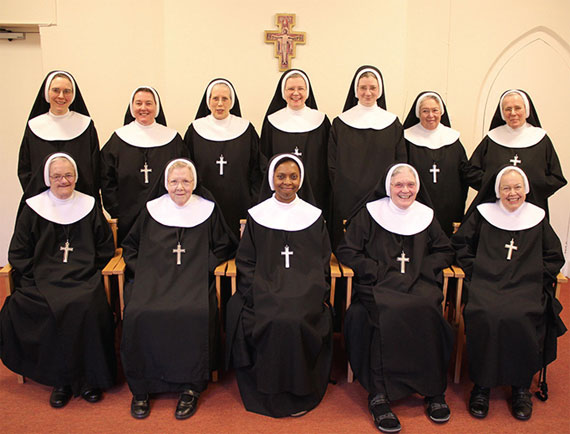
On Jan. 2, 2013, 12 fully habited nuns left their convent forever. They walked or were helped to a waiting coach. On board there were some suit-cases and bedding. They left with all they possessed.

So opened the Apostolic Constitution Anglicanorum Coetibus, given in Rome, at St Peter’s, on Nov. 4, 2009, the Memorial of St Charles Borromeo. It provided for the establishment of Personal Ordinariates through which Anglican faithful might enter, including in a corporate manner, into full communion with the Catholic Church. As it turned out, she was not alone in how she felt. Finally, Mother Winsome, herself now intent on becoming Catholic, called the whole community together. She told them that any sister wishing to be received into the Catholic Church “had to be prepared to walk down the drive with just what she could carry in a bag in her hand, leaving everything else behind, with-out any guarantees for the future, just going forward in blind faith in accordance with her conscience.”

In the end, 11 sisters, and a recently joined religious sister from another community, elected to make that walk. Three of the sisters were in their eighties, three were in their seventies, two of the sisters were prepared to leave the monastery’s Infirmary and the care they received there to follow the call of conscience. One of the more elderly members of the community said what many of them now felt: “I want to die a Catholic.”

Cardinal Schönborn: women priests ‘too profound a change’ for the Church

Card. Christoph Schönborn has clarified his views on female ordination, saying that women priests would be “too profound a change.” However, he signalled his support for the introduction of deaconesses.

In an interview with Austrian news site OE24, the Archbishop of Vienna said that while there were female deacons in the early Church, he did not foresee a female priesthood in the future.

“There were deaconesses in the first centuries, which could be reintroduced, but there have never been priestesses in the Catholic Church. That would be too profound an encroachment on the 2,000 year tradition, and even Pope Francis said: ‘that is not foreseen.’”

The cardinal had previously caused controversy after saying that a Pope “cannot decide” by himself whether or not the ordi-nation of women is permitted.

“Ordination [of women] is a question that surely can only be settled by a Council,” he told Die Presse. “A Pope cannot decide this by himself. This is too large a question for it to be settled from the desk of a Pope.”

Pope talks to Reuters about the ‘dialogue with China’

Pope Francis was interviewed by Philip Pullella of Reuters. In the tête-à-tête, the pontiff said that with respect to the dialogue with China, “We are at a good point.” In addition to diplomatic channels there are friendships and cultural exchanges. The Chinese people are “very wise” and know how to wait.

Q: How is the rapprochement with China?
We are at a good point, but relations with China follow three different paths. First of all, there is the official one. The Chinese delegation comes here, takes part in meetings, and then the Vatican delegation goes to China. Relations are good and we have managed to do good things. This is the official dialogue.

Then there is a second dialogue, of everyone and with everyone. “I am a cousin of the minister so and so who sent me to say that….” There is always an answer. “Yes, all right, let’s go forward.” These side channels are open, let’s say, at a human level, and we do not want to burn them. We can see goodwill, both from the Holy See and the Chinese government.

The third path, which for me is the most important in the rapprochement with China, is cultural. Some priests work at Chinese universities. Then there is also culture, like the exhibit that was put on in the Vatican and in China. This is the traditional path, like those of the great ones, like Matteo Ricci.

I like to think about relations with China as, multifaceted, based not only the official diplomatic one, because the other two are very enriching. I think things are going well. In your question, you mentioned two steps forward and one step backward. I think the Chinese deserve the Nobel Prize for patience, because they are good, they know how to wait, time is theirs and they have centuries of culture…. They are a wise people, very wise. I respect China a lot.

Q: How do you respond to concerns such as those of Cardinal Zen?
Cardinal Zen taught theology in patriotic seminaries. I think he’s a little scared. Perhaps age might have some influence. He is a good man. He came to talk to me. I received him, but he’s a bit scared. Dialogue is a risk, but I prefer the risk to the sure defeat of not talking. With respect to time, someone mentioned Chinese time. I think it is God’s time, forward, calm.

Pakistani imam treats patients in Catholic cathedral

More than 100 parishioners of Lahore’s Sacred Heart Cathedral were treated at a free medical camp organized by an imam.

Qari Abdul Qayyum Zaheer, a televangelist, and his team of four doctors offered full body check-ups and food supplements at the health camp at St Victoria’s Nursery in the cathedral compound on June 24. Awareness sessions on the health effects of extreme heat and climate change were also conducted.

“We only charged 350 rupees (US$2.88) for a test of body organs and vitamins. That’s one third the cost of an ordinary medical test in a private hospital. Sunstroke, dehydration and gastrointestinal infections were common among the visitors,” Zaheer told ucanews.com.

The U.N. World Meteorological Organization has confirmed that the hottest April temperature ever witnessed on earth was recorded at Nawabshah, a southern district of Sindh province, where the mercury reached a scorching 50.2C (122.4F). Media reports say 65 people have died due to the heat wave in Karachi.