

In a Decree approved by Pope Francis on Palm Sunday, April 13, 2025, the Dicastery for the Clergy has promulgated revised norms governing the discipline of Mass intentions. The updated legislation, which enters into effect on Easter Sunday, April 20, seeks to safeguard both the spi-ritual integrity of the Eucharistic sacrifice and the faithful’s trust in the Church’s handling of their offerings.
Building upon the existing canon law and the 1991 de-cree Mos iugiter, the new norms emphasize that while the faithful may continue to offer stipends for Masses to be celebrated according to specific intentions, this sacred tradition must remain free of any semblance of commercial exchange. The decree reaffirms the value of such offerings as a form of spiritual participation and support for the Church’s mission.
The decree permits “colle-ctive intentions”–a practice where multiple offerings are united in a single Mass–only under strict conditions: the donors must be explicitly informed and must freely consent. The decree further restricts the frequency of such collective celebrations, aiming to preserve the normative link between each offering and a distinct Eucharistic celebration.
The norms also prohibit any substitution of promised Masses with simple mentions during liturgies, categorizing such pra-ctices as gravely illicit. Empha-sizing justice to the faithful and the avoidance of simony, the Dicastery calls for vigilance from bishops, who are instructed to catechize the faithful, monitor implementation, and ensure accurate record-keeping of int-entions and offerings.
Pastoral concern remains central to the decree. Priests are encouraged to celebrate Masses for the poor, even without offer-ings, and diocesan bishops may redirect surplus intentions to mission territories or parishes in need. The Holy See’s action seeks to renew fidelity to the Church’s long-standing tradition, protect the dignity of the Eucharist, and promote greater transparency and trust within the People of God.

Pope Francis greets pilgrims on Palm Sunday in Saint Peter’s Square
Pope Francis wished a “Happy Palm Sunday and Happy Holy Week” to all those gathered for the Palm Sunday of the Lord’s Passion celebration in Saint Peter’s Square. The Pope came out into the Square from the Basilica for around ten minutes, immediately following the final blessing of the Mass where he offered his good wishes and then visited in his wheelchair among the faithful. Pope Francis’ latest visit marked another public occasion among the people, following his presence last Sunday April 06 at the Jubilee of the Sick and the World of Healthcare and his visits to Saint Peter’s Basilica last week and visit to the Basilica of Saint Mary Major on April 12 to pray before the Marian icon of the Salus Populi Romani.

Eviction-facing Indian Catholics to fight Muslim charity’s claims
Threatened with eviction from their homes, some 600 families, mo-stly Catholics, have vowed to conti-nue a 16-month-old hunger strike in Kerala state, in southern India. The protesters resolved to continue their fight after a court last week stopped a government-appointed commission tasked with finding ways to protect their land rights, their leaders said. The court stated that the government lacks the authority to appoint such a commission. Last December, the government established a commi-ssion to propose solutions for the dispute, which began after a Muslim organization claimed that the villa-gers lived on some 400 acres of land donated to it for charitable purposes many years ago. The court ruling “is a setback for us. But the people will continue their struggle,” said Fr. Antony Xavier, the parish priest of Velankanny Matha Church in Munamban, in Ernakulam district. The priest told on March 21 that the state government, the respondent in the case, “has agreed to appeal the single bench ruling. We want the government to appeal.” The 610 affected families, all from his parish in the Kottapuram diocese, purchas-ed the land at market rates, paid for it, and registered the deeds following all state legal systems. “We will conti-nue the fight until our legal rights to the land are recognized.”

Goans oppose tourism project near 16th century basilica
About 700 people, mostly Catho-lics, marched through Old Goa, the colonial-era Portuguese capital, to protest a government plan for a tourism project near the Bom Jesus Basilica, the 16th-century church that houses the relics of Saint Francis Xavier. Environmentalists and resi-dents of Old Goa joined the protest at the popular pilgrimage site on Mar. 23 to oppose the project. The Goa Tourism Department reportedly planned to build a ‘tourism mall’ on the ruins of a 16th-century church near the basilica. Residents of Old Goa have formed a forum–Save Old Goa Action Committee–to oppose the project, which they say is planned with scant regard for their history, Catholic sentiments and environment. “It is outrageous that a commercial structure is being planned on the ruins of the Five Wounds of Christ Church. The project is also within the 100 meters of the world heritage site of Bom Jesus Basilica,” Catholic priest Savio Barretto, former rector of the Basilica of Bom Jesus told on March 24.
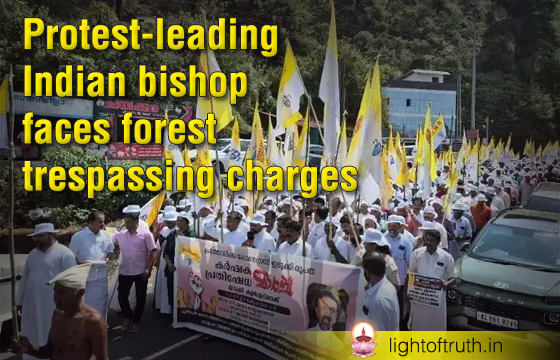
Protest-leading Indian bishop faces forest trespassing charges
An 88-year-old Catholic bishop and 23 others are facing legal action in southern Indian Kerala state for entering a restricted forest after they led a march demanding the reopening of a blocked public road. Kerala State Forest Department filed charges against retired Bishop George Punnakottil of Kothamangalam and others, including elected representatives, for violating forest laws and trespassing into the forest land. “It is highly condemnable that a case of trespass has been registered against an elderly bishop” for advocating a public cause, said Father James Kokkavayalil, the secretary of the Public Affairs Commission of the Eastern Rite Syro-Malabar Church on March 24. The bishop and political leaders led a march of some 3,000 people on March 23 along a public road that the forest department closed for traffic and denied public entry in 2012. The department also opposed the proposals to reopen the road, saying it passes through ten kilometres of protected forest and that traffic noise and vehicle pollution will harm the environment and endanger wildlife. Protesters say that the road constructed during the British colonial era continues to be the shortest route connecting Aluva town near the western coast to Munnar town in the eastern hills. It cuts the distance by some 30 kilometres and does not have sharp hikes and slopes, “Munnar is an internationally acclaimed tourist destination. Reopening of the road will help local people and tourist traffic,” Father Kokkavayalil told UCA News on Mar. 24. In a March 23 statement, the eastern rite bishops’ body said the forest department’s move against the bishop and others “is unlawful as it blocked the public movement illegally.” The land of the road belongs to the “revenue department and not to the forest,” it said. The bishops also accused the forest department of usurping the public road and “infringing upon citizens’ right to free movement.” Kerala Catholic Bishops Council (KCBC) also issued a statement on March 24 deploring the legal action and urging the state government to “immediately correct the forest department’s anti-people policies.”
The statement said the forest department “grossly misused” the law against people pressing for their basic facilities.
It asked the department to withdraw all such legal moves against people. Several cases were registered against people allegedly for violating India’s Wildlife Protection Act 1972, a federal law meant to protect forests and wild animals, after they protested the government’s failure to protect them from wild animal attacks. According to government data, 486 people were killed in wild animal attacks between 2019-2024. At least 22 people were killed by elephants, and a person was mauled to death by a tiger in the state in 2023-24. Other wild animal attacks killed 71 people.
Indian court drops contempt charges against 5 Salesian priests
A court in northeastern India has dropped contempt of court charges leveled at five Salesian priests after they submitted a written apology. The priests in Meghalaya state were facing charges after they allegedly demolished a school building owned by their Salesian congregation without the court’s say so. However, after having apologized, the state High Court dropped the charges on March 19, saying the priests “have the greatest respect for this court.” “They had and have no intention of disobeying the orders passed by it and every intention of obeying them. They tendered an unqualified apology and prayed for forgiveness,” the highest court in the state said. The court had charged the priests – Sagi Stephen, Arcadius Puwein, Edmund Gomes, Dianetius Fernandez and Cyril Tirkey – on Jan. 28, calling on them to explain “why they should not be punished for criminal contempt.” The charges came after they began demolishing a 72-year-old dilapidated school building in the state capital, Shillong. They allegedly ignored a public interest litigation against the move pending in the High Court. The court also told them to explain why they needed to demolish it. “We are happy that the court accepted our apologies and let off without any punishment,” said Father Stephan, one among the accused.
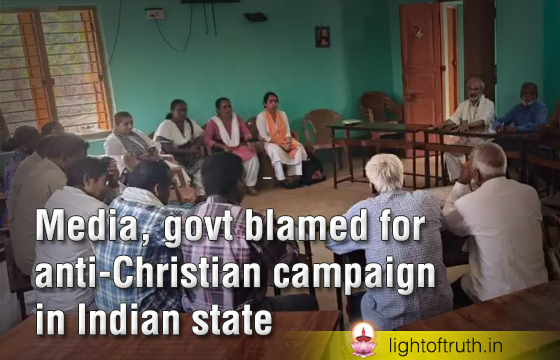
Media, govt blamed for anti-Christian campaign in Indian state
A six-member team that studied reasons for increased hostility toward Christians in an eastern Indian district have blamed the media and a new government for causing the problem. “A few local daily newspapers played a villainous role in escalating the hate campaign against Christians,” the team said in a March 15 report after touring Balasore district in Odisha state. “The changing of the guard in Odisha state has further escalated the vulnerable situation of Chri-stians,” it added, referring to the Bharatiya Janata Party (BJP) taking power in the state in June 2024. The team of six lawyers, who included priests and nuns, visited villages in the Raibania area and listened to Christian villagers discussing how Hindus opposed burying their dead and conducting religious ceremo-nies. “We interacted with more than 25 affected Christians about ongoing challenges they faced,” said Catholic priest, lawyer and activist Ajay Kumar Singh. He told on March 23 that the fact-finding team toured the Balasore diocesan area, which reported several cases of anti-Christian activities like burial denial and disruption of religious ceremonies. Their re-port said some tribal Christians also faced social boycott threats for practicing their faith. “The triggering point of the unrest” was on Dec. 18, when a tribal-dominated village in the area opposed burying Budhia Murmu, a local santal tribal Christian.

Thieves target Catholic Church in eastern India
Thieves have ransacked and desecrated a Catholic Church in the eastern Indian state of Odisha, stealing the tabernacle containing the Holy Eucharist and money from the donation box, sources confirmed. The incident targeting the Holy Family Church in Sambalpur diocese, about 390 kilometres south of the state capital Bhubaneswar, took place on the night of March 21. Church officials said the thieves broke into the Church, founded in 1981, in Titilagarh, in Balangir district, and fled with the tabernacle and money, but did not damage the statue of Mother Mary close to the donation box. Church authorities lodged a complaint with Titlagarh police on March 22. “My parishioners and I are shocked by this incident,” Divine Word priest Joseph Antony, the parish priest, told on March 23. The thieves took advantage of stormy weather and a power outage to commit the crime, he said. Prior to targeting the Holy Family Church the thieves stole a music keyboard and a dona-tion box containing money from a nearby Protestant church, he said. “CCTV footage showed three people were involved,” the priest added. Bishop Nira-njan Sual Singh of Sambalpur said Christian communities in tribal-dominated areas of Odi-sha have been targeted recently. “Our churches and our Chris-tian community have increasi-ngly come under attack in these tribal areas,” Singh told on March 23. Odisha is ruled by the Bharatiya Janata Party (BJP). On March 22, Singh sent a letter to Catholics in the dio-cese, lamenting the desecration of Holy Eucharist.
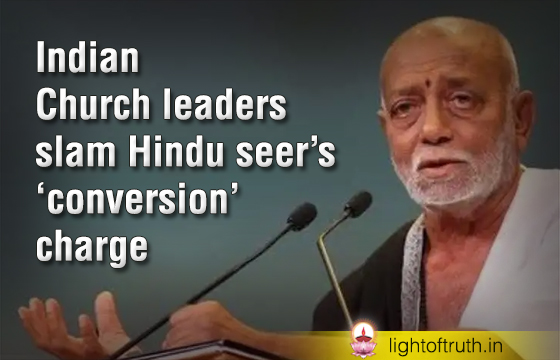
Indian Church leaders slam Hindu seer’s ‘conversion’ charge
Church leaders and a Christian law-maker have slammed a popular Hindu spiritual leader for accusing Christian school teachers in western India’s Gujarat state of converting students to Christianity. Morari Bapu claimed that 75% of govern-ment school teachers in Gujarati’s tribal-dominated Tapi district are Christians and “are actively involved in converting students to Christianity.” The spiritual leader’s discourses use poetry and music to tell the life of the Hindu god Ram. He made the allegation at such a discourse in Songadh town on March 14.
“The unwarranted comments without even a shred of evidence need to be condemned unequivocally,” said Father Cedric Prakash on March 20. The Jesuit priest and rights activist based in Gujarat said that the Hindu spiritual leader has a large following in Gujarat. “His followers lap up everything he says, even blatant lies such as this,” Prakash added. He said Christian missionaries have empowered indigenous tribal people in the area through a well-run network of quality educational institutions. “This has surely rankled those who for years have been exploiting them and keeping them on the margins of society,” Prakash said. Mohan Kokani, the lone tribal Christian legislator from Vyara constituency in Tapi district, called the conversion claim “baseless.” Konkani, a member of the Bharatiya Janata Party (BJP) said: “We have not received a single complaint of a Christian teacher converting students in the district. Bapu should give proof of his statement.”
The elected legislator said that till 1970, the tribal area lacked health and education facilities. “Christian missionaries arrived and provided health care and education, so people accepted them. They did not lure anyone to Christianity,” Kokani said. John Dayal, a senior journalist and spokesperson of the All India Catholic Union, said India’s constitution guarantees freedom of religion and belief. “In a Hindu majority country where the law-and-order machinery is firmly in Hindu hands, there’s no question of any forcible or fraudulent conversion as alleged,” he said. “This is a falsehood created, perpetuated and enlarged to suit a political objective,” Dayal added.

Burial refusal forces Christians to become Hindus in eastern India
Four members of a Christian family have been forced to become Hindus to bury the head of their family in a Hindu-majority tribal village in eastern India’s Odisha state, relatives said. Hindus at Siunaguda village in Nabarangpur district refused to bury Kesab Santa, 70, in the village burial ground unless the family members converted to Hinduism, they said. “My cousin Turpu Santa and family had no option but to become a Hindu to bury his father,” Gangadhar Santa, a relative and a Christian, told on March 16. Santa died on March 2 in the village, which is located about 550 kilometres southwest of the state capital, Bhubaneswar. The village had three Christian families following Brothers in Assembly, a neo-Christian Church. They lived alongside 30 Hindu families in the village. A village council member admitted to the forced conversion. “The village burial ground is for the Hindus and not for Christians. So we asked Turpu Santa to become a Hindu to use our burial ground, and he accepted it,” Tularam Dishari, a village panchayat (council) member, told on March 17. Those converted to Hinduism are Turpu Santa, 50, his wife, 48, and their son, 24, and daughter, 20. Santa said despite threats, the other two families refused to become Hindus. “These three families in the village were baptized some 18 years ago,” he said. Three years ago, Hindus did not allow the burial of a Christian man in another village. “So, the body was carried some 15 kilometres away from the village and buried near the roadside,” Santa said. Pastor Benjamin Upadi, who heads the Brothers in Assembly Church in the region, told that the Hindus have become “very intolerant and aggressive” towards the minority Christians. “They do not want any Christian families to live in the village,” he said.
Upadi said the pastors of different denominations have now decided to buy a plot of land for a burial ground, pooling together some US$7,000. Catholic priest Dibakar Parichha, the chancellor of the Archdiocese of Cuttack-Bhubaneswar that covers the region, said the intolerance toward Christians increased since last year after the Bharatiya Janata Party (BJP) came to power in the state.