
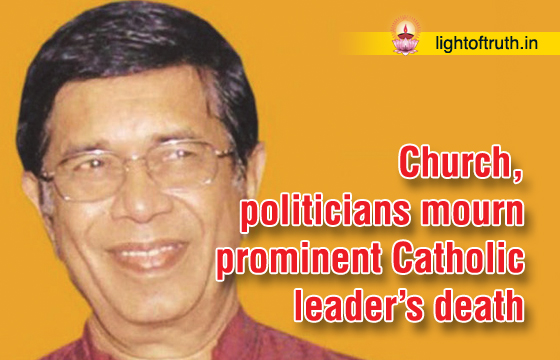
Cardinal Oswald Gracias, head of the Catholic Church in India, on September 13 joined political and social leaders to mourn the death of Oscar Fernandes, a former federal minister. Fernandes, a member of the Congress party, died earlier in the day at Mangaluru, a port town in Karnataka state. He was hospitalized after he suffered an injury in July. He was 80. Fernandes was being treated the ICU at Yenepoya Hospital in Mangaluru after the fall during his regular morning yoga sessions.
He is survived by his wife Blossom Fernandes, son, and a daughter.

Mob attacks pastor in Chhattisgarh
A pastor and two others were beaten up by a right-wing mob inside a police station in Raipur, capital of the central Indian state of Chhattisgarh.
The mob accused the pastor of indulging in forced religious conversions. The September 5 attack occurred after heated arguments between the mob and those who accompanied the pastor to the police station where they were called for questioning.
The incident took place at the Purani Basti police station in Raipur. The police had received complaints of forced religious conversions being carried out in the Bhatagaon area. A few local right-wing Hindutva leaders, too, reached the police station shortly after.
The complainants were furious and gheraoed the building demanding action against those carrying out such conversion. The arrival of the pastor, along with some Christians of the Bhatagaon area, sparked the exchange of words between the mob and those called in for questioning.
The pastor was then taken into the station in-charge’s room where the tense situation only worsened. Soon the pastor was subjected to physical assault, officials said. A video of the incident shows some members hitting the priest with slippers and shoes.

Minorities’ commission awaits
Pakistan’s National Commission for Minorities (NCM) has called on President Arif Alvi to approve a draft bill for empowerment of the commission formed by the federal cabinet last year.
The recommendations, shared in a Sept. 7 meeting at the presidential house, include appointing only a non-Muslim as commission chairman and cover the process of appointing members and budget allocation.
“This bill should have been passed 70 years ago. We hope it is passed in our tenure. This commission was formed 20 years ago but none of our communities knew about its existence. It only existed on paper. We have already shared our concerns with the prime minister and the chief justice of Pakistan,” Jaipal Chhabria, a Hindu NCM member, told.
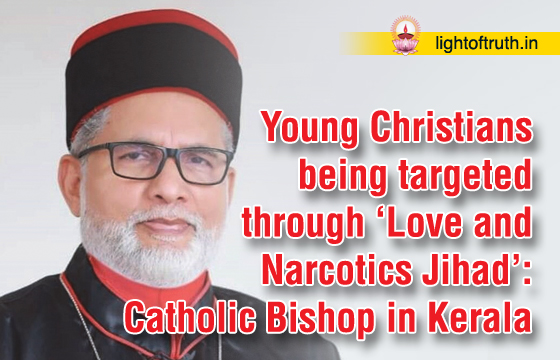
Young Christians being targeted through ‘love and narcotics jihad’: Catholic Bishop in Kerala
A prominent Catholic Bishop in Kerala claimed that young men and women, belonging to the Christian community and other non-Muslim faiths, were being lured and targeted through means such as ‘love jihad’ and ‘narcotic jihad’ in the state.
Addressing the laity on the occasion of the Eight day of Lent of Mary earlier this week, Joseph Kallarangatt, Bishop of the Palai diocese of the Syro-Malabar Church, alleged that those who claim that ‘love jihad’ doesn’t exist in Kerala are “blind to reality.” “Such people, be they politicians or those from social and cultural spaces, media may have their own vested interests. But one thing is clear. We are losing our young women. It’s not just love marriages. It’s a war strategy to destroy their lives,” he claimed.
The Bishop, presiding over a diocese that has the largest concentration of Syro-Malabar Catholics in the state, alluded to former DGP Loknath Behera’s statement that Kerala was becoming a recruitment centre for terrorists and that it was home to ‘sleeper cells’ for such persons.
“In a democratic country like ours, since it’s not easy to use weapons to destroy people of other faiths, jihadis are using means which are not easily identifiable. In the view of jihadis, non-Muslims are to be destroyed. When the objective is expansion of their religion and destruction of non-Muslims, the means they use are of different forms. Two of such widely-discussed means today are love jihad and narcotics jihad,” he alleged.
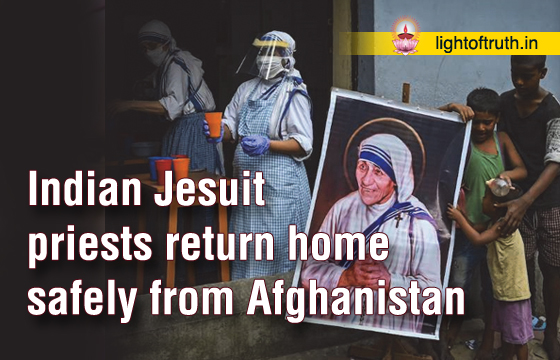
Indian Jesuit priests return home safely from Afghanistan
Four Missionaries of Charity nuns and two Indian Jesuit priests stranded in trouble-torn Afghanistan after the Taliban took control have been moved to safety.
Missionaries of Charity, a religious order of women founded by St. Mother Teresa of Kolkata, has thanked people for their continued prayers and support leading to the safe evacuation of the stranded nuns from the strife-torn country.
The Taliban took control of Afghanistan on Aug. 16, much earlier than expected by the international community. Among the four nuns, one of them is from India. Missionaries of Charity nuns started their mission in Afghanistan in 2004, three years after US-led forces freed the country from the clutches of the hardline Islamist group.
“Our four nuns have been shifted out of Afghanistan and are safe,” Sister Christy, based in Kolkata, the headquarters of the congregation, told on September 8. “We thank everyone who prayed and supported us in the hour of crisis.”
She refused to divulge any further details of the rescued nuns and their current location except to say that they are not in India.
However, Catholic News Agency report-ed that the nuns and 14 disabled children in their care were taken to Rome on Aug. 25 along with 277 other people on two evacuation flights.
“The children, aged six to 20 years old, were residents of an orphanage founded in 2006 by the Missionaries of Charity in Kabul, which has now been forced to close due to the Taliban’s takeover of the city,” CNA reported. Two Indian Jesuit priests — Father Jerome Sequeira, the head of the Jesuit mission in Afghanistan, and his assistant Father Robert Rodrigues — have returned to India from Afghanistan.
“Yes, our priests have safely returned to India,” a Jesuit priest told on Sept. 8. “They have completed their quarantine as per the Covid-19 protocol and are taking rest now.”
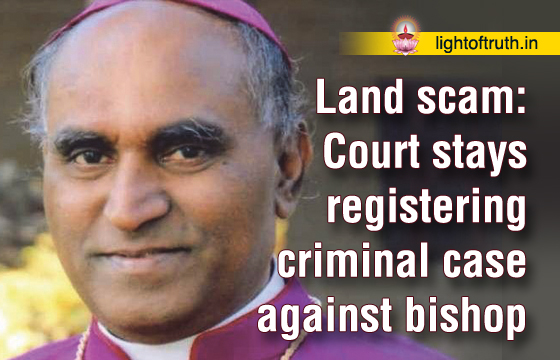
Land scam: Court stays registering criminal case against bishop
A court in Karnataka, south-ern India, has spared a Catholic Bishop from facing police inquiry into a land dispute.
The Sessions Court in Chik-magalur’s September 1 order observed the accusation against Bishop Thomasappa Anthony Swamy of Chikmagalur and a priest was false. A group of priests and lay people had earlier accused the prelate and Father A Shantharaj of selling a property attached a Church school by fabricating documents.
V T Thomas, the prelate’s lawyer, challenged the case and explained to the court that the plot in dispute was “never sold” and no manipulation of documents had been done.
Presenting proof of documents and minutes of the St Joseph’s Education Society that controls the property, the lawyer pleaded that the case filed by Michael Sadananda Baptist against the Bishop was “fabricated and without evidence.”
Thomas, the lawyer, told that a criminal case has also been filed with city police against Baptist “for cheating, tampering documents, mischief, and criminal conspiracy to tarnish the name of the Bishop and the Diocese.”

Crisis deepens in India’s Eastern Church over liturgy
The liturgical dispute in India’s Eastern-rite Syro-Malabar Church has deepened after a section of priests opted not to follow a synod decision to have a uniform liturgical celebration in all 35 dioceses.
Some 300 priests of Ernakulum-Angamaly Archdiocese, the seat of the church’s Major Arch-Bishop, Cardinal George Alencherry, met their archiepiscopal vicar, Archbishop Antony Kariyil, on Aug. 28 and explained their decision, said Father Jose Vailikodath, a priests’ council member.
“We met Archbishop Kariyil and urged him to get a dispensation from Pope Francis over the synod decision so that we can continue with our traditional mode of celebrating Holy Mass, facing the congregation,” Father Vailikodath told on Aug. 31.
The bishops’ synod, the church’s supreme decision-making body, on Aug. 27 asked parishes in all dioceses to implement a uniform mode of Mass from Nov. 28. The synod had decided on a uniform liturgy in 1999 but the decision was not implement-ed in some dioceses following opposition from priests and laity.
Bishops who find it difficult to implement the decision should do it in a phased manner “through effective catechesis.” All dioceses should complete the process by next Easter Sunday, April 17, said the synod of the church based in southern India’s Kerala state in an official circular.

Indian bishops launch handbook on ecumenism
A handbook on a better understanding of ecumenism has been released by Archbishop Leopoldo Girelli, the apostolic nuncio to India and Nepal, in India’s capital New Delhi.
The book titled May They All Be One: Ecumenism in Catholic Perspective has been compiled by the Conference of Catholic Bishops of India (CCBI) to help re-establish unity among all Christians. “The book proposes a common call for Christian unity made by the Second Vatican Council through prayer and dialogue. Adequate formation for the ecumenical dialogue needs to be fostered among all the churches in India,” Archbishop Girelli said during the book’s launch on Aug. 31.
Addressing members of the clergy, laity and faithful from different church denominations, the Vatican ambassador said that “the Church is open to ecumenical endeavor for the witness of unity among all people.”

Judge bats for cow as India’s national animal
The observations of a high court judge in calling for the cow to be declared India’s national animal have evoked mixed reactions from social activists.
Justice Shekhar Kumar Yadav of Allahabad High Court in the northern state of Uttar Pradesh made the observations on September 1 while denying bail to Javed, a Muslim man accused in a cow slaughter case.
Fifty-nine-year-old Javed was jailed in March for slaughtering a cow but his lawyer told the court that his client had been implicated in a false case.
“All circumstances must be considered and the cow should be declared as a national animal and cow protection should be made the fundamental right of Hindus,” the judge is reported to have said. Human rights activist A.C. Michael told that there is nothing wrong in declaring the cow as a national animal. “In fact, it should be whole- heartedly welcomed. The government of the day should immediately imple-ment the law to protect the cow.”
Michael, a former member of Delhi Minorities Commission, said Indians do worship the cow and depended on it for agri-culture and allied economic activities. The judge seemed neutral in his observations but the judiciary must also recognize the rights of those consuming beef.
“The law must not be misused by cow protection activists or private cowsheds built to show off and doing little to protect the cow, as the judge himself observed,” the Christian lay leader said.
Justice Yadav had said that the cow is known as the mother in the country and is worshipped as a goddess. “Cows give milk, which is needed for a strong and healthy constitution. It gives cow dung for fertilizers and urine that kills germs … It produces calf and oxen, which help in agriculture when they grow up,” he said.
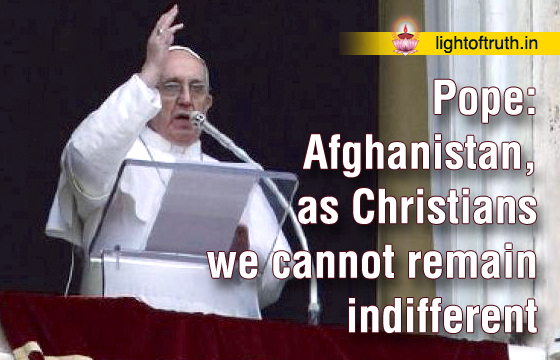
Pope: Afghanistan, as Christians we cannot remain indifferent
The Pope is calling for “intensified prayer and fasting” for Afghanistan, which he follows with “great concern”. “As Christians,” he said at the Angelus, “in historical moments like these we cannot remain indifferent.”
Francis expressed his sympathy “for those who mourn for the victims of the suicide attacks,” asking that “we continue to assist those in need and pray that dialogue and solidarity may lead to peaceful and fraternal coexistence,” and calling for help to be given especially to women and children.
Earlier, before the recitation of the Marian prayer, to some thousands of people present in St Peter’s Square, commenting on the passage of the Gospel in which Jesus says that “there is nothing outside man that, entering into him, can make him impure”, while it is “from within, from the heart” that evil things are born, Francis urged people to “learn to blame oneself” for evil.
“Often,” he said, “we think that evil comes above all from outside: from the behaviour of others, from those who think badly of us, from society. How often we blame others, society, the world, for everything that happens to us! It is always the fault of others, of people, of those who govern, of bad luck. It seems that problems always come from outside. And we spend our time laying blame; but this is a waste of time. You become angry, bitter, and keep God out of your heart. Like those people in the Gospel, who complain, are scandalised, polemical and do not welcome Jesus. One cannot – he warned – be truly religious in complaining: complaining poisons, brings anger, resentment and sadness that close the doors to God”.