

The international community fed by biased news tends to presume that all Muslim-majority nations ban any kind of celebrations, which is false.
Only a few among the 50 or so Muslim majority countries in the world, among them the Kingdom of Saudi Arabia, Somalia, Tajikistan, Brunei, Morocco and Afghanistan, disallow celebrations like Christmas.
Speaking for and from Pakistan, non-Muslim citizens are permitted to take a couple of days off for their festivals.
There are over 5 million Christians in Pakistan, though they make up a small proportion of its 162 million people.
We are lucky because Dec. 25 is a public holiday as it is the birthday of the nation’s founder, Muhammad Ali Jinnah, also referred to as Quaid-e-Azam or the Great Leader.
The student community gets a longer winter break with schools and colleges closing on Dec. 23-24 until Jan. 2-3.

Catholics caution Philippine govt against Chinese aid
Catholics in Bacolod Diocese in the Visayas region have cautioned the Philippine government against accepting China’s aid to help victims of Super Typhoon Rai.
Chinese ambassador Huang Xilian on December 22 offered US$1 million as cash aid and 4,725 tons of rice to the typhoon-hit Southeast Asian country.
Philippine President Rodrigo Duterte accepted the aid and thanked the Chinese government.
The San Lorenzo Ruiz group, comprising representatives from various parishes in the region, said the Philippine government must scrutinize if there were any “strings attached” before accepting Chinese aid.
“The country is in need of money because we are still recovering from the pandemic. Now a natural calamity has hit us. But this does not mean we should put our defenses down while accepting these big donations,” the group said in a Facebook post on Dec. 23.
They further said the Duterte government must exercise caution to avoid falling into a debt trap like fellow developing nation Bangladesh, whose 6.81 percent external debt is now Chinese money.
“Let us be careful because all this could lead us towards a debt trap. These donations may lead to debts later on. Everyone must look at this deal because the million dollars may be a donation but the succeeding millions, if any, would be in the form of debt,” the group added.
The Chinese ambassador said the cash was allocated by the Chinese government for relief and recovery efforts by the Philippine government in badly hit provinces such as the Surigao, Siargao and Dinagat islands in the Visayas region.
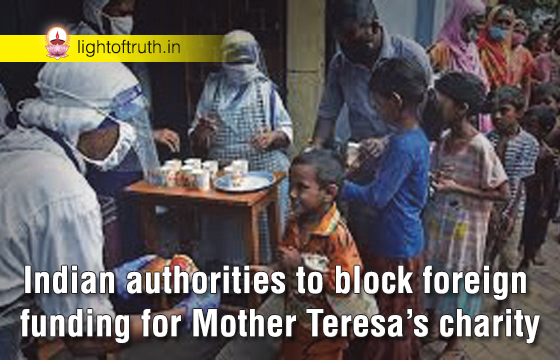
Indian authorities to block foreign funding for Mother Teresa’s charity
For decades, the Christian congregation founded by Mother Teresa in an Indian slum was seen by supporters as a symbol of selfless giving and a magnet for donations from around the world. But to India’s Hindu right wing, it was a target of their ire — and a hotbed, some alleged, for the conversion of desperate Hindus into Christians.
Now, the Missionaries of Charity — an organization that grew from a humble order of 12 sisters led by Mother Teresa into one of the world’s most recognizable Christian non-profits with branches from Venezuela to Washington, D.C. — is facing potentially crippling sanctions from the Indian government. The organization’s international donations will be effectively frozen on Saturday after India’s Home Ministry said Monday it will not renew the group’s license to receive funds from abroad because it found “adverse inputs.”
Story continues below advertisement
Although the ministry did not provide details about its reasoning or the case, the decision comes at a moment of rising Hindu nationalism in India — and mounting scrutiny of foreign non-profits and human rights organizations — under the administration of Prime Minister Narendra Modi and his Bharatiya Janata Party.
The funding ban threatens an operation of thousands of nuns who have depended for decades on the enduring legacy of Mother Teresa to raise money from around the world and use it to provide shelter, food and education for orphans, the homeless and the sick. Mother Teresa died in 1997 and was made a saint in 2016.
Leaders at the Missionaries of Charity declined to comment but issued a brief statement saying they have asked members to stop accessing accounts with foreign funds until the matter is “resolved.” A senior official from the Archdiocese of Calcutta, where the non-profit is based, condemned the government move as an attack on both the Christian community and on “the poorest of India’s poor” who depend on its services.

Vatican agency reveals number of missionaries murdered around the world during 2021
22 Catholic missionaries were killed around the world in 2021, half of them in Africa, according to a report released by the Fides News Agency and distributed Thursday by the Vatican press office.
Fides, the news agency of the Congregation for the Evangelization of Peoples, reported that of the 22 missionaries killed in 2021, 13 were priests, two were women religious, one was a male religious, and six were lay people. Half of the total were killed in Africa: seven priests, two religious sisters, and two lay people.
In its report, Fides explains that their annual list “has not only included missionaries ad gentes in the strict sense, but has tried to register all Catholic Christians engaged in some way in a pastoral activity who died violently, not expressly ‘in hatred of the faith’.” According to the report, seven missionaries were murdered in Latin America, three in Asia, and one in Europe.
“In recent years, Africa and Latin America have alternated in the first place of this tragic ranking. From 2000 to 2020, according to our data, 536 missionaries were killed world-wide,” says the report.
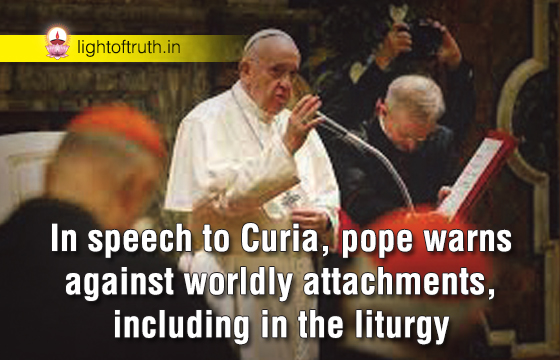
In speech to Curia, pope warns against worldly attachments, including in the liturgy
To close a year in which he put limits on the celebration of the Traditional Latin Mass, Pope Francis warned against the temptations of pride, spiritual worldliness, and attachment to superficial reassurances, including liturgical preferences.
In his Dec. 23 speech to members of the Roman Curia, the Pope centred on the biblical figure of Naaman the Syrian, who while being a powerful general in the Syrian army known for his courage and bravery, also had leprosy, which he hid beneath his armour.
In his search for a cure, Naaman, taking the advice of a slave girl, set out to find the Prophet Elisha for help.
Although he initially believed Elisha’s command to shed his armor and bathe in the Jordan River seven times to be too simple, he eventually obeyed and was healed, but only after humbling himself and letting go of his notions of power.
“The story of Naaman re-minds us that Christmas is the time when each of us needs to find the courage to take off our armor, discard the trappings of our roles, our social recognition and the glitter of this world,” and adopt an attitude of humility, the Pope said.
More Americans Left Religion During the Pandemic
Religious affiliation in the U.S. has continued to fall during the pandemic, according to a new survey from the Pew Research Centre. The percentage of Americans who identify as Christians now stands at 63%, down from 65% in 2019 and from 78% in 2007. Meanwhile, 29% of Americans now identify as having no religion, up from 26% in 2019 and 16% in 2007, when Pew began tracking religious identity. Many places of worship closed during the pandemic—some voluntarily, others as a result of state and local social-distancing rules—and in-person church attendance is roughly 30% to 50% lower than it was before the pandemic.

Abducting Christian girls for marriage is ‘genocidal’, pontifical charity says
Across the world, girls and young women from Christian families are forced into sexual slavery and religious conversion.
This is one of the most underreported examples of the persecution of Christians, usually in Muslim-majority countries with significant Christian popu-lations, such as Egypt and Paki-stan.
Aid to the Church in Need (ACN) documented first-hand accounts of kidnappings, forced marriages and forced conversions in its Hear Her Cries report, pre-sented in London on Nov. 24.
The pontifical charity was marking Red Wednesday, an annual event meant to draw atten-tion to the plight of persecuted Christians around the world.
The report noted that examining the topic of sexual violence and persecution of faith minorities is far from strai-ghtforward.
“While there is growing consensus about the need for research into the nature and scale of religious and sexual coercion of women, the challenges of setting about the task have been consistently highlighted in studies on the subject.”
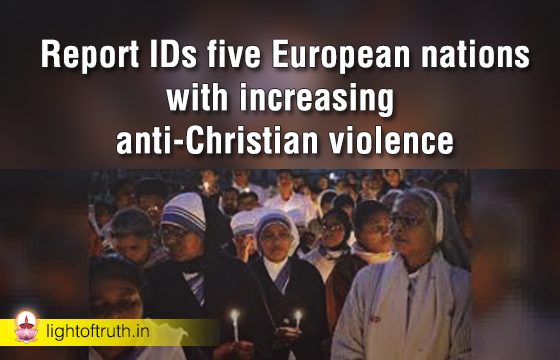
Report IDs five European nations with increasing anti-Christian violence
Catholics are facing soaring levels of discrimination in some of the most influential countries in Europe, a new report said.
The Vienna-based Observatory on Intolerance Against Christians in Europe identified the United Kingdom, France, Germany, Spain and Sweden as the five countries most affected by a “rising phenomenon” of harassment and violence toward Christians.
“These countries were selected because, according to our observations, Christians face the most difficulties in them,” said the Dec. 7 report, “Under Pressure: Human Rights of Christians in Europe.”
It said Christians increasingly endured both subtle and explicit discrimination as a result of secularist and Islamist ideologies taking hold in the local populations, producing an intolerance that is “becoming more visible.”
The report found that the phenomenon had resulted in a 70 percent increase in hate crimes against Christians in 2019 and 2020. “The negation of a public voice is mainly based on strong and sometimes even extreme opposition to Christian morals derived from core beliefs,” the report said.
“In some cases, it does not stop at negation, but goes even further toward a criminalization of public or even private opinions.”
The report, compiled over two years, concluded by inviting “international and civil-society organizations to contribute toward improving this situation by reporting and raising awareness about this phenomenon.”
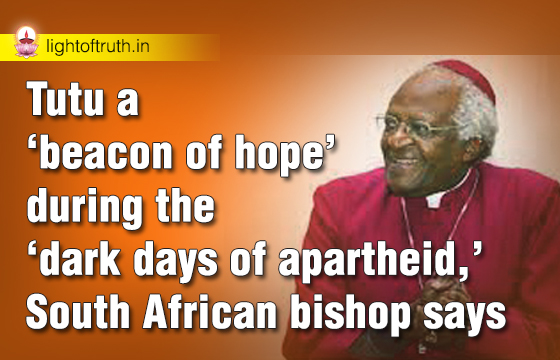
Tutu a ‘beacon of hope’ during the ‘dark days of apartheid,’ South African bishop says
Archbishop Desmond Tutu was “a beacon of hope during the bleak days of apartheid,” according to Bishop Victor Phalana of Klerksdorp and the liaison Bishop for justice and peace at the Southern African Catholic Bishops’ Conference.
The Anglican prelate died on Sunday at the age of 90. A representative of the Archbishop Desmond Tutu IP Trust said he died “peacefully” at a Cape Town nursing home.
“He spoke truth to power and criticized both the apartheid government and the ANC-led government when they started to tolerate corruption and when they took time to deal with the problem of poverty in our country,” Phalana told Crux.
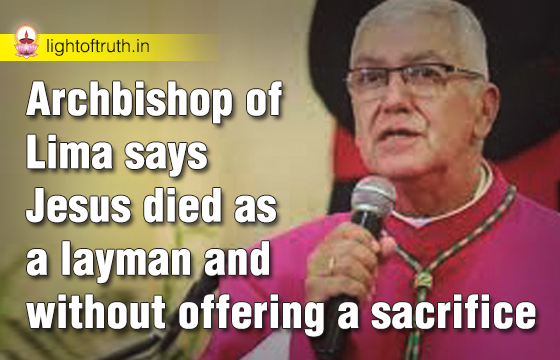
Archbishop of Lima says Jesus died as a layman and without offering a sacrifice
Archbishop Carlos Castillo Mattasoglio of Lima, Peru, has yet to clarify remarks he made in a pre-Christmas Mass that contradict the teaching of the Catholic Church about Jesus’ death. The Catechism of the Catholic Church affirms that Jesus is “the true priest” whose death is “a redemptive sacrifice.” Speaking on Dec. 19, however, Castillo stated that Jesus died as “a layman,” and did so without offering a “sacrifice.”
“And Jesus doesn’t die offering the sacrifice of a holocaust, Jesus dies as a murdered layman, to which He decides not to respond with vengeance and who accepts the cross to give us a sign of life,” the archbishop said during Mass in the Lima cathedral.
“And he dies as a layman who gives hope to humanity, he dies as a human being like all of you who are present here, we too, because we can’t be priests without first being baptized lay people,” he said.
Castillo said that “lay person comes from laos, which means people. And God wanted to sanctify his people, and if we are here, it is to serve them.”
The prelate recalled that God had promised Israel that from his people “a shoot would come forth that would be the Saviour.”