
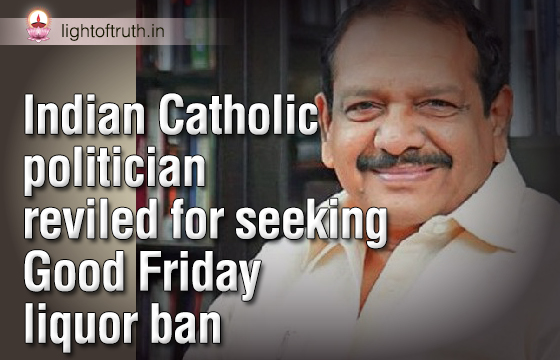
A Catholic politician’s demand that the state government in Tamil Nadu keep liquor shops closed on Good Friday has triggered a backlash on social media.
Peter Alphonse, the chairperson of Tamil Nadu Minorities Commission, wrote to Chief Minister M.K. Stalin on March 3 urging him to close all government liquor shops on April 15.
He said the liquor shops should be closed as a mark of respect and solidarity with the Christian community, which commemorates on Good Friday the passion and death of Jesus Christ with fasting and abstinence.
Alphonse made the letter public on social media on March 9, triggering an immediate backlash from netizens and politicians who described it variously as “unnecessary” and a “bad idea.”
Even the supporters of Indian National Congress, the party to which Alphonse belongs, slammed the idea as “crazy.”
Social media users called his demand for keeping liquor shops closed “arbitrary” and tantamount to “imposing unnecessary restrictions” on other communities who do not adhere to his religious beliefs. However, Alphonse found support from Savukku Shankar, a prominent political critic.
Shankar, who has more than 200,000 followers on Twitter, told that “the minorities in this country are pushed to such a situation as they continue to lose faith in the state and look towards religion for safety.”
“This is a failure of the state. Unless they are reassured they will further go into a shell. I understand them, so I have no grievance against Mr. Alphonse’s letter,” he added.
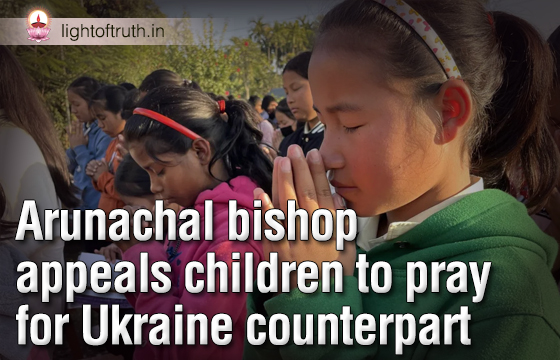
Arunachal bishop appeals children to pray for Ukraine counterpart
The Catholic Bishop of India’s remotest diocese has appealed children to pray for their counterparts in war-torn Ukraine.
Bishop George Pallipparambil of Miao made the appeal March 10 soon after Russian airstrikes hit a kindergarten in Dnipro city of Ukraine.
“I appeal to all our children in the diocese to pray the ‘Our Father, as many times as possible for the suffering children and families in Ukraine. Let us target 1 million. The Our Father has the greatest need of today,” the Salesian prelate said in a note addressed to all in the northeastern most corner of India.
He expressed deep sad- ness at the loss of lives of civilians, children and women amid “painful happenings in Ukraine.”
“What we are seeing and reading leaves us with a lump in our throat. Words fail us to express our pain and anguish. I suggest that we continue our prayer. “Give us this day, our daily bread and forgive us as we forgive,” the prelate’s note prayed.

Missionaries of Charity elects first Indian superior general
The Missionaries of Charity congregation has elected Sister M Joseph as its new superior general. The election took place March 12 at the congregation’s Mother House in Kolkata, eastern India.
Sister Joseph replaces Sr Mary Prema (Pierick), a German who led the congregation founded by Saint Mother Teresa of Kolkata, for the past 13 years.
Sister Joseph is currently the superior of the congregation’s Kerala region, according to sources in the Mother House. Further details about the new leader of the world renowned Catholic religious congregation are awaited. The elected councillors are Sr Christie (Japan) Sr Cecile (Poland), Sr Marie Juan (East India) Sr Patric (Ireland). Saint Mother Teresa’s immediate successor was Sister Nirmala Joshi of Nepalese origin, who led the congregation during 1997-2009. Sister Joshi had started the contemplative branch of the Missionaries of Charity and remained at its head until she was elected to succeed Mother Teresa as the superior general.
Indian nuns from Missionaries of Charity stay back in Ukraine
The two Missionaries of Charity (MC) nuns from India working in war-torn Ukraine have decided to stay back to serve the people amid the Russian army advancing to invade the country. Sisters Rosela Nuthangi and Ann Frida from India’s Mizoram, a Christian-dominated state in India’s northeast, have expressed their “decision to stay on in Ukraine, risking their lives to serve people fleeing the war and the injured,” said a note from regional Bishop’s council.
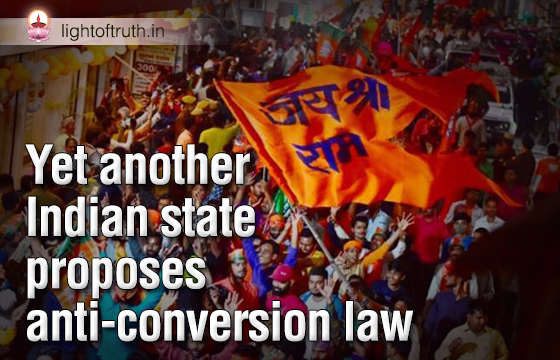
Yet another Indian state proposes anti-conversion law
The northern state of Haryana became the 11th Indian state to consider enacting a law against religious conversions amid protests by opposition members who called it “divisive politics.”
The pro-Hindu Bharatiya Janata Party (BJP) government introduced the Haryana Prevention of Unlawful Conversion of Religious Bill, 2022, in the legislative assembly on March 4.
Raghuvir Singh Kadian, a legislator from the opposition Congress party, tore its copy as a mark of protest and was suspended from the assembly.
If the bill is passed by the legislature, Haryana will follow in the footsteps of the BJP-ruled Karnataka in the south in adopting what is often referred to as the “freedom of religion” statute in the country.
Nine other states — Uttar Pradesh, Himachal Pradesh, Gujarat, Chhattisgarh, Odisha, Madhya Pradesh, Arunachal Pradesh, Uttarakhand and Jharkhand — have previously enacted their own anti-conversion laws, which have been challenged in courts at many places.
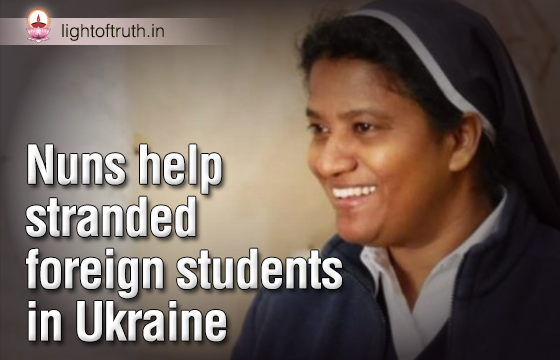
Nuns help stranded foreign students in Ukraine
An Indian Catholic nun and her associates are working round-the-clock to help stranded students and others fleeing war-torn Ukraine.
“God is using me to save people from death in Ukraine,” said Sister Ligi Payyappilly, the 48-year-old superior of the Sisters of St. Joseph of Saint-Marc in Ukraine.
Payyappilly, who is Indian, and 17 sisters of her congregation are giving shelter and food to the distressed students, besides helping them cross the Ukrainian border to escape to countries including Hungary, Ro-mania and Slovakia.
“Being in Ukraine for over 20 years, I have a lot of contacts and networks that helped me carry out this mission so far,” Payyappilly told GSR by phone after midnight March 3, just before her scheduled two-hour sleep. Her convent is in Mukachevo in western Ukraine, some 480 miles southwest of the national capital of Kiev.
People helped by Payyappilly’s team profusely thanked the nuns.
“We never thought we would be alive now,” said Vignesh Suresh, a third-year student of medicine who hails Payyappilly as “God’s angel who came to help us when we were totally lost.”
Speaking to GSR en route to Bucharest by train, Suresh said he and 45 other Indian students were stranded at the Polish border for 15 hours when Sisters Payyappilly and Christina Tymurzhina, a Ukrainian, came to help them.
“The sisters took us to their convent in their vehicles, hugged each of us with their love and warmth, gave us food, a warm hall to sleep in and escorted us in the morning to cross the Romania border,” Suresh said as his friends slept on the train.
JAMSHEDPUR JESUIT PROVINVCE’S – PLATINUM JUBILEE
On Saturday, 12th March, 2022, the Jamshedpur Province JESUIT family members gathered together to thank the Almighty God for the numerous blessings received by the Province and for guiding the Province over these seventy five years- 1947 to 2022. The concelebrating of the Holy Eucharist was led by His Excellency Most Reverend Felix Toppo, S.J, Archbishop of Ranchi. Archdiocese – Jamshedpur Province’s very own Jesuit, assisted by Rt. Rev. Telesphore Bilung, SVD, Bishop of Jamshedpur, Rev. Fr. Raphael Hyde, S.J. Provincial of Calcutta Province, Rev. Fr. Ajit Kumar Xess, S.J. Provincial of Ranchi Province and Rev. Fr. Jerome Cutinha, S.J, Provincial of Jamshedpur.
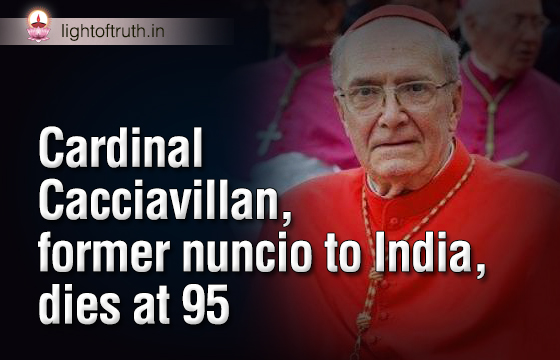
Cardinal Cacciavillan, former nuncio to India, dies at 95
Italian Cardinal Agostino Cacciavillan, a former papal nuncio to India who delicately handled the rivalry between the three rites in the country, died on March 5 at the age of 95. The long-time Vatican diplomat was also a nuncio to the United States and headed the Vatican investment office.
He served in Washington as nuncio to the United States and Vatican re-presentative to the Organization of American States from 1990 to 1998.
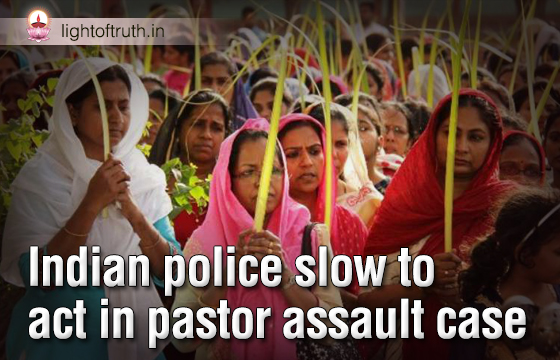
Indian police slow to act in pastor assault case
Police in India’s national capital New Delhi took four days to file an offense against unknown attackers of a tribal Christian pastor who was manhandled and forced to chant a slogan hailing Hindu gods.
Pastor Kelom Tete was attacked by a mob in South Delhi’s Fatehpuri Berri area on Feb. 25. He was accused of being involved in religious conversion activities and forced to chant “Jai Shri Ram” (Hail Lord Ram), according to the offense registered on March 3.
BIBLE QUIZ IN TELUGU RELEASED
“Ignorance of the Bible is ignorance of Christ!’ (Saint Jerome). The book BIBLE QUIZ (Telugu edition) is an extremely useful means in banishing this ignorance and imparting true knowledge of the entire Bible to our young generation in the twin States of Andhra Pradesh and Telengana.” said Most Rev. Thelagathotti Raja Rao, Bishop of Vijayawada and Chair-man of the Andhra-Telangana Bible.