
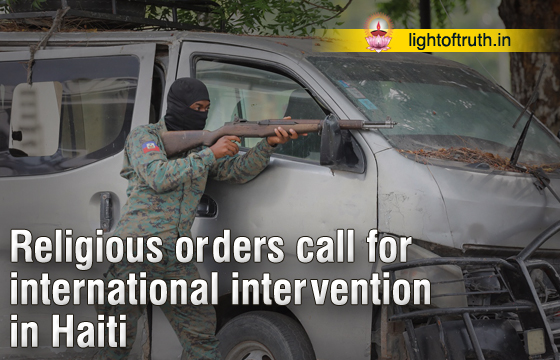
Religious orders working in Haiti have called on the inter-national community to directly intervene to address the reign of terror of armed gangs they described as “diabolical, frightening and unacceptable.”
The same gangs are responsible for nearly four kidnappings a day in 2022 and violence that killed more than 200 and forced 3,000 to flee their homes during July alone.
In an Aug. 4 open letter to Najat Maalla M’jid, U.N. special rapporteur on violence against children, the Justice Coalition of Religious — made up of 20 religious orders — urged the inter-national community “to respond swiftly and effectively to the atrocities occurring in Haiti.”
In a document of testimonies published by the coalition, Passionist Father Rick Frechette, a doctor in Port-au-Prince, said “99% of people on the street want a foreign military force to save them.” He described the situation on the streets of Port-au-Prince as “Somalia-type battles.”
The coalition letter noted that the “Haitian state has failed in its sovereign obligation to protect the population.” It diverged from a July 29 statement from the Haitian bishops’ conference, which said state authority must be restored and that the government must take immediate action to “disarm the gangs, to allow the police to tackle violent crime and create a climate of serenity and confidence.” The bishops’ message stopped short of calling for action from the international community.
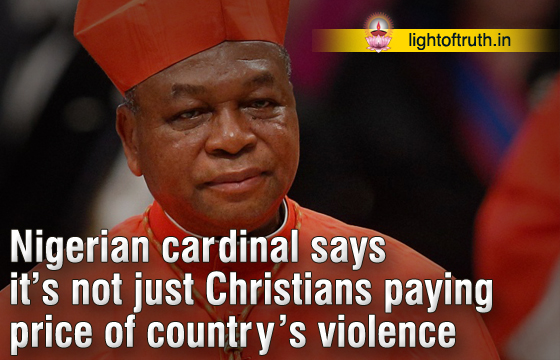
Nigerian cardinal says it’s not just Christians paying price of country’s violence
According to the former top Catholic official of Nigeria’s capital city, the violence in the country is “getting out of hand.” It’s not only Christians paying the price, he said. None of the country’s 200 million people are safe. “There is great insecurity throughout the country, people are being killed every day; bandits and terrorists seem to have a free hand,” said Cardinal John Onaiyekan, archbishop emeritus of Abuja. “We don’t know where the security forces are.”
“No one is safe, not just Christians. It is as if the government has lost control.” The country has presidential and parliamentary elections scheduled for February and March 2023.
According to the prelate, both Christians and Muslims are victims of violence, perpetrated by criminals who “go around illegally killing innocent people.”
Speaking on the occasion of the XIX Plenary Assembly of the Symposium of the Bishops’ Conference of Africa and Madagascar (SECAM), which ended on July 31 in Accra, Ghana, Onaiyekan said his country has been experiencing “indiscriminate” violence since the rise of Boko Haram in 2009.
The insurgency group is one of the largest Islamic terrorist organizations, and their stated goal is to turn Nigeria into an Islamic state, much like ISIS tried to do in Iraq.

Pope Francis on birth control: Can the teaching of the Church on contraception change?
Can the Church’s teaching on birth control change? During Pope Francis’ return flight from Canada, a journalist asked him about the possibility of a development in the Church’s teaching on contraception.
“This is very timely. But know that dog-ma, morality, is always in a path of development, but development in the same direct-ion,” Pope Francis responded on July 30.
The pope went on to say that he thinks that the development of Catholic moral doctrine, in general, is fine but recommended in particular that it follows the rules outlined by the 5th-century theologian St. Vincent of Lérins.
Pope Francis explained that St. Vincent of Lérins taught “that true doctrine in order to go forward, to develop, must not be quiet, it develops ut annis consolidetur, dilatetur tempore, sublimetur aetate.”
“That is, it consolidates with time, it expands and consolidates, and becomes more steady, but is always ‘progressing.’ That is why the duty of theologians is research, theological reflection. You cannot do theology with a ‘no’ in front of it … the magisterium will be the one to say no,” the pope added.
Francis also addressed the recent controversy over a book published by the Vatican’s publishing house, which discussed “the possible legitimacy of contraception in certain cases.”
The book “Theological Ethics of Life: Scripture, Tradition, and Practical Challenges” was a 528-page synthesis of a theological seminar sponsored by the Pontifical Academy for Life in 2021.
Pope Francis said: “On the issue of contraception, I know there is a publication out on this issue and other marriage issues.”
“These are the proceedings of a congress and in a congress there are hypotheses, then they discuss among themselves and make proposals. We have to be clear: those who made this congress did their duty because they tried to move forward in doctrine, but in an ecclesial sense, not out, as I said with that rule of St. Vincent of Lerins.”
On the subject of birth control, the Catechism of the Catholic Church states that “legitimate intentions on the part of the spouses do not justify recourse to morally unacceptable means (for example, direct sterilization or contraception).”
St. Paul VI issued Humanae Vitae, the landmark encyclical reaffirming Church teaching against contraception, on July 25, 1968.
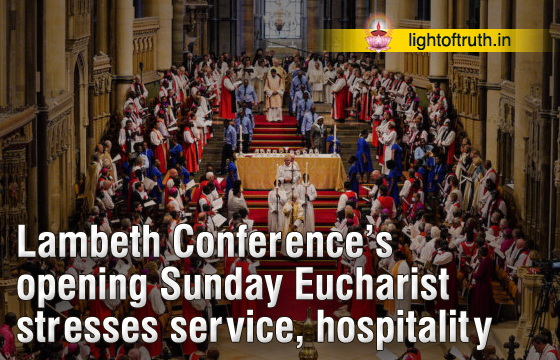
Lambeth Conference’s opening Sunday Eucharist stresses service, hospitality
Episcopal and Anglican bishops and their spouses filled Canterbury Cathedral on July 31 for the opening Sunday Eucharist of the Lambeth Conference.
The service spanned several hours and was marked by prayer and pageantry in a worship space with more than 1,400 years of history that was described in a welcoming message as “the heart of our communion.”
More than 600 bishops representing an estimated 165 countries are attending the July 26-Aug. 8 conference.
Archbishop of Canterbury Justin Welby, head of the Anglican Church, convened the Lambeth Conference of Anglican bishops. Standing just inside the cathedral door, Archbishop Welby offered an opening prayer, seeking unity among bishops in their shared faith despite individual differences.
“Let us pray earnestly for God’s blessing upon those who are gathered here,” the archbishop said, “that through our discussions and our walking together we may grow into a deeper understanding of one another and a deeper love for the world Jesus Christ came to save.”
The Lambeth Conference is a decennial assembly of bishops of the Anglican Communion convened by the Archbishop of Canterbury. The first such conference took place at Lambeth in 1867.
As the Anglican Communion is an international association of autonomous national and regional churches and is not a governing body, the Lambeth Conferences serve a collaborative and consultative function, expressing “the mind of the communion” on issues of the day.
Lambeth is a riverside area home to Lambeth Palace, the residence of the Arch-bishop of Canterbury.
This is the 15th Lambeth Conference and the first in 14 years, after past conferences typically were held once a decade. Welby initially postponed calling his first Lambeth Conference by two years due to theological divisions between some of the provinces, and his plans to hold the conference in 2020 were delayed by another two years because of the Covid-19 pandemic.
The last Lambeth Conference was in 2008.
The bishops displayed a broad spectrum of colour, nationality and dress, reflecting the diversity of the Anglican Communion’s 42 provinces – four more provinces than existed in 2008.

Cardinal Müller: ‘The German Synodal Way was over before it even started’
Cardinal Gerhard Ludwig Müller, prefect emeritus of the Congregation for the Doctrine of the Faith, has sharply criticized the Synodal Way in Germany.
In an interview, the 74-year-old cardinal said that the Synodal Way, declared a “reform process” by its initiators, is “over” and was on an “anti-Catholic, wrong track.”
The Holy See issued a statement June 21 noting that the Synodal Way was “not authorized” to “oblige the bishops and the faithful to adopt new forms of governance and new orientations of doctrine and morals.” It was “necessary” to clarify this in order to “safeguard the freedom of the people of God and the exercise of the episcopal ministry.”
The Synodal Presidium – consisting of the German Bishops’ Conference and the Central Committee of German Catholics (ZdK) – then accused the Vatican of a lack of willingness to communicate. It stated: “Unfortunately, the synodal presidium has not been invited to a conversation until today. That this direct communication does not take place so far, we regret irritated. Synodal church goes after our under-standing differently! This also applies to the way of today’s communication, which astonishes us. It does not testify to a good style of communication within the Church when statements are published that are not signed by name.”
It was the “birth defect of this body” to set itself up as a vanguard of the Church, he said.
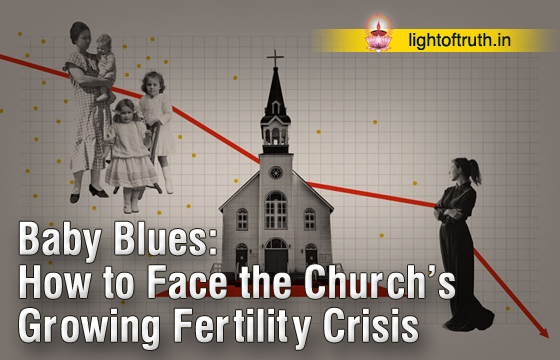
Baby Blues: How to Face the Church’s Growing Fertility Crisis
Data from the National Survey of Family Growth (NSFG) from 1982 to 2019, along with data from four waves of the Demographic Intelligence Family Survey (DIFS) from 2020 to 2022, point to a widening gap in fertility rates between more religious and less religious Americans.
In recent years, the fertility gap by religion has widened to unprecedented levels. But while this difference may comfort some of the faithful who hope higher fertility rates will ultimately yield stable membership in churches and synagogues, these hopes may be in vain. Rates of conversion into unfaith are too high, and fertility rates too low, to yield stable religious populations.
As a result, data from over 70,000 women surveyed from 1982 to as recently as 2019 can be used to estimate fertility rates for three broad groups of women: those without any religious affiliation, those with religious affiliation but less than weekly attendance, and those with at least weekly attendance.
It’s evident that birth rates among Americans who attend weekly have never dropped much below 2 children per woman, and as recently as 2008 were around 2.4 children each. Fertility among religious people did decline after the 2008 recession, but by 2017–2019, it was rising again.
Finally, fertility among non-religious women rose considerably from 1982 to 2005, then again from 2008 to 2012, showing a very different pattern than the one we see for religious women.
From 2010 to 2013, non-religious women had about the same birth rates as women who attended religious services less than weekly, before their fertility slumped through 2019.

Ordinary Indians pay price for Gandhian hypocrisy
Hypocrisy has been the name of the game when it comes to alcohol in India, particularly in Gujarat, the home state of Prime Minister Narendra Modi and the father of the Indian nation, Mahatma Gandhi.
Any number of human deaths will not stop politicians and even the state’s denizens from swearing by the Gandhian way of being teetotalers and continuing to keep Gujarat a dry state, where the law bans storing, selling and transporting alcohol. And yet, 42 people died and 50 others remain in hospital in critical condition after consuming spurious liquor in Gujarat earlier this week.
The terrible human tragedy reported in Botad district — a repeat of the 2009 hooch tragedy in Ahmedabad in which 159 people died in similar circumstances — has yet again brought into focus the debate on prohibition.
Gujarat, since its foundation in 1960, adopted the policy of being a dry state as a mark of respect and tribute to Mahatma Gandhi.
Gandhi’s idea was influenced by his Hindu morals and Islamic scriptures that described liquor as evil. He regarded alcohol as a social evil, capable of adversely impacting the lives of humans of all classes. “Let’s not fool ourselves. It is time to come out of denial mode and accept the fact that Gujarat is not as dry as it claims to be”
Despite more than six decades of policing, the state has failed to stop a thriving bootlegging industry. Time and again it has been proved that Gujarat’s prohibition policy has been a sham, a farcical exercise.
The tragedy in Botad prompted former chief minister Shankersinh Vaghela to question the futility of prohibiting liquor. Does banning alcohol really benefit people? No, said Vaghela who wants the prohibition policy to be reviewed as early as possible. He wants to relax restrictions and legalize sales and distribution to reduce illicit supplies.
Vaghela also suggested this could provide economic opportunities for the state’s tribal people for whom liquor is not taboo, unlike mainstream society. “Let’s not fool ourselves. It is time to come out of denial mode and accept the fact that Gujarat is not as dry as it claims to be,” he said.

Ranchi St Anne congregation completes 125 years
The first indigenous women religious congregation in eastern India has concluded its 125 years of founding through various programs at Ranchi, capital of the Jharkhand state.
Jesuit Archbishop Felix Toppo of Ranchi July 23 presided over the jubilee Mass at St. Mary’s Cathedral in Ranchi, capital of Jharkhand state.
He was assisted by Bishops Vincent Barwa of Simdega, Binay Kandulna of Khunti, Anand Jojo of Hazaribag, Julius Marandi of Dumka, Fulge-nce Aloysius Tigga, Antonis Bara of Ambikapur concelebrated along with Father Linus Pingal Ekka, apostolic administrator of Gumla.
The Mass was also attended by 75 priests from various parts of India and some 800 members of the congregation representing all four provinces and the delegations of Andaman and Europe.
In his homily Archbishop Toppo commended the vigor and zeal of the Daughters of St Anne in serving God’s people. The jubilee theme was “Celebrating God’s Graciousness: Committed to Renewed Mission.”
“Today is the apt time to raise our hearts and minds in praise of God for all his merciful acts that we have benefited for last 125 long years,” the prelate said.

Stella Maris chaplain receives major anti-trafficking hero award
A Stella Maris port chap-lain in Thailand has been recognized by the US Department of State for her dedicated and untiring work supporting trafficked seafarers and fishers.
Apinya Tajit, Stella Maris Deputy Director in Chanthaburi diocese received the US Department of State 2022 Trafficking in Persons Report Hero Award from Secretary of State Antony J Blinken at a ceremony in Washington DC on July 19.
She has helped hundreds of workers in the fishing sector from various countries, including Thailand, Indonesia, Cambodia, Burma and Bangladesh and has also played an active role in raising awareness of child trafficking, visiting schools throughout Thailand to educate more than 10,000 students each year.
Apinya has worked with global maritime network Stella Maris since 2005 and has for the past seven years dedicated her energies towards combatting human trafficking.
“This Award is completely unexpected to me, and I feel honoured to receive it. Stella Maris works closely with law enforcement agencies in Thailand to support trafficked fishers and seafarers. We assist by way of helping identify victims, rescuing them, helping them reintegrate into society,” she said.
We provide training, access to legal advice, and funding to help them rebuild their lives,”

Faith sustains Catholic mother amid hard times in Myanmar
Mary Song Thi May ‘is a special gift from God bringing His love to her people’ in Mai Yen Parish in Mai Son district.
For more than a decade now, Benedette Marang Ji Grawng has been living in a crowd-ed camp for displaced people in conflict-torn Myanmar.
With each passing day, simple life becomes even more difficult to endure with increasing challenges and hardships, but that hasn’t diminished her faith, says Ji Grawng, a Catholic mother.
“The more difficulties I face, the deeper and stronger my faith becomes. I believe in God who fulfils all our prayers,” says the slightly built 43-year-old Kachin mother of three.
In the midst of her busy daily schedule involving cleaning, cooking, sewing clothes and taking care of a three-year-old child, the devout Catholic finds time to share teachings from the Bible with her two teenage children, aged 16 and 18. “I also send my children to catechism and Bible classes,” Ji Grawng told. “My children are obedient and I am proud to be their mother.”
She lives with her three children and husband, Paul Magi Seng Awng, in a tiny 81 square foot (7.5 sq meter) room in the Catholic Church-run St. Paul Ja Maing Kaung camp for internally displaced persons (IDPs).