
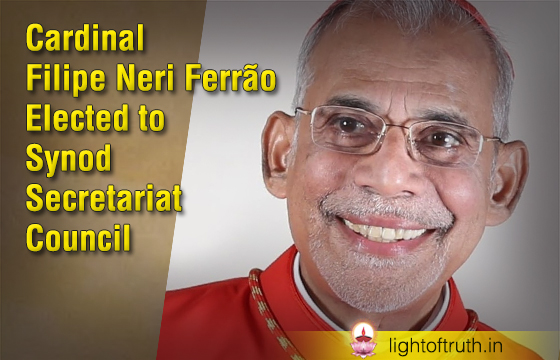
Cardinal Filipe Neri Ferrão, Pre-sident of the Conference of Catholic Bishops of India (CCBI) and the Fe-deration of Asian Bish-ops’ Conferences (FABC), has been elected as a member of the Ordinary Council of the General Secretariat of the Synod. The election took place on October 23, 2024, during the 15th General Congregation of the Synod of Bishops. The Ordinary Council of the General Secretariat is responsible for the preparation and implementation of the Ordinary General Assembly. The Members of the Ordinary Council take office at the end of the Ordinary General Assembly that elected them; they are Members of the next Ordinary General Assembly and cease from their mandate at the dissolution of the latter. The Council, chaired by the Holy Father Pope Francis, is an integral part of the General Secretariat.
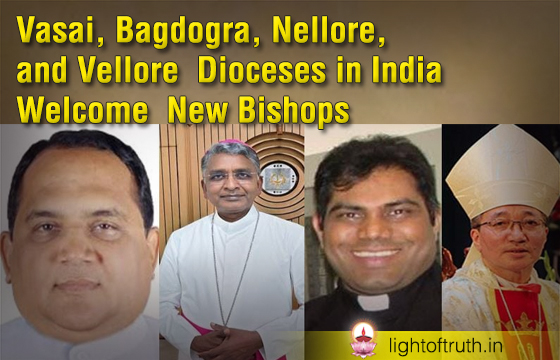
Vasai, Bagdogra, Nellore, and Vellore Dioceses in India Welcome New Bishops
The Holy Father Pope Francis has made new appointments to four Indian dioceses, naming Fr. Thomas D’Souza (54) as the Bishop of Vasai in Maha-rashtra, Fr. Ambrose Pitchaimuthu (58) as the Bishop of Vellore in Tamil Nadu, and Rev. Anthony Das Pilli (51) as the Coadjutor Bishop of Nellore in Andhra Pradesh. Additionally, he has transferred Bishop Paul Simick (61), previously the Apostolic Vicar of Nepal, to serve as the Bishop of Bagdogra. The appointments were announced on November 9, 2024.
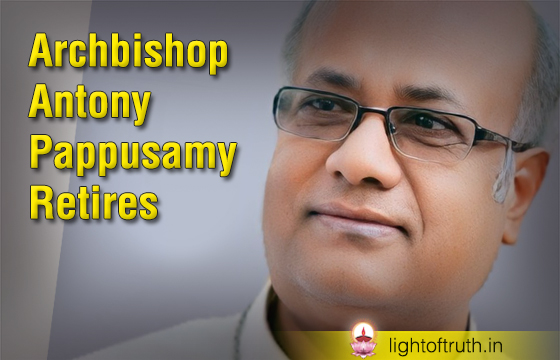
Archbishop Antony Pappusamy Retires
Pope Fran-cis has accepted the resignation of Archbishop Antony Pappu-samy, 75, from his duties as the shepherd of the Archdiocese of Madurai, appoi-nting Bishop Antonysamy Savari-muthu, 63, of Palayamkottai as the Apostolic Administrator. This transi-tion marks a new chapter for the Archdiocese, which Archbishop Pappusamy has led with dedication and pastoral care since 2014. Known for his humility, warmth, and deep-rooted faith, Archbishop Pappusamy has left an indelible mark on the lives of the faithful and his fellow clergy. His compassionate approach allowed him to connect personally with those he served, transcending titles and roles to form a spiritual family. His legacy, defined by empathy and devotion, will continue to inspire the Church well beyond his tenure.
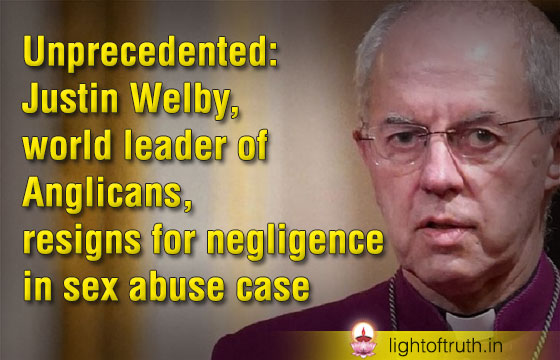
Unprecedented: Justin Welby, world leader of Anglicans, resigns for negligence in sex abuse case
A disturbing chapter in the Church of England’s recent history is back in the public eye, with fresh scrutiny falling on Archbishop Justin Welby following the release of a long-delayed report by investigator Keith Makin. The report highlights how John Smyth, a former Queen’s Counsel lawyer and influential figure within a Church-aligned evangelical movement, repeatedly abused more than 130 young boys and adolescents under the guise of Christian mentorship at Iwerne Trust camps, events attended by elite students from the UK’s top public schools.
Smyth’s abuse spanned years, concealed behind the closed doors of a soundproofed shed and veiled by a culture of secrecy. Despite initial warnings in 1984, he moved to Zimbabwe, where he continued his “camp” practices, leading to the tragic death of a young boy, Guide Nyachuru, in 1992. When Smyth faced renewed scrutiny and arrest in Zimbabwe, he fled to South Africa, where he lived unpunished until his death.
The Makin report’s release, over a decade in the making, revealed a web of delayed responses and inadequate resources from the Church of England, a fact that has deeply angered victims. “Justice delayed is justice denied,” victims expressed, grieving the years it took to acknowledge their suffering. They pointed directly to Welby’s office as the root cause of this delay, emphasizing that the Church’s hesitation only intensified their anguish.
In a particularly controversial twist, Archbishop Welby, who had once been co-nnected to the Iwerne Trust camp as a youth leader, is now implicated for alleged failures to act despite having received a briefing on the extent of Smyth’s abuses in 2013. His response to these revelations has been seen as inadequate by both victims and clergy alike. In interviews, Welby acknowledged “incompetence” but denied any deliberate cover-up, a sentiment that has left many victims unsatisfied.

Muslim Kingdom of Bahrain to sponsor digitization of Arabic documents from Vatican Library
In conjunction with the inter-national meeting of representa-tives from some of the world’s leading libraries, Conservata et Perlecta Aliis Tradere. Libraries In Dialogue, organized by the Vatican Apostolic Library, 14-16 Nov 2024, the Vatican Apostolic Library will sign a Memorandum of Understanding with the Kingdom of Bahrain on 15 Nov 2024 at the Vatican Apostolic Library. The agreement, which refers to the Document on Human Fraternity (4 Feb 2019), the encyclical Fratelli tutti (3 Oct 2020), and the visit of His Holiness Pope Francis to Bahrain (3-6 Nov 2022), aims to strengthen the relations between the Vatican and the Kingdom of Bahrain, with the goal of establishing and fostering a mutually beneficial cultural and scientific collaboration. On behalf of His Majesty King Hamad bin Isa Al Khalifa, Dr. Majed bin Ali Alnoaimi, Bahrain’s Minister of Public Affairs, will sign the cooperation agreement with H.E. Mons. Angelo Vincenzo Zani, Archivist and Librarian of the Holy Roman Church.
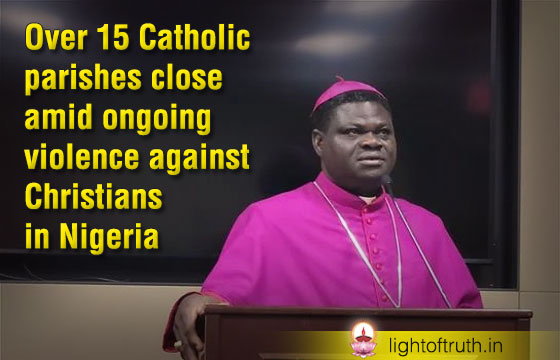
Over 15 Catholic parishes close amid ongoing violence against Christians in Nigeria
Bishop Wilfred Chikpa Anag-be of the Diocese of Makurdi in Nigeria has called for action to address escalating insecurity in Nigeria’s Benue State, which has led to the closure of over 15 parishes in his diocese.
In an interview with ACI Africa, CNA’s news partner in Africa, during the seventh Inter-national Theological Conference organized by the Institute of Consecrated Life in Africa, Anagbe urged the Nigerian government to prioritize security to restore hope and enable dis-placed persons to return to their ancestral homes. “Benue state is like the epicentre of what is ha-ppening. In my Diocese of Ma-kurdi, I have lost about 14 to 15 parishes now,” the bishop said. “When I mean parishes, some parishes have about 20 ‘outsta-tions,’ some have about 15. It covers almost 20-25 kilometres. So, the demography of the state and the diocese is shrinking.”
Anagbe clarified that the closure of parishes owing to inse-curity is also being witnessed in the Otukpo Diocese as well as in the Katsina-Ala Diocese. Both are located in embattled areas of Nigeria. The bishop expressed concern about the constant re-ports of killings and kidnappings in the country, emphasizing the role of the Nigerian government to protect lives and property.
“Every day we must hear about killings and kidnappings. And it is not for the people to defend themselves because the protection of lives and properties is in the hands of the govern-ment,” the Catholic leader explained. He said authorities in Nigeria should “do the needful thing,” adding: “We have been plunged into untold hardship. It is not just Makurdi but the whole of this country. As you travel from any part of this country … until you arrive, you are not safe.”
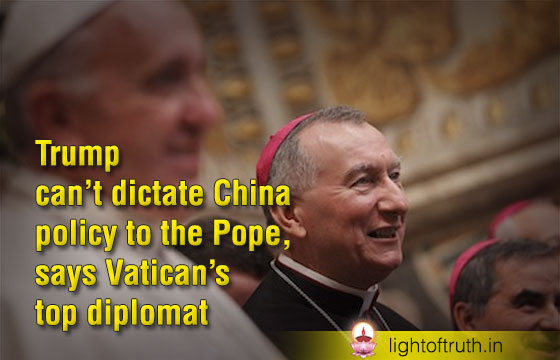
Trump can’t dictate China policy to the Pope, says Vatican’s top diplomat
The Vatican’s top diplomat has said that a controversial deal with China on the appointment of bishops will continue “regard-less of reactions that may come from America” during the new Trump administration.
Italian Cardinal Pietro Paro-lin, the Vatican’s Secretary of State, spoke to reporters on the sidelines of an event at Rome’s Jesuit-run Gregorian University on artificial intelligence and international humanitarian law.
Asked about tensions that arose between the White House and the Vatican over China du-ring the previous Trump admi-nistration, which included then-Secretary of State Mike Pompeo warning that the Vatican risked “losing its moral authority” for its approach to Beijing, Cardinal Parolin indicated there would be no change of course.
“We’ve gone forward with China regardless,” Cardinal Pa-rolin said. “We renewed the accord for another four years,” he said, referring to the most recent renewal in October. “The dialogue [with China] continues, in small steps but it continues,” he said. “I confirm this approach, regardless of reactions that may come from America.”
Veteran Italian political analyst Massimo Franco called Cardinal Parolin’s comments “a preventive move in view of an attack the [Trump] administration against the strategy of détente between Pope Francis and the regime of Xi Jinping”. In a piece for Corriere della Sera, Italy’s newspaper of record, Franco suggested that Pope Francis and his allies may be concerned with the support for Trump and his hard line on China among con-servative Catholics in America and elsewhere.
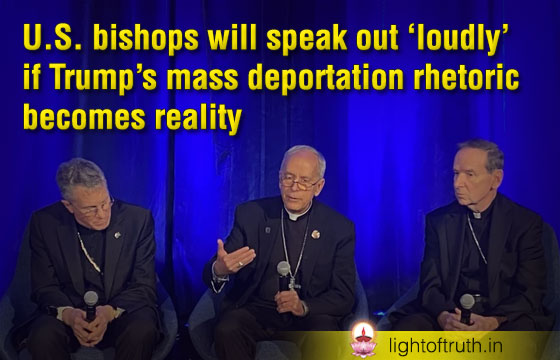
U.S. bishops will speak out ‘loudly’ if Trump’s mass deportation rhetoric becomes reality
The U.S. bishops are taking a wait-and-see approach to what President-elect Donald Trump does with his campaign promise to carry out mass deportation of immigrants who are in the country illegally. But the bishops say they are prepared to speak out forcefully if Trump does advance the controversial proposal in a way that undermines human dignity.
That was the message delivered by leadership of the United States Conference of Catholic Bishops (USCCB) on the first public day of their fall assembly, held in Baltimore on Nov. 12, one week after Election Day. ”We are waiting to see just what exactly takes shape,” said Bishop Mark Seitz, head of the USCCB migration committee, who spoke to members of the media alongside USCCB president Archbishop Timothy Broglio and Bishop Michael Burbidge, chairman of the USCCB’s pro-life committee. If the Trump administration moves forward in a way that violates basic human rights, Seitz said the bishops are prepared to “raise our voice loudly.”
Seitz, the bishop of the Diocese of El Paso, has pushed back against the Texas state government’s attempt to restrict Catholic ministry to migrants in his diocese. He said that the bishops were “concerned” about Trump’s immigration rhetoric on the campaign trail but that they “don’t want to get ahead” of the administration before it announces its concrete plans.
“We know that very often the reality is different from the rhetoric,” he said. “We’ll watch and respond as needed.”
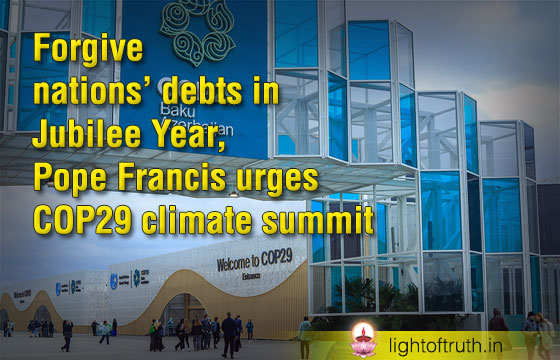
Forgive nations’ debts in Jubilee Year, Pope Francis urges COP29 climate summit
With financing the major focus at the United Nations climate change conference, Cardinal Pietro Parolin delivered directly to world leaders Pope Francis’ appeal that weal-thy nations use the upcoming 2025 Jubilee Year to forgive debts “as a matter of justice.”
Parolin, Vatican secretary of state, made the comments on behalf of the pope Nov. 13 during the second and final day of the World Leaders Climate Action Summit at the COP29 climate conference. Head of the nine-person Holy See delegation, Parolin emphasized that increasing financial assistance for developing nations to combat the effects of climate change is a crucial priority for the pope.
A central focus at COP29 is establishing a new target for climate financing from deve-loped nations to developing ones to replace the $100 billion annual goal set 15 years ago and reached in 2022. As much as $500 billion to $1 trillion annually could be required to fully fund climate actions at scale, according to a review by the World Resources Institute. Developing nations alongside climate activists have called for financing to come in the form of grants, rather than loans that further deepen debts.
“Efforts should be made, in particular, to find solutions that do not further undermine the development and adaptive capacity of many countries that are already burdened with crippling economic debt,” Parolin said. “Indeed, ecological debt and foreign debt are two sides of the same coin, mortgaging the future.”
Parolin then repeated a request Francis made in May ahead of the Catholic Church’s 2025 Jubilee Year “directed to the more affluent nations …that they acknowledge the gravity of so many of their past decisions and determine to forgive the debts of countries that will never be able to repay them. More than a question of generosity, this is a matter of justice.”
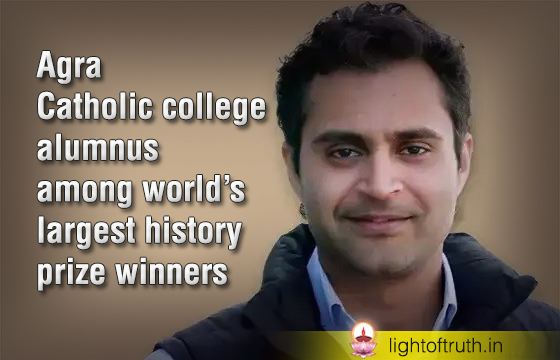
Agra Catholic college alumnus among world’s largest history prize winners
A former student of Agra’s St Peter’s College has brought glory to the Catholic institution by wi-nning the world’s largest history prize this year. Tripurdaman Singh is among nine research scholars to win the Dan David Prize that celebrates the next gener-ation of outstanding historians, archaeologists, curators and digital humanists. The prize money of US$300,000 each is given to support their research. Father Mathew Kumblummottil, who was Singh’s principal, said he joined St Peter’s College in the ninth grade and passed the twelfth grade with Commerce, before moving to the United Kingdom for further studies. The college is managed by the archdiocese of Agra. “As a student, he was a very soft-spoken person but very talented, particularly in debating and creative writing,” recalled the 66-year-old priest, who is now the parish priest of St Peter’s Church, Bharatpur, Rajasthan. Father Kumblummottil said he has “only very happy memories of him. He makes it a point to contact me whenever he is in Agra.”
The priest told that Singh was born in 1988 in the royal family of Bhadawar near Agra.