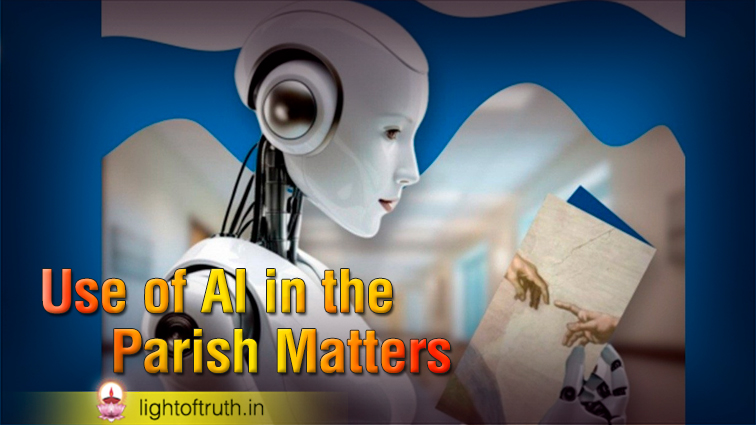
In the last Issue of Light of Truth (April 16-30) there was an article on social media. When I read that article the following question aroused in me; what is the position of the Church in the use of AI in the parish matters; especially in the liturgy and sacraments? What is the position of the official Catholic Church?
The pontifical Theological commission with the approval of Pope Leo XIV recently issued a document on technological development by name ‘Quo vadis humanitas’ that means ‘where does the humanity heading towards’. This document is a critical evaluation, clarification and directions given by the official Church for the Christian community and for the world in general. Church says that the technological development should not forget the integrity and dignity of the human being because everything is centred upon humanity. It says simply on the watchfulness needed for the processes of development of any sort, however the Church is clear about the limits of AI in relation with interiority and spiritual matters.
The document warns that ‘spiritual seekers often place indiscriminate trust in online search engines, rendering human mediations of the sacred, replaced by digital technology “including requests for virtual blessings, exorcisms, and ‘digital spiritualism’”. Trends claiming to save humanity through technology ultimately impact ‘the relationship with the Mystery – of the origin and ultimate purpose of human life,’
“When human beings reduce created nature (person, cosmos) to matter to be transformed, they no longer manifest the glory of the Creator, but replace Him. In this context, one must understand that religious and spiritual traditions still have something essential and indispensable to contribute regarding the wisdom of living in relationship to God. Thus the document Quo vadis humanitas stresses that if the technological development forgets the reality of human nature (Physical and Metaphysical) all developments are in futile. The dignity of Human nature depends on the emotional and spiritual nature leading to compassion, love, forgiveness and relationships. Technology may not be able to supply these aspects. It can sometimes facilitate.
The Dicastery for the Doctrine of Faith and the Dicastery for Culture and Education together has published a document with the approval of Pope Francis on 28th January 2025 by name ‘Antiqua et Nova: note on Relationship between Artificial Intelligence and human Intelligence’. In this document one could find a detailed discussion on Artificial intelligence in relation to human intelligence. There the concluding remark is very important for our discussion. While speaking on the difference between AI and the intelligence that formed, it is said: “…In contrast, human beings, “by their interior life, transcend the entire material universe; they experience this deep interiority when they enter into their own heart, where God, who probes the heart, awaits them, and where they decide their own destiny in the sight of God”… “It is within the heart, as Pope Francis reminds, that each individual discovers the “mysterious connection between self-knowledge and openness to others, between the encounter with one’s personal uniqueness and the willingness to give oneself to others. Therefore, it is the heart alone that is “capable of setting our other powers and passions, and our entire person, in a stance of reverence and loving obedience”… (AN.n.107, cf. Dilexit Nos n. 18). Here the prominence of interiority and the symbolic understanding of heart are highlighted.
Actually one has to start from the above mentioned arguments to find out an answer to the question. The spiritual life, prayer and worship, meaningful religious rituals all these are first of all related to human beings and secondly to the interior life of human person. So AI is not a substitute for human intelligence or interiority but it is only an aid invented by man for his self-realization designed by God.
AI offers apparatuses for generating prayers, composing music, designing visuals, and enabling real-time polyglot translations. While enhancing efficiency and accessibility, AI in liturgy raises questions about authenticity, requiring a balance between innovations and preserving spiritual depth. Key uses include drafting liturgy, creating art, and assisting pastoral ministry. AI tools like Chat GPT can generate prayers to worship and litanies, liturgy Text generation, Multimedia and Music (AI composes new music, provides instrumentation for worship bands) and creates visuals for bulletins or projected displays. Some AI tools allow for real-time translation during services, enhancing inclusion for diverse language congregations; AI is used to formulate brainstorm sermon ideas, outline theological arguments, or generate study questions based on scripture.
One of the discussions arising is only this: whether AI can truly ‘worship’ or lead worship, as it lacks human emotion, relational qualities, and a body. The Church views AI as a tool rather than a replacement for human ministry and pastoral care. In general, the Church says that in the use of AI in liturgy and sacraments we need discernment. This discerning proses is to avoid over-automation and ensuring that AI-generated content is reviewed for theological soundness. The overarching goal is often to use AI to enhance, rather than replace, the spiritual depth of traditional worship.