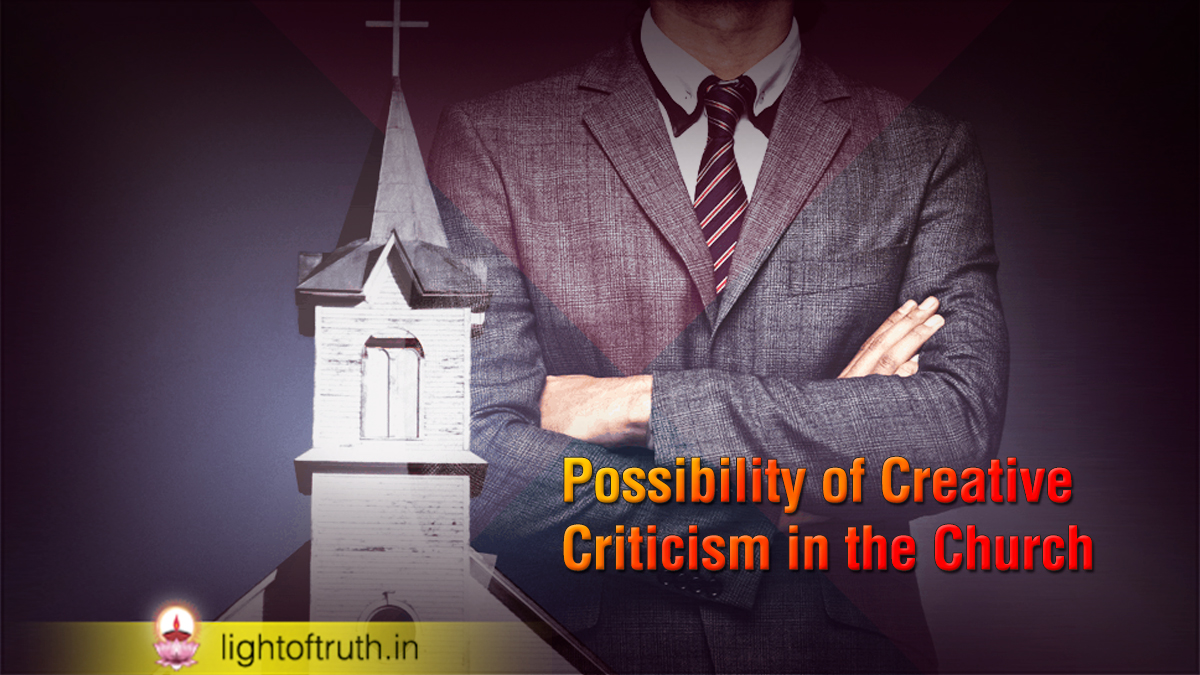
In the May 1-15 Light of Truth the article ‘A call to introspection….’ there is a sentence ‘the Augustinian theologian Martin Luther when rebelled… his intention was not to break away from the Church but to invite dialogue, reflection and reform’ by this are we justifying Martin Luther and his activity? Is it possible to have creative criticism on Church matters?
This question is valid and good and in a way contextual also. In the above mentioned article itself it is said that the arguments put forward by Martin Luther was the mind of a vast majority of genuine faithful in the Catholic Church. So what happened was it was taken up by those people and it became a powerful movement. In the article it is written not as a justification, however it is a reality and a warning to all those who hold authority and power in the Church. Listening all, understanding the working of the Holy Spirit in any one member of the Church and discerning what is what is necessary. Martin Luther who was an Augustinian Monk and ordained priest found a contradiction in his study of the Bible and some of the actions of Rome. So he genuinely and intellectually wished to enter in to dialogue and discussion. But that ended in the formation of a faction in the Catholic Church.
A nonbiased historical evaluation of Martin Luther’s activity and its repercussions is of course a scar in the face of the Catholic Church but is also a remarkable lesion for the Church and its governance. The opening up of the windows and doors of the Church with the Second Vatican Council and the openness to listen and share the concepts and ideas with all, the transparency found in the teachings of the popes after second Vatican Council are the resonance of the thunderstorm that took place in the 16th century.
Recent popes Pope Paul VI, John Paul II, Pope Benedict XVI, Pope Francis and leading to Pope Leo XIV following the Vatican II paved the way for dialogue, co-responsibility and collaboration in the Church. They, especially Pope John Paul II and Pope Francis following the path of Gaudium et spes (Church in the Modern World) accepted to bear with all critical evaluations. ‘Chirsti fidelis laichi, Catechesi tredenti, Laudato si, Christus vivit, Amoris latizie, Fratelli tutti, Evangelii gaudium etc. seminated the seeds of a participatory and co-responsible Church.
There is a false belief that in the Church clerics have an upper hand in every decision making. It is true that the clergy has got power and authority according to the ordination in their pertaining areas. This does not mean that they have the sole authority of everything in the community. Every member of the Catholic community has got the right to speak and express his/her opinion. Though the Church is not democratic it is participatory. It is not only a collaboration but principally it is co-responsible. Pope Francis during the inauguration of the Synod on Synodality admonished the prelates as follows: Empty words, worldly words, and – to descend a bit to a certain human habit, but not a good one -gossiping. Gossiping is the “anti-Holy Spirit”; it goes against him. It is a very common disease among us. And empty words sadden the Holy Spirit. “Do not sadden the Holy Spirit of God, in whom you were sealed” (cf. Eph 4:30). What great evil it is to sadden God’s Holy Spirit. Do we even need to say this? Gossip, backbiting: this saddens the Holy Spirit. It is the most common disease in the Church: gossiping. And if we don’t let him heal us of this disease, it will be hard for this synodal journey to be a good one”. Pope continues to say on criticism that: “At least in here, if you don’t agree with what that bishop, or that sister, or that layperson says, tell them to their face. That’s what a synod is for. To tell the truth, not for talking behind people’s backs”.
Church is not afraid of varied voices. Church welcomes it; because it is the gathering of ‘the people of God’ driven by the inspirations of the Holy Spirit. Pope Francis says: And in our theology, make room for the Holy Spirit… discern the voices of the Spirit from those that are not of the Spirit, but worldly. In my opinion, the foulest disease that we see in the Church today – it has always been there, not just today – is what goes against the Spirit: the spirit of worldliness. It is a spirit, but not one that is holy: the spirit of worldliness. Pay heed to this: let us not yield the place of the Holy Spirit to worldly things – even good things, like common sense; that is helpful, but the Spirit goes beyond that. We must learn to live in our Church with the Holy Spirit”. Pope through these words reiterates that our discussions, arguments and even criticisms shall not be against the will of the Spirit. In other words it must not be out of self-interests.
So the Church is not against difference of opinions, not against creative evaluations, suggestions and critical notes provided it shall to be with self-interest, it shall be with the prompting of the Spirit and with a listening mind.