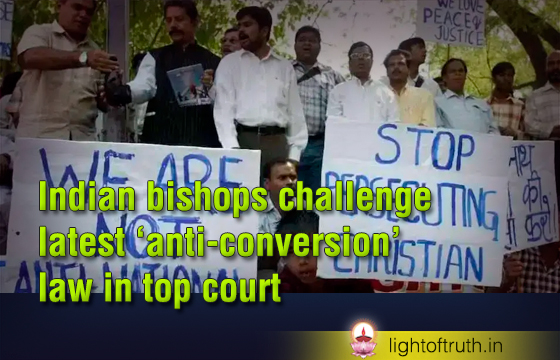
India’s Supreme Court has admitted a petition filed by the Catholic Bishops’ Conference of India (CBCI) challenging the constitutional validity of Rajasthan’s newly enacted anti-conversion law, considered one of the harshest in the country. “We are happy that the Supreme Court has accepted our petition,” said Sister Sayujya Bindhu, secretary of the CBCI legal cell. Rajasthan became the 12th Indian state to pass such a law when the assembly approved the Rajasthan Prohibition of Unlawful Conversion of Religion Act, 2025, on Sept. 9.
The law imposes penalties of up to 20 years in prison and fines of one million rupees for alleged conversions involving minors, women, persons with disabilities, and members of Scheduled Castes and Tribes. Mass conversions, if deemed illegal, can attract life imprisonment and fines of 2.5 million rupees, with repeat offenders facing even higher penalties. It also provides for up to 14 years in jail for using marriage as a means of conversion.
Bindhu, a lawyer, said the law violates constitutional guarantees that protect an individual’s right to profess, practice, and propagate their faith. She warned that vague terms such as “allurement” and “coercion” could be exploited to target Christians and their institutions, noting that even providing education or medical care might be misinterpreted as inducement.
A bench of Justices Dipankar Datta and Augustine George Masih admitted the petition on Dec. 8 and directed the Rajasthan government to submit its response. The case has been tagged with similar petitions challenging the law.
CBCI spokesperson Robinson Rodrigues said the legislation undermines religious freedom and has become a tool for filing false allegations of conversion. The Supreme Court is already hearing challenges to similar laws in Uttar Pradesh, Madhya Pradesh, Gujarat, Chhattisgarh, Karnataka, and other states. Enforcement of these laws has triggered numerous complaints against Christians and Muslims.