Pakistan reopens churches after outcry

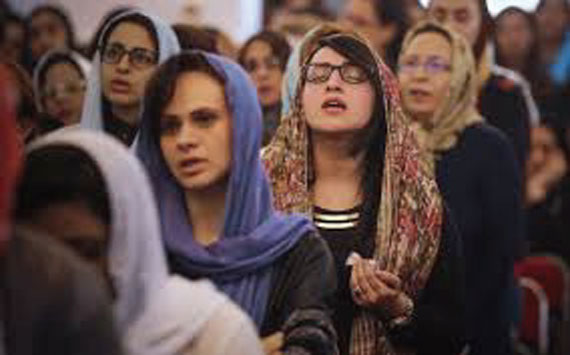
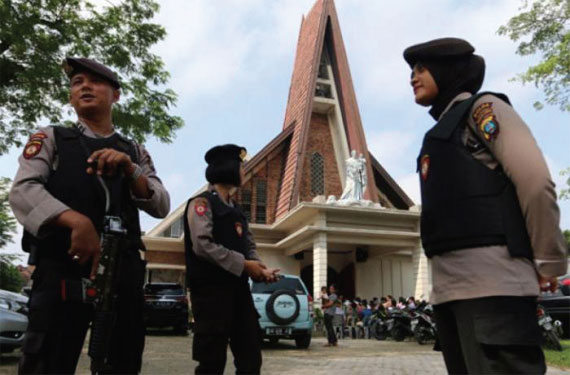
Pakistan’s north-western Khyber Pakhtunkhwa province has allowed six Christian churches to reopen, some two weeks after their forced closure over alleged security threats, minority representatives said. The home-based churches are in Abbottabad, the city where Al Qaeda chief Osama bin Laden was found and killed in a raid by U.S. Navy Seal commandos in 2011.

The surprise ban, which came shortly after the U.S. placed Pakistan on a special watch list for severe violation of religious freedom, angered minority leaders and rights activists who called the move discriminatory.

The ban was overturned by Khyber Pakhtunkhwa Speaker Asad Qaiser when the matter was taken up by opposition law-makers in the provincial assembly.

“All churches have got verbal permission to reopen and worship according to their religious faith and beliefs. We are expecting to get a written order soon,” Pastor Christopher Shakar said in a statement.

“We are grateful to everyone for being with us when we were facing difficulties to worship our Lord. God has proven once again He is always with us.”

According to the pastor, Sunday Mass was also held at the churches.

Basharat Khokhar, a minority rights activist, had condemned the Khyber Pakhtunkhwa government for its prejudicial behaviour toward religious minorities.

“On one hand, the government wants to pay billions of rupees to Muslim clerics, while on the other hand it is shutting down Christian worship places,” Khokhar said.

On Jan. 18, Khyber Pakhtunkhwa Chief Minister Pervez Khattak approved a plan to provide a monthly stipend of 10,000 rupees (US$100) to thousands of Muslim prayer leaders in a scheme that will cost 3 billion rupees.

Kachin bishops meet Myanmar military chief

Four Kachin bishops have met Myanmar’s military chief Min Aung Hlaing to talk prospects for peace in the country’s north, where fighting between the military and armed ethnic groups has intensified. Retired Abp Paul Zinghtung Grawng of Mandalay and Bishops Philip Lasap Za Hawng of Lashio, Francis Daw Tang of Myitkyina and Raymond Sumlut Gam of Banmaw attended a meeting at Bayintnaung Parlor in Naypyidaw on Jan. 16.

For one hour and 45 minutes, the bishops and Min Aung Hlaing discussed the situation in Kachin and Shan states, where intense fighting has erupted in recent months between ethnic armed groups and Myanmar’s military.

Since late last year, the military has conducted an offensive using airstrikes and heavy artillery, resulting in thousands of internally displaced persons fleeing their camps.

“We conveyed the message on the Catholic Church’s stance of getting a durable peace through dialogue instead of arms, and the church stands ready to take part in nation building in collabora-tion with all stakeholders,” he told ucanews.com.

Bishop Gam said the military chief reaffirmed its commitment to ending civil wars in Myanmar while opening the door to all armed ethnic groups to negotiate.

Since the situation deteriora-ted in 2011, more than 100,000 people have been displaced. Most of the state’s 1.7 million Kachins are Christians, including 116,000 Catholics.

Pakistan religious minorities face discrimination at work

Parmala Ravi Shankar quit working for a multinational company in Pakistan after four days when a manager asked her not to use the same eating utensils as Muslim colleagues. She was told to instead bring her own from home.

“I was wondering what is going on — am I not a human being?” Shankar recalls.

What happened to her is by no means unique.

Other well-known cases include that of a woman who was sentenced to death for blasphemy after an argument over her drinking water from the same glass used by Muslims.

The Human Rights Commi-ssion of Pakistan, in collaboration with organizations such as the Catholic Bishops’ Conference, has conducted case studies in Karachi and Hyderabad of Sindh province.

Moazzam Ali, a project coordinator, said a primary aim was to highlight impacts on people’s lives. A survey posed 22 questions related to consti-tutional guarantees such as the outlawing of discriminatory employment practices.

Father Saleh Diego, director of the National Commission for Justice and Peace (NCJP) of the Catholic Bishops’ Conference, said some people had a discri-minatory mindset.

Franciscan sister dedicated to orphans in Medan

Sister Bernadette Saragih is a Franciscan nun. She works at the St Angela orphanage in Medan, North Sumatra province, where she helps girls and young women on their path towards independ-ence, responsibility and integra-tion. For years, she was involved in rescuing young women from human trafficking on Batam Island (Riau province); now she has dedicated her new apostolate to what she likes to call “a house of success.”

At St Angela, residents are trained to hone their skills, acquire qualifications, and obtain an education.

Her latest initiative earned the Franciscan nun wide public acce-ptance thanks to the assistance and contribution of a number of prominent local Catholics.

On 5 and 6 January, Sister Bernadette and the young women from the St Angela theatre lab presented a piece titled ‘Prodigal Son,’ inspired by the relative Gospel parable.

The project, directed by Venantius Vladimir Ivan and produced by Cassandra Putri Prayitno, included scores of young people from Jakarta, including members of the Katak Theatre and E for D theatre groups.

Bangladesh agrees with Myanmar to complete Rohingya return in two years

Bangladesh and Myanmar agreed to complete within two years the return of hundreds of thousands of Rohingya Muslims who fled an army crackdown last year in Myanmar. United Nations Secretary-General Antonio Guterres and the U.N. Refugee Agency (UNHCR), responding to the plan, said they were concerned about forcibly repatriating over 650,000 Rohingya who fled to neighbouring Bangladesh after a conflict erupted in western Rakhine State in August. Statements from the Myanmar and Bangladesh foreign ministries said Bangladesh would set up five transit camps on its side of the border. Those camps would send Rohingyas to two reception centres in Myanmar. The repatriation process would start shortly, the statements said. Myanmar said it would build a transit camp that can house 30,000 returnees. The Bangladesh statement said: “Myanmar has reiterated its commitment to stop (the) outflow of Myanmar residents to Bangladesh.” Guterres said the UNHCR had not been involved directly in the agreement. “It will be very important to have UNHCR fully involved in the operation to guarantee that the operations abide by international standards,” he said.

Filipino priest turns church into dance floor

A Filipino Catholic priest is in hot water after turning his parish church into a dance floor, complete with disco lights, to celebrate his birthday. Father Wilfredo Lucas, priest of San Miguel Archangel Parish in the town of Plaridel, Bulacan province, was caught on video dancing in front of the church altar. Bishop Jose Francisco Oliveros of Bulacan Diocese said he is already investigating the incident. “I am sorry this thing happened,” said the prelate. Msgr. Bart Santos, the diocese’s vicar general, said he had met with Father Lucas, who said he was sorry about what happened. “He was very apologetic,” he said. A Manila television station showed on Jan. 23 a video of the priest dancing with a woman inside the church. The news report said the priest usually holds events inside the church to save on costs.

Serving isolated parishes may mean ordaining married men, cardinal says

The idea of exceptionally ordaining older married men of proven virtue to celebrate the Eucharist in isolated Catholic commu-nities is something that should be discussed, said Cardinal Beniamino Stella, prefect of the Congregation for Clergy.

“It is not about being in favour of or against something, but about attentively evaluating various possibilities without being closed or rigid,” the cardinal said in a new book in Italian, “Tutti gli Uomini di Fran-cesco” (“All Francis’ Men”) released Jan. 22 by Edizioni San Paolo.

The book, by Italian journalist Fabio Marchese Ragona, includes interviews with churchmen named to the College of Cardinals by Pope Francis.

Francis was asked by the German news-paper Die Zeit last year about whether, in the Latin-rite church, he could see allowing married “viri probati” — men of proven virtue — to become priests.

“We have to study whether ‘viri probati’ are a possibility. We then also need to determine which tasks they could take on, such as in remote communities, for example,” Francis said.

The issue is expected to come up in the 2019 special gathering of the Synod of Bishops to study questions related to the church’s pastoral work in the Amazon. Already at Synods in 1990 on the priesthood and 2005 on the Eucharist some bishops — especially from Brazil’s Amazon region — suggested ordaining married men as the only way to ensure Catholics in isolated villages could receive the Eucharist regularly.

One possibility to explore is the exceptional ordination of older married men in remote communities, he said. “Continuing to maintain their family and jobs and receiving a formation contextualized for their environment, they could offer part-time service to the community they come from in order to guarantee the sacraments, especially by presiding at the eucharistic celebration.”

Pope marries couple on flight during Chilean trip

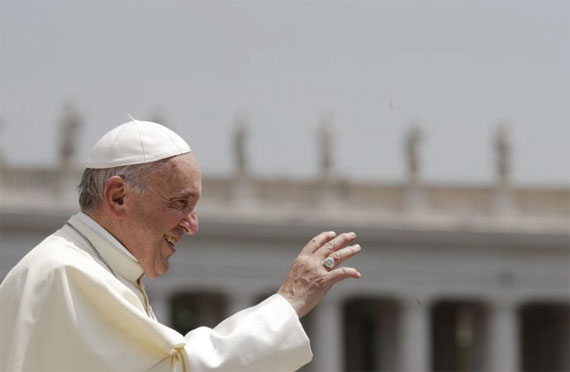
Love was literally in the air as Pope Francis performed an impromptu wedding ceremony at 36,000 feet aboard his flight in Chile.

During his flight to Iquique Jan. 18, the Pope was approached by LatAm flight steward Carlos Ciuffardi Elorriaga and asked for a blessing for him and his wife, stewardess Paula Podest Ruiz.

The couple were supposed to be married in their home parish in Santiago February 27, 2010. However, tragedy struck when an earthquake destroyed the church. Eight years later, they remained only civilly married.

Ciuffardi told journalists aboard the flight that, after he explained their story, he asked the Pope for their blessing.

At that moment, the Pope surprised the couple with offering to marry them right there on the plane.

Ciuffardi said the Pope asked the couple, “Well, do you want to get married?”

“I said, ‘Well, yes. Are you sure?’ Then the Pope said, “Are YOU sure?’ I told him, ‘Yes! Let’s get married,’” Ciuffardi recalled excitedly.

THE ‘CRADLE TO GRAVE’ STRATEGY OF CHRISTIAN PERSECUTION: REPORT

The UK “should lead the way” in tackling unprece-dented levels of Christian persecution a Conservative MP said on January 17. Teresa Villiers, MP for Chipping Barnet was speaking at the launch of the annu-al World Watch List, a survey of global Christian compiled by the Christian Charity Open Doors.

The report reveals that 3,000 Christians were killed for their faith last year, more than double the number recorded in the previous survey. It also states that more than 200 million Christians in the top 50 countries experience high levels of persecution or worse. Eleven of the countries in the list are now places of extreme persecution, the highest number ever recorded.

Mrs Villiers said more should be done to tackle Christian persecution: “The UK must encourage other countries, particularly those experiencing high levels of persecution, to tackle the problem.”

Citing the Commonwealth Heads of Govern-ment meeting, which will be held in London this April, she said: “The meeting is a chance for the UK to set the agenda on this issue and encourage those countries to do more.” This is particularly pertinent given that nine of the countries attending the meeting are listed on the World Watch List.

The event featured speakers Michael and Hannah from Egypt and Pakistan respectively, talking about the levels of persecution endured by Christians in their native countries.

Michael, an elder in one of Cairo’s local evangelical churches, works for the leadership team of a national ministry and with partners to strengthen the church and teach Christians in Egypt to stand strong through persecution and pressure.

Hannah, from Pakistan, described how the country of her birth is being “violated by extremist ideologies” that “treat Christians as foreign enti-ties” and encourage “the vast majority of Muslims to believe that Pakistan is only for Muslims.”

In Eritrea Clinics and schools closed: the regime prohibits Christian social activities

“In Eritrea, the regime has begun to persecute religious confessions and, in particular, the Catholic Church. The object-ive is clear: to try to prevent its influence on society: not by prohibiting worship, but social activities.” This is the alarm launched by Mussie Zerai, a priest of the eparchy of Asmara, for years a chaplain of the Eritreans in Europe and active in saving migrants in danger in the Medi-terranean. “Since 1995 – explains the religious to Fides – there has been a law in force in the country according to which the State wants to carry out all social activities. Therefore, the latter cannot be carried out by private or even by religious institutions. So far, the law has been applied in a bland manner and has not seriously affected the network of services offered by Christians and Muslims. In the last few months, however, there has been an acceleration.”

Public officials have decreed the closure of five Catholic clinics in various cities. The minor seminary (which served both the diocese and the religious congre-gations) was closed in Asmara.

Official Website

Exit mobile version