Chinese authorities ban children going to churches

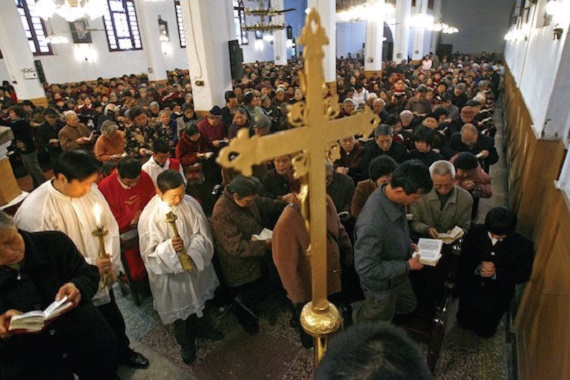
Communist authorities are continuing to tighten their grip on practising Christians with at least four regional governments across China issuing notices that restrict children from joining Christian groups and attending religious activities.

The ban includes turning children away from churches even if they attend with their parents and teachers. Additionally, the ban includes promises that officials will launch investigations into both government approved churches and underground congregations who operate outside the tightly controlled official Beijing-run Catholic and Protestant churches.

The latest move comes as part of a concerted crackdown on religion that began with a three-year cross removal campaign in the Christian stronghold province of Zhejiang. The state’s move against religions became official last year when Chinese leader Xi Jinping instituted formal plans to “sinicize” religion with the intention of bringing more religious followers under the control of the ruling Communist Party, which itself is officially atheist and forbids members from practising.

“An emergency notice from the higher authorities strictly forbids all secondary and primary school teachers, students and toddlers to join Catholic or Protestant churches,” the school district of Yonglin in Wenzhou, eastern Zhejiang, said in a note to all primary schools, adult educational institutes and kindergartens.

Maria, a Catholic laywoman in the district who identified herself by her baptismal name, told ucanews.com that about her daughter’s teacher sent an audio and written message to the parents’ chat group “asking us not to bring children to the church.”

The teacher indicated the education bureau issued that instruction while adding that an inspection team would launch open and undercover investigations to find out how many children went to the church.

On Aug. 12, the local street committee office also sent officials to churches to persuade parents not to take their children there. However, Maria said, there were still many children participating in the procession for the feast of the Assumption of Mary, one of the four most important feasts for the China Church, on Aug. 15.

In another incident,  a church-run summer camp that two Protestant classmates of her niece attended, was eventually disbanded and all participants sent home, Maria said.

“The move by the authorities is unnecessary. Even if they are not allowed to go to church, we parents can pass on our religious belief to our kids at home,” Maria said while admitting that recent events had her concerned.

Nepal criminalizes religious conversion under new law

Religious communities in Hindu-majority Nepal need to press for changes to a new law impacting on religious freedom, which is inconsistent with the nation’s international commit-ments. While there has been ongoing discussion of some specific aspects of the law, many Christian leaders have yet to grasp its wider implications.

On Aug. 9, amendments were made to the country’s 164-year-old general criminal code, known as the Muluki Ain. The revised criminal code imposes sanctions for several offences not included in the old law.

Aspects of the new law can be considered as reforms.

However, it also incorporates ‘anti-conversion clauses’ which effectively narrow religious freedom, notably for minorities.

One government repre-sentative previously main-tained that the criminal code amendments would protect freedom of religious belief, but within certain limits.

A critic of this justi-fication compared it to allowing a bird to fly freely, but only within a narrow cage.

In late 2015, Kamal Thapa, then deputy prime minister, maintained that changes to be introduced to the criminal code would ensure full religious freedom.

Sri Lankan bishops condemn govt’s decision to legalize abortion

Bishops in Sri Lanka have condemned a government move to allow abortion in some circumstances. Cabinet has approved presentation of a bill to parliament to legalize abortion when a pregnancy is due to rape or if a fetus is diagnosed with a “lethal” congenital malformation. The Sri Lankan bishops’ conference stressed that the church believes life begins at conception. A person could not safeguard their own rights at the expense of violating somebody else’s rights, said Bishop Valence Mendis of Chilaw, secretary general of the bishops’ conference.

Bishop Mendis, in a joint statement with Bishop J. Winston S.Fernando, president of the bishops’ conference, defended the “right to life” of an unborn child. An estimated 600 illegal abortions take place in Sri Lanka every day, including many in factory zones where large numbers of women work.

Christian student in Pakistan killed by Muslim classmates

Classmates beat a Christian student in Pakistan to death three days after starting his new school because he drank water from a cup meant for Muslim students, his family says. Sheron Masih was a Grade 9 student at a govern-ment-run school in Burewala, in Punjab province.

He was killed because he was a Christian, the student’s father, Elyab Masih, told ucanews.com by phone. “On his first day at his school, a teacher called my son a chuhra and kicked him out of the class for not wearing school uniform,” he said. “My son was so terrified, he skipped school the next day.”

Chuhra is a derogatory term aimed at Christian sanitary workers.

“I bought him a new uniform after which he agreed to return to school. Later in the day I was told that my son was dead after being assaulted by his class-mates,” he said.

Military claims priest still hostage in devastated Marawi

The vicar-general of the Prelature of Marawi and several other Catholic hostages taken by militants inspired by the so-called Islamic State (IS) are still alive after more than three months of fighting in the southern Philippine City.

At a press conference announcing the retaking of St Mary’s Cathedral, Major General Carlito Galvez, commander of government forces in Marawi, denied social media reports that terrorist gunmen may have spirited Father Teresito Soganub out of the city. The military presented gold-plated religious items including chalices and crucifix recovered by troops from the cathedral, which rebels abandoned on Aug. 25. Some of the items were damaged when the terrorists stormed the church on May 23, the first day of the conflict.

Marilyn Suganob-Ginni-van, a younger sister of the priest, said the family was glad to hear the information. “We are continuously praying for his safety and the other hostages. May God spare them [from death],” she told ucanews.com in a text message. “In two or three weeks’ time,” Galvez said the military expects the city to return to normal, as the battle zone has narrowed to just “400 to 600 square meters.” Captain Jo-ann Petinglay, spokesperson of Joint Task Force Marawi, said the cathedral needs repairing after many bullets struck the building. “It’s not totally wrecked. There was damage to the walls [from bullets],” she added. Earlier, IS-linked websites released a video showing fighters toppling over statues and desecrating icons before trying to set fire to the cathedral.

ORTHODOX PRIEST JAILED FOR PLOTTING TO POISON GEORGIAN PATRIARCH’S ASSISTANT

A senior Georgian Orthodox priest has been jailed for the attempted murder of the secretary of the Church’s leader of 40 years, Patriarch Ilia II. Archpriest Giorgi Mamaladse received a nine-year sentence from the City Court in Tbilisi for plotting to poison Shorena Tetruashvili, the patriarch’s long-serving assistant, in what prosecutors said was an attempt to “gain more power” in the Georgian Church. The priest, who headed the Church’s property management service, as well as a church-owned medical centre, was arrested last February at the capital’s international airport. He was carrying cyanide and a pistol in his luggage and was preparing to board a flight to Berlin, where the 84-year-old patriarch was receiving medical treatment.

Georgian newspapers said the case relied on evidence from a journalist with intelligence links, who had secretly recorded the 31-year-old priest requesting help in obtaining the poison. The priest’s defence lawyer insisted Giorgi Mamaladse had not received a fair trial and was ready to take his appeal to the European Court of Human Rights.

DRAMATIC INCREASE IN CATHOLIC ACCEPTANCE OF ABORTION, FINDS NEW SURVEY

The number of Catholics who believe “the law should allow an abortion if a woman decides on her own she does not wish to have a child” rose to 61% in 2016, a large increase from 39% in 2012 and 33% in 1985, according to the 2016 British Social Attitudes survey.

The percentage of Catholics stating pre-marital sex “is not at all wrong” doubled over the same time period from 38% in 1985 to 76% in 2016. The report found an even greater shift in Catholic attitudes towards same sex relationships. While only 9% said these were “not wrong at all” in 1985, by last year 62% of Catholics agreed with this view.

Catholic views on abortion have been highlighted recently by Conservative MP and leading Brexit supporter Jacob-Rees Mogg, who said in an interview on 6th September that, as a devout Catholic, he opposed abortion, even in pregnancies occurring after rape or incest.

The Social Attitudes Survey found that the highest percentage of people who agreed with its pro-abortion statement were those with no religion, at 78% in 2016.

Nineveh Christians rebuild their homes, but threats remain in Iraq

With towns and cities such as Qaraqosh and Bashiqa in Iraq’s Nineveh Plains now liberated from Islamic State (IS) forces and their original inhabitants begin-ning to return, there is confidence among some local Christian leaders that life is slowly beginning to get back to normal.

“I am optimistic, yes, very optimistic,” says Qaraqosh’s Syriac Catholic Archbishop Yohanna Petros Mouche. “When you look around the villages you see that life is back again.”

A drive through Qaraqosh proves his point. A young boy cycles by, carrying a plastic bag full of bread, while Arabic graffiti on the wall of a house in Bashiqa burnt down by retreating IS forces reads: “Tomorrow will be more beautiful.” The return of Nineveh’s Christians is most visible in Qaraqosh. About 1,500 families – more than 20% of the total Christian population before IS came – have now gone back. A local priest, Father George, has helped facilitate the return through a Centre for Support and Encouragement, a project based in Nineveh’s liberated towns to help returnees who fled the IS invasion.

Three Kenyan Christians ‘called out by name,’ then beheaded by suspected Al-Shabaab

On 15 June 2014, twin attacks by Al-Shabaab on Mpeketoni left 52 people dead. The attackers killed all who could not recite Muslim prayers, before destroy-ing their homes. A group of around 30 heavily armed men in military gear, suspected to be Al-Shabaab militants, killed three men in Lamu West, near Hindi, at about 1.30 am on September 6.

In eastern coastal Kenya, along the Somali border, Lamu has been beset by Islamist attacks for years. This has instilled fear in regions where Christians are the minority. Wednesday’s attackers, armed with AK-47 rifles, surrounded homes in Bobo village and called out the names of the non-Muslim men, according to local sources.

When the men came out, the assailants ordered them to show their ID cards, before beheading them. The three victims were all Christians.

Gerald Wanjohi was one victim; his wife Catherine climbed onto the roof when the attackers broke down their door. “They were speaking in Somali and broken Swahili,” she testified. Al-Shabaab has targeted Kenyan Christians for years, attacking churches, public places and buses.

On 18 August, three Kenyan Christians were hacked to death by Al-Shabaab militants after they refused to recite the Islamic prayer of faith. A fourth Christian – the mentally challenged older brother of one of the three – was also killed.

In July, the radical Islamist group beheaded nine Kenyans – some of whom belonged to a local church – in the Pandaguo area of Lamu West. This practice appears to be a change of strategy for the group, which has used Improvised Explosive Devices (IEDs), guns and grenades in the past to attack Kenyan Christians.

As World Watch Monitor reported last month, Al-Shabaab has set up bases in Boni, a forest that straddles the Kenyan-Somali border. The group has been using the forest as a cover to attack villages on the Kenyan side, according to security sources.

Pope Francis moves to develop a more decentralized church

“All roads do not need to go through Rome!” – Deligne.

Everything is clear for the former president of the Argentine Bishops Conference who has become Pope. Decisions in the Church do not necessarily need to go through Rome.

“Excessive centralization, rather than proving helpful, complicates the Church’s life and her missionary outreach,” he lamented in §32 of Evangelii gaudium, the document that is the program for his pontificate.

For several months, the C9 (the nine cardinals who advise him on the reform of the Curia) have tackled the question of Church decentralization.

During its latest meeting in mid-June, the group studied “the possibility of transferring certain faculties of the Roman dicasteries to local bishops or bishops conferences in a spirit of healthy decentralization.”

The example given then was that of permanent deacons who currently need to ask authorization from Rome to remarry if they are widowed or wish to be ordained as priests if they are widowers or celibate.

Such authorizations could eventually be given by bishops conferences and no longer by the Congregation for the Clergy.

But according to Greg Burke, director of the Holy See Press Office, this is just one of many examples of decentralization currently being considered by the C9.

“In many dicasteries, there are things of this nature that depend on Rome but which need not necessarily do so,” he explained.

The Pope’s recently published “motu proprio” on liturgical translations, Magnum principium, is typical of this desire.

As a result of John Paul II’s Liturgiam authenticam the work of liturgical translation became blocked, with the Congregation for Divine Worship responsible for verifying that the original Latin was “translated integrally and very precisely.” The outcome was that it ended up imposing its decisions on bishops conferences. By recalling that the work of “faithfully preparing the versions of the liturgical books in current languages” needs to be carried out in a “collaboration full of reciprocal, attentive and creative confidence” between the bishops conferences and Rome, Pope Francis has transformed this situation.

In the Curia, however, certain offices have seen these changes as a loss of Rome’s power to make decisions that are binding for all dioceses.

Official Website

Exit mobile version