- Rev. Fr. Dr. Pius Perera,
Diocese of Jhanci
 In north India the solemnity of the resurrection of Jesus Christ (Easter) is known under the name ‘Pescha Parv.’ The very name Pescha has the ringtone of the paschal mystery, the kernel of Easter celebration. In fact, the ordinary lay faithful are not adequately catechized about the rich mystery of the foundational truth of the very Christian existence, namely the resurrection of Jesus from the dead. To the common folk – Christians and the people of other faith alike – in North India the main popular celebration is the ‘Bada Din’ – Christmas.
As a missionary parish priest of a village parish in Pakdilpur (Gidurah) of Chitrakoot District in Utter Pradesh, I have taken up catechizing my parishioners about the inner meaning of ‘Pascha Parve’ (Easter Celebrations) as a challenge. I simplify it for them by describing Easter celebration as a journey from Gosala (Crib) to Khali Kabre (empty tomb). It is an invitation of Jesus to take the faithful from the Crib to the altar of mercy, the confessional, to experience the healing presence of Jesus Christ the risen Lord.
The Risen One Is a Guaranteed Mandate
In the context of Easter Celebration, we as missionary disciples are called to witness the Gospel message “He is not here; He is risen” (Mt 28: 6), in order to drill into the minds of the faithful the meaning of the resurrection of Jesus. Easter Sunday is the culmination of the ‘Paschal Triduum’ (Holy Thursday, Good Friday, and Holy Saturday). It shows actually the Passion and death leading to the empty tomb, the symbol of resurrection. The empty tomb where Jesus is buried is the symbol of the faith that he is not here among the dead. He is transformed and is no more under the yoke of worldly passions and suffering of this world. He is risen and he lives forever. Jesus Christ is the same yesterday, today and forever (Heb 13: 8). It is a victory over sin and death. It is not just a recalling of the past event in history, it is an everyday reality. It is like a grain of wheat falling to the soil and dying to yield much fruit (Jn 12: 25).
If the risen Lord is not here, where is he now? Where is He who is now risen? First, He is at the right hand of God. “All authority in heaven and on earth has been given to me; therefore go and make disciples of nations and baptize them in the name of the father and of the Son and of the Holy Spirit and teaching them to obey everything I have commanded you. And surely I am with you always to the very end of the age” (Mt 28: 18-20). This famous missionary mandate of Christ reveals that, first and foremost, he is at the right hand of God. The words of St. Septhen, the first martyr for Christ, is stated thus in the Acts of the Apostles: But filled with the Holy Spirit he gazed in to heaven saw the glory of God and Jesus Standing at the right hand of God (Acts 7: 55) He is not merely in heaven looking down, but he is now in a position to exercise power in the world and in the process of history. He is spreading his Kingdom-authority in the world through the ministry of the Church.
The risen Jesus Christ is there in the ministry of the gospel: “Go and make disciples” (Mt. 28: 19). As the Gospel is preached it transforms men and women into his disciples. This transforming ministry of the word is immediately connected with the risen Christ. In the letter of St. Paul to the Ephesians we read, “He came and proclaimed peace to all those who are far off and peace to those who are near” (Eph 2: 17). It means that in the preaching of the Gospel Christ comes to us.
Presence of the Risen Jesus in the Community
The risen Jesus Christ is in the community of his people. ‘Surely I am with you until the end of the age’ (Mt 28: 20). He is Emmanuel – God with us- (Mt. 1: 23, Is 7: 14). When the risen Christ says ‘I am with you’ he uses the second person plural. This means that the risen one is with all – with the Ecclesia (Kalein in Greek and Kalesia in Hindi). This is not a promise made to any individual Christian, but to the community of believers. In the Gospel of Luke, Chapter 24, the disciples he met on the way to Emmaus recognized the risen Christ in the breaking of the bread. Luke is probably referring to the Lord’s Supper. In the public worship of the Church, Christ comes into focus. In the ministry of Christians, when they love, serve, uplift, and meet one another using the spiritual gifts received from the hands of the risen Christ… one experiences his living presence. This is how the Missionaries in North India and anywhere bear witness to the Gospel of the risen Lord in their everyday life. The Risen Jesus is with us till the end of history. This is a great promise made by Christ. “I will be with you no matter wherever you go in this world.”
Witnessing in the light of the Risen
We are confronting a time of violent war in the Middle East, the central stage where the events of Paschal mystery took place historically more than twenty centuries ago. As the missionary disciples of risen Jesus Christ, Christians are called to move out into a violent world as agents of peace (in this context let us now remember the Lebanese priest Pier El Rahi who sacrificed his life while helping victims in Lebanon in the ongoing war); into a broken world as ambassadors of reconciliation… into a needy world as servants of the poor like St. Mother Theresa of Calcutta, Fr. Stainsamy S. J. of Jharkhand, and Deya Bhai in Barul village of Chhindwara District in Madhya Pradesh. The missionaries do so knowing fully well that it is God’s will to eventually end wars, hatred, selfishness, and all forms of poverty and injustice. The resurrection of Christ assures us that God will redeem not just souls but also bodies and will bring about a new heaven and new earth (Rev. 21: 1, Is 65: 17). As risen one, Christ stands out just within in our present harsh times, but he waits till the end of history to heal and renew everything. That is the promise of the Risen Lord Jesus Christ. Therefore, we shall not fear.
Presence of the Risen in Gatherings
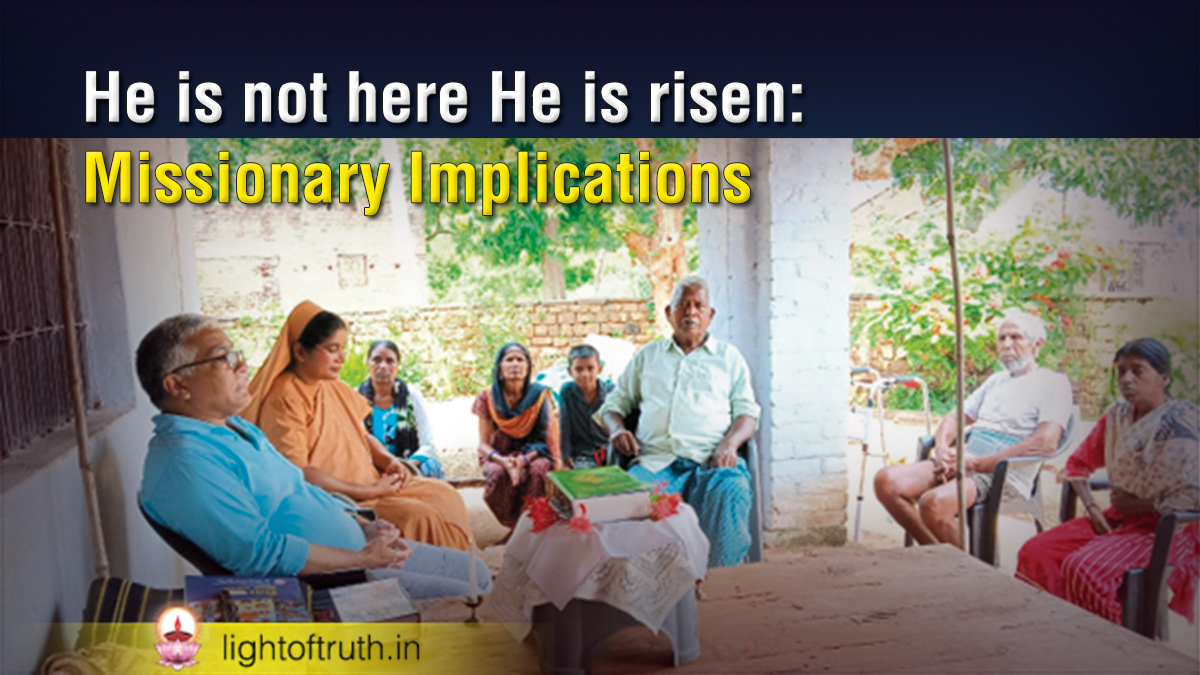
“Where two or three gather in my name, there am I with them” (Mt 18: 20) is a promise from Jesus. In this connection I would like to introduce the special presence of the Risen one in the Gospel sharing. The concept of a quasi-sacramental presence of the risen Jesus in the Basic Ecclesial Communities (BEC) describes how these small local groups act as a visible sign of Christ’s grace and presence, resembling the sacraments without having formal rituals. Normally, BECs consists of four to six families in a neighborhood are viewed as a new way of being Church as said in Lumen Gentium of Vatican II. When a community itself becomes a foundationally sacramental or a communion, there is there the presence of the risen Lord.
Dei Verbum, the dogmatic constitution on the Divine Revelation, presents the risen Lord Jesus Christ as the central reality of the salvation history. He is present and encountered today primarily through the inseparable unity of the sacred scripture and the sacraments. The document highlights that Christ’s presence is not primarily historical but a living reality that nourishes the Church (DV 21, 26). The quasi–sacramental presence of Christ in BECs is nourished or nurtured by a seven-step-method of Gospel Sharing.
The Seven-step-method is a structured prayerful approach of reflection on the Sunday Gospel passages in small groups of families. It includes invoking the Holy Spirit, reading and meditation of the Gospel passage in silence, sharing personal insights, discussing community actions on the basis of the Gospel passages and closing with a prayer and practical decisions.
Step one: prayer of invocation. Jesus is invited in prayer into our midst by two or three people. It could be called an opening prayer.
Step two: Reading the Gospel passage. A particular passage of the Gospel is read more than once to make it perfectly clear for it to touch the heart and the mind.
Step Three: proclaiming the word. Saying aloud a word or phrase that struck the person during the reading. It could be read from the text itself.
Step Four: Allowing God to speak. Spend some time in silence so that God speaks to each one personally and inspires his/ her heart.
Step Five: Faith sharing. Sharing one’s personal experience based on the verses that helped him/her to open his heart. This sharing is very different from preaching.
Step Six: Action oriented discussion (common word of life). This is actually the application of the Message into practical life. It is not strictly personal, but community based.
Step Seven: Concluding prayer. It is a spontaneous prayer, including prayer of petitions.
The seven-step-method of Gospel sharing is designed to be a living Bible study, focusing on personal transformation and community service. Normally, we encounter the risen Lord in reading, meditating and sharing the word of God and in expressing it in our daily actions. So, Our Lord Jesus Christ is not in the Tomb; He is with us, among us and within us.
(Rev. Fr. Dr. Pius Pereira is a priest serving within the Roman Catholic Diocese of Jhansi, specifically associated with the mission in Orai, Jalaun, Uttar Pradesh. He is part of the missionary team at Divine Mercy School, Mavai Road.)