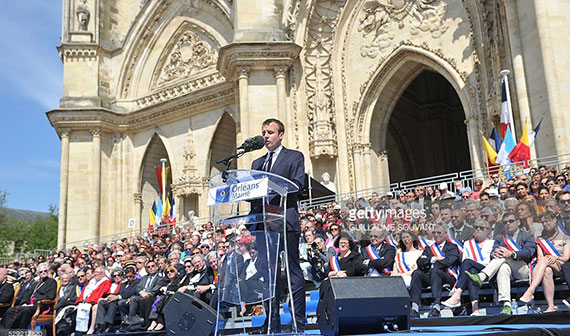
The head of the French bishops’ conference welcomed the election of President-elect Emmanuel Macron and said he hoped June legislative elections would not place the country “in an ungovernable situation.”
Archbishop Georges Pontier of Marseille, president of the French bishops’ conference, told Vatican Radio on 8 May that French Catholics had also been left “divided like the rest of French society” and said he counted on Macron and his new government “being able to function.”
“Macron has been elected in an important manner – we must hope he succeeds for the good of our country, otherwise it will be catastrophic,” said Archbishop Pontier.
“Priorities for his new five-year term must include struggling against unemployment, which is so destructive for families, for prospects and for projects, as well as the necessity of staying in Europe – and giving this Europe the means of retaining the respect of every people.”
Macron won the second-round presidential ballot with 66.1% of votes against 33.9% taken by Marine Le Pen, head of France’s National Front. Macron ran on a pro-market platform that included support for the European Union and cuts to public administration, as well as lower corporation taxes and measures to defend secular values.
At 39, the new president is France’s youngest head of state for two centuries. He swept to victory just a year after setting up his 200,000-member movement, En Marche! (On the move).
In a interview on his diocesan website on 3rd May, Archbishop Pontier said the Catholic Church had sought to encourage “reflection and discernment” among voters, rather than “taking sides for one or another candidate.”
However, the French daily Le Monde said on 4th May that the church’s refusal to back Macron against Le Pen had “provoked a deep discontent among the faithful.” France’s highest-circulation Catholic newspaper, La Croix, declared support for Macron and accused church leaders in an editorial of lacking will “to put an end to extremism.”
Born in Amiens, northwest of Paris, Macron was educated at Jesuit-run La Providence high school, before studying at the capital’s prestigious Ecole Nationale d’Administration and joining Rothschild and Cie Banque in 2008 as an investment banker.
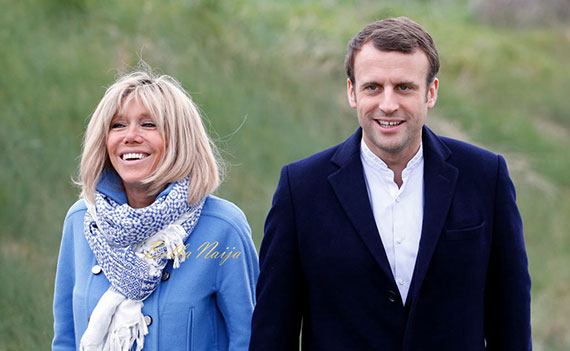
In 2007, he married his former La Providence drama and literature teacher, Brigitte Trogneux, who was 24 years older and had three children from a previous marriage.
Macron worked as an economic adviser to President Francois Hollande and was appointed economy minister in 2014, deregulating some branches of industry and liberalizing Sunday trading. He resigned last August to pursue his presidential bid.
French writer Samuel Pruvot, who interviewed the new president at length for a book, said Macron sought baptism at age 12 under the influence of his Jesuit teachers, but viewed the Catholic faith “more intellectually than spiritually” and would “distance himself as much as possible from church, faith and Catholicism” as president.
“He’ll be diplomatic with the church, treating it like an elderly aunt whom he hasn’t seen for a long time, and who’s left his life, but for whom he still retains some affection,” Pruvot told the Catholic online portal Aleteia on 4 May.
“Macron recognizes there’s a law of God and a law of people, which aren’t the same and reflect a different hierarchy of values. … He recognizes this, but doesn’t adhere to it, since he considers that the truth is inaccessible and one must simply seek a consensus so people can calmly live together.”
In a joint declaration published on 5th May in La Croix, 38 Catholic organisations urged voters not to support Le Pen and warned that the National Front’s program posed “a danger to democracy, social peace and Europe’s future.”
However, leaders of France’s pro-family “La Manif Pour Tous” movement, whose nationwide protests against same-sex marriage, assisted suicide and other liberal changes have been supported by some Catholic bishops, warned citizens that Macron would “continue the anti-family policy” of Hollande.
Both Macron and Le Pen visited Catholic cathedrals in Rodez and Reims respectively during their final day of campaigning May 5. Polling experts said both attracted a substantial number of Catholic votes.
The BBC news and more surprisingly Channel 4 News as well, focused on the uncomfortable fact that 11 million French men and women voted for Marine Le Pen. In addition, a huge amount abstained in the second round: roughly a quarter of the voters, faced with the prospect of Le Pen, still could not bring themselves to vote for Macron. As for those who voted for Macron in the second round, many of them would have been voting against Le Pen, rather than for Macron. So, while the two-to-one victory is the second round looks like a resounding victory, it is not so impressive on closer inspection. There are an awful lot of people in France who are far from happy with the prospect of President Macron.
Marine Le Pen managed to land two significant blows on her opponent during the campaign. First of all, she said Macron was the continuity candidate, and seeing him walking side by side with his former boss, M.Hollande, this seems hard to deny. Macron was a member of the former deeply unpopular government, but skilfully presented himself as someone new. In addition, he is a graduate of the Ecole Nationale d’Administration, France’s elite university which has produced most of the ruling class from time immemorial. That, and having worked for Rothschild’s, hardly constitutes an inspiring back story. Macron was most definitely not the insurgent candidate.
The second blow was in the words: “Whoever wins, France will be ruled by a woman – me or Madame Merkel.” When Macron did his solitary ‘walk to victory’ through the courtyard of the Louvre, he did so to the sound of Beethoven’s Ode to Joy, which is of course the anthem of the European Union. Opening impressions can never be cancelled, and this deliberate choice to underline his enthusiasm for the Union may well come back to haunt him.
Some 62% of French Catholics who voted did so for Emmanuel Macron, according to a poll carried out by IFOP for La Croix and the Christian weekly Pèlerin. Among those who attend Mass regularly, the proportion was 71%. While this qualifies as a resounding success for Macron, the same poll shows that the National Front increased its share of the Catholic vote between the two rounds.
In the first round, Marine Le Pen’s share of it, combined with that of eliminated right-wing candidate Nicolas Dupont-Aignan, was 19% and 14% among regular church-goers.
 Le Pen reached 38% and 29% respectively among these constituencies in Sunday’s runoff. This means that some of those who voted for erstwhile Republican front-runner Francois Fillon in the first round switched their allegiance to the National Front candidate in the second.
So what is the extent of this swing from the right to the far right? It’s impossible to quantify in terms of numbers of actual votes because the poll does not take into account the significance of spoiled or blank ballots. We only know that, as per usual, Catholic turnout was slightly greater than the national figure: 78% versus 74%.
What the poll did reveal, however, is that 14% of those who voted for Fillon in the first round abstained in the second, 12% cast blank or spoiled ballots, 50% voted for Macron and 24% for Le Pen. IFOP’s director of strategy and opinion, Jérôme Fourquet, suggested that this second round breakdown also broadly applied to Catholic voters, who make up a significant share of Fillon’s vote.
Either way, the election showed a strong anchoring in the right among a segment of French Catholics.
After street protests in 2012 and 2013 by La Manif Pour Tous – a movement created to vocally oppose legislation permitting gay marriage – and then a succession of terrorist attacks, regional elections in 2015 were marked by a conservative drift.
Some 83% of regular church-going Catholic voters backed candidates from right-wing or far-right wing parties, according to IFOP. Some 24% voted for the National Front.
During the primaries, Fillon, by courting Sens Commun – an offshoot of La Manif Pour Tous – and by talking up the threat posed by Islamists, managed to win over Catholics despite the scandals that plagued him during the campaign (According to IFOP, 55% of regularly churchgoing Catholics voted for him in the first round).
“We see Catholics worried about becoming a minority in a society where Islam is growing,” said Fourquet.
“It’s a cultural sense of insecurity but also a physical one, exacerbated by the murder of Fr Hamel in July,” he added, referring to the killing of an elderly priest in his Normandy church by two Islamist extremists.