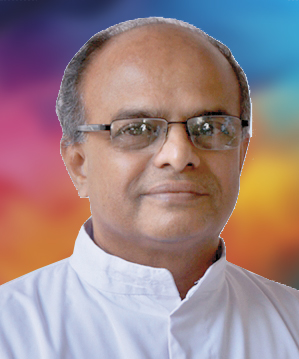
- Fr. Davis Manjaly CMI
In Human Life there is always space for continuos Adaptation. For that needs a deep change of heart, a renewal in behaviour, attitude and orientation of life. This means returning to our roots—the original spirit of our faith. It is a journey back to Christ as revealed in the Gospels and to the simplicity, unity and love of the early Christian community. The characteristic of the early Church was unity (being ‘of one heart and one mind’) and sharing (Acts 4:32). The early church was a poor and persecuted church; and was a charismatic community. Their real strength did not lie in material wealth but in the power of faith (cf. Acts 3:6). Their confidence and mission were rooted entirely in the name of Jesus.
A shift of Emphesis
With the Edict of Milan in 313 AD, Christianity was granted religious freedom and began to receive imperial support. Constantine also convened the Council of Nicaea in 325 AD, a landmark event in shaping Christian doctrine. The 1700th anniversary of the Council of Nicaea was celebrated recently. In 380 AD, Emperor Theodosius I declared Christianity the official religion of the Roman Empire through the Edict of Thessalonica.
These advances are often seen as great blessings that contributed to the growth and expansion of the Church, especially in Europe. However, they can also be viewed from another perspective – as the beginning of a gradual decline in the original spirit of Christianity.
The Church, once poor and persecuted, slowly became increasingly rich and powerful. A close alliance developed between Church and state, where, at times, political influence overshadowed spiritual guidance. Instead of being led solely by the Holy Spirit, the Church often found itself shaped by political power.

True respect, after all, is not gained through elaborate titles or costly attire, but through an authentic life rooted in humility, integrity, and closeness to the people. Mahatma Gandhi, the father of our nation, stands as a powerful model of this truth. His simplicity and authenticity won him deep respect across the world.

Colossal churches, cathedrals, and institutions were built which were signs of wealth and power. Gradually, a spirit of extravagance entered in the day to day affaires of the Church and in the life of its leaders. They began to live like princes and in some cases, royal families exerted influence over Church affairs, including the appointment of bishops and even the Pope. As royal culture and values seeped into ecclesial life, there was a growing distance between Church leaders and the ordinary faithful. The simplicity, unity and spirit of service that characterized the early Christian community began to fade.
Clamour for Change
The period of the Reformation was another crucial moment in the history of the Church. Martin Luther King questioned some of the unjust practices within the Church, especially the sale of indulgences. He was an Augustinian theologian (same order Pope Leo XIV belongs to) who sought renewal from within.
In 1517, he famously nailed his Ninety-Five Theses to the door of the church in Wittenberg, Germany. His intention was not to break away from the Church, but to invite dialogue, reflection and reform. However, his protest quickly gained widespread support, as many people were already dissatisfied with Church practices and governance. What began as a call for discussion soon became a powerful movement-the Reformation-that shook the Church.
This situation compelled the Church to engage in deep self-examination and reform. Many committed leaders and saints emerged during this time, contributing to the renewal and strengthening of the Church. Although the Church has often viewed Luther as a rebel, many others recognize him as a reformer. Had he not raised his voice, the internal decay within the Church might have worsened. In this sense, his bold step can be seen as a wake-up call, inviting necessary change.
An examination of conscience
Over time, the Church seems to have adopted many royal customs and symbols (the mitre, crozier, ring, and other symbols, along with liturgical vestments and sacred vessels like the chalice, paten, monstrance, and tabernacle) often reflect a sense of opulence. While they carry deep symbolic meaning, they can also appear as signs of wealth and aristocratic culture. I watched the coronation of Charles III in May 2023. What struck me was how closely it resembles certain Episcopal ordination ceremonies.
This creates a striking paradox when we remember Jesus – who was born, lived, and died in simplicity and poverty. The One whom we follow had no place to lay His head, yet our expressions of faith can sometimes lean toward splendour and display.
Ostentatious celebrations have, in many places, become normal. We see this in grand ceremonies for ordinations, jubilees, parish feasts, and weddings – marked by elaborate decorations, illumination, fireworks, and lavish meals. All this happens even as many poor people live around us, often unnoticed.
Another area that invites this introspcction is the use of titles within the Church. Many of the titles once used in monarchies – such as Your Holiness, Your Beatitude, Your Grace, and Your Lordship – have also been adopted by Church leaders, who are essentially called to be servants. Jesus Christ Himself cautioned against such titles in His criticism of the Pharisees (cf. Mat 23:5–10). He emphasized humility and service, and preferred to be known simply as the Son of Man.
In today’s world, even powerful secular leaders are addressed in simpler ways. For instance, the President of the United States is commonly addressed as “Mr. President,” and the British Prime Minister as “Mr. Prime Minister.” Yet, the Church in many places continues to retain traditional titles.
In India, Hindu religious leaders are addressed as Pujya Swamiji. India is a land known for simplicity – sign of Indian spirituality – and renunciation and religious leaders are models of it. They usually wear a simple dhoti with an upper cloth, or a plain, collarless shirt. Even for Pooja, they wear a simple dress.
True respect, after all, is not gained through elaborate titles or costly attire, but through an authentic life rooted in humility, integrity, and closeness to the people. Mahatma Gandhi, the father of our nation, stands as a powerful model of this truth. His simplicity and authenticity won him deep respect across the world.
The appearance of Christian leaders can at times become a counter-witness when it does not reflect the simplicity and humility of Christ. Recently, I watched a video of the liturgical procession of bishops at a national leveal meeting. It was striking and colourful spectacular. I found myself wondering: if Jesus were to see this, what might His reaction be? What impression does it create, especially among people of other faiths? Does it communicate the simplicity of the Gospel, or does it risk appearing distant and overly elaborate? Perhaps it is high time that we change such paraphernalia.
The whole world was shocked and deeply moved by the simplicity of the funeral of Pope Francis, carried out according to his own instructions. A simple coffin, a modest ceremony, and above all, a plain tomb bearing only the name “Franciscus”—without titles, not even “Pope.” He chose to be laid to rest at the Basilica of Saint Mary Major rather than the traditional St. Peter’s Basilica. This decision itself was striking and deeply symbolic. It was more than a personal preference – it was a powerful message. In its simplicity, it challenged long-standing customs and raised a profound question before the Church. It pointed toward a new way of witnessing-one rooted not in grandeur, but in humility. This can be seen as a kind of paradigm shift, a call to return to the essence of the Gospel.
Synodality and Its Impact
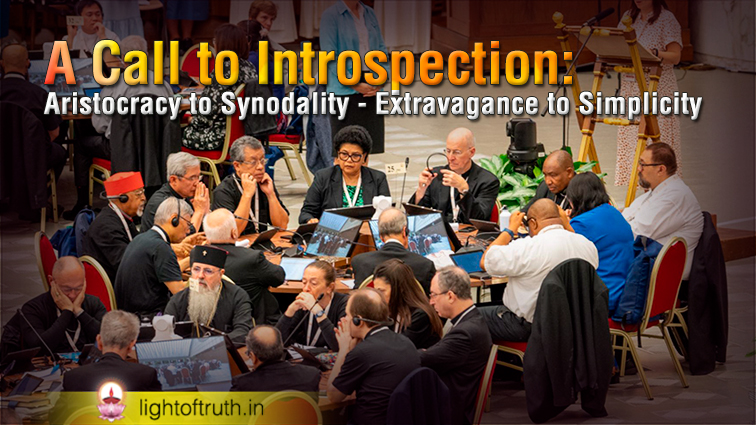
In recent years, the Church has engaged in wide-ranging discussions and discernment on synodality at various levels. Synodality calls the entire People of God to walk together-through listening, dialogue, and communal discernment, even making space for respectful dissent. It envisions a Church that is more circular and Christocentric, where participation and shared responsibility are valued.
However, we must honestly examine: has this process brought about substantial transformation, or only minor adjustments? The need of the hour is not superficial change, but deep renewal and genuine transformation. What is required is not cosmetic surgery, but a kind of “surgical” renewal that touches the very heart of the Church.
If such renewal does not arise from within, it may eventually be imposed from outside. This is why we are called to return-not to a medieval model of the Church-but to the spirit of the early Christian community: simple, united, Spirit-led, and close to the people.
Adaptability and Transformation
We are invited to be attentive to the movement of the Holy Spirit, discerning the signs of the times with openness and courage. In some parts of the world, particularly in historically powerful Western contexts, signs of decline and fatigue are visible. At the same time, the Church in Africa continues to flourish-often as a poor and, at times, persecuted Church.
One of its strengths lies in its ability to embrace local culture and traditions. The liturgy is meaningfully inculturated, incorporating elements such as local music, dance, and symbols, making worship vibrant and accessible to the people.
The Second Vatican Council opened the doors for such aggiornamento—a process of renewal and updating, marked by openness to other cultures and religions. This vision remains ever relevant today.
In India espeiall in mission areas, if the Church is to remain relevant, it must meaningfully engage with Indian culture and traditions and respond to the aspirations of the people. We are called to present Christ and the Church in a way that resonates with the Indian context—rooted in its spirituality, values, and lived experience. This calls for a sincere effort to move beyond an exclusively Western expression of the Church. Many people perceive such expressions as distant from, or even disruptive to, Indian culture and values. Therefore, our liturgy and lifestyle need to be more deeply attuned to the richness of Indian spirituality—simple, contemplative, and close to the people.
Pope Francis beautifully expressed this when he said, “Shepherds should have the smell of the sheep.” This invites a profound question: do we carry the “smell” of our own people and culture, or are we still marked by an aristocratic, Latin, or Syrian identity?
The Church must constantly examine itself and renew its life in order to remain faithful to its mission. As Karl Barth famously said, Ecclesia semper reformanda—the Church must always be reformed.