- Prof Dr Nishant A. Irudayadason,
Pontifical Athenaeum Jnana Deepa, Pune 411014
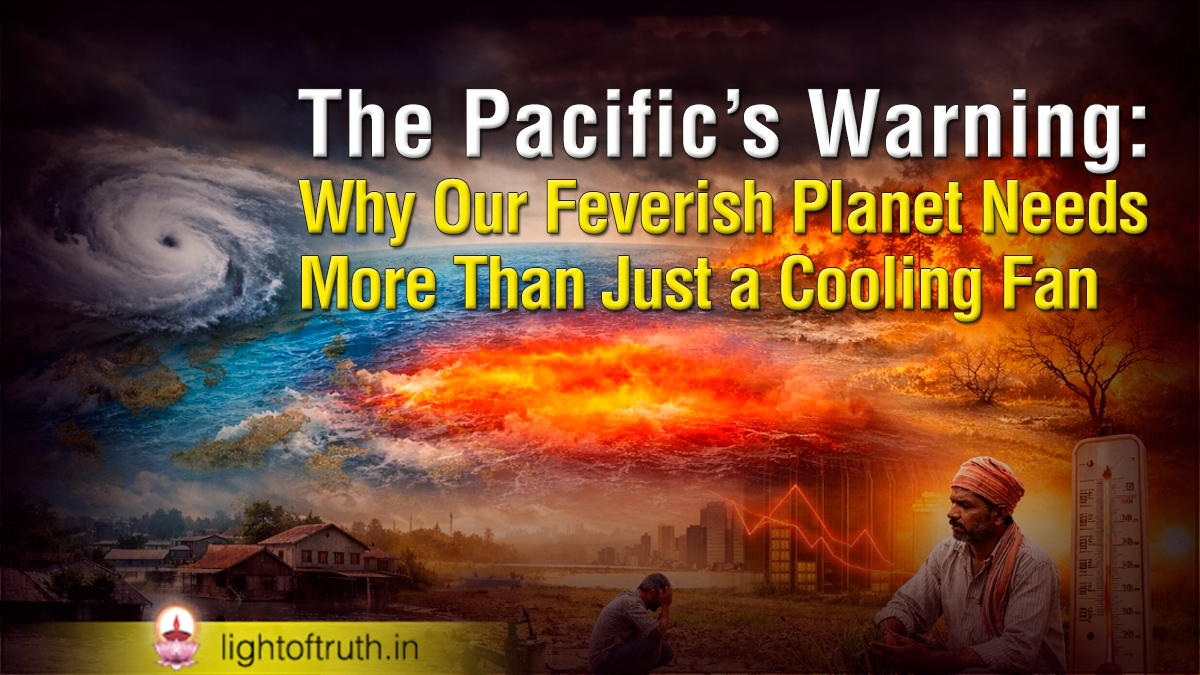
 Peruvian fishermen in the early 1500s once looked at the Pacific and saw a local current they called the “Christ Child,” but today we recognise El Niño as a global behemoth that dictates the survival of modern industrial economies. The 2023–2024 event stands as the fifth most powerful on record, racking up over $103 billion in damages and pushing global temperatures toward a record-breaking year that is likely to exceed the critical 1.5°C threshold since pre-industrial times. As we look toward the high probability of another powerful El Niño through 2026 and into 2027, with sea surface temperatures potentially rising by 2°C or more, the warning from the World Meteorological Organisation is blunt: this phenomenon will pour fuel on the fire of an already warming world. This isn’t just about a change in the weather; it is a recurring signal that our historical relationship with the planet is fractured beyond its natural capacity to self-regulate. Humans must care for the Earth because the relatively stable climatic conditions of the Holocene, which allowed our civilisations to thrive for 10,000 years, are rapidly disappearing under the weight of industrial activity.
Scientific evidence now confirms that we have overstepped seven of the nine “planetary boundaries” that define the safe operating space for humanity. We have crossed the line on climate change, biosphere integrity, freshwater change, and even the introduction of “novel entities” like synthetic chemicals and plastics. By pushing these limits, we are triggering feedback loops that could lock the Earth into a “hothouse” state, making vast regions uninhabitable and raising sea levels by up to 60 meters over time. Caring for the Earth is no longer an act of altruism but a requirement for maintaining the life-support systems we take for granted, from the freshwater cycles that support our crops to the stratospheric ozone that shields us from radiation. If we continue to ignore these thresholds, we risk a “non-linear,” abrupt collapse of the biophysical systems that provide our food, air, and water. The Holocene is our only proven “safe zone,” and moving further into the danger zone of these boundaries makes our future highly unpredictable and uncertain.
The fallout from these climatic shocks reveals a global system where environmental pain is transmitted through supply chains, disproportionately burdening the world’s poorest populations. In India, El Niño acts as an economic restructuring force, driving up food inflation as monsoons fail and agricultural yields for staples like rice and corn wither. While industrial sectors like cooling appliances and renewable energy backup systems might see a temporary surge in demand during heatwaves, this growth is a symptom of a deeper crisis rather than a sign of true prosperity. A powerful El Niño can double the likelihood of civil conflict in affected tropical countries, as resource scarcity intensifies existing social inequalities. We see this tension in the Indian Ocean as well, where devastating marine heatwaves kill off the coral reefs that support fisheries providing up to 90% of the protein intake for some coastal communities. These reefs are crossing thresholds where they can no longer recover between events, leading to shorter food chains and lower overall fisheries productivity.
Caring for the Earth requires a transition away from export-oriented, chemically intensive agriculture toward resilient systems that generate food security while restoring ecosystems. We must break our addiction to fossil fuels and accelerate the shift to renewables, as global heat waves continue to drive up coal consumption and strain power grids to the point of failure. On a practical level, this means investing in climate-resilient infrastructure and early warning systems that give farmers and fishers the months of preparation needed to save their livelihoods. Adaptive management, such as Peru’s regulation of the anchoveta fishery based on oceanic indicators, shows that we can respond to planetary shifts if we have the political and commercial will to act on scientific data. We must also expand protected marine areas and rehabilitate degraded wetlands to provide a natural first line of defence against storm surges and flooding. Using “blue” and “green” water more efficiently and matching fertiliser use to agronomic needs are essential steps to pull us back from the brink of transgressed boundaries.
The intersection of science and society is often jagged, requiring a buy-in from political and industrial leaders that has so far been insufficient to stay within our planetary limits. We cannot rely on technology alone to cool a feverish planet; we need a fundamental reassessment of how we feed and power our world without exhausting its finite resources. Stewardship is not a pipe dream but a necessity, as our destiny is tightly bound to the same Pacific currents that once only concerned 16th-century fishermen. The current El Niño development is a call to action for informed decision-making and preparedness, as the time to cushion the blow for our communities is right now. Caring for the Earth means recognising that the lines we have crossed are not just abstract scientific measures, but the very boundaries that keep our civilisation from tumbling into an unpredictable and dangerous future. Ultimately, maintaining the observed resilience of our Earth system is the only way to ensure long-term social and economic development for the generations to come.