- Valson Thampu
“Love made objective… reverts once more to its nature, and becomes subjective again in the eating” – Hegel
The Sacrament expresses the spiritual essence of Jesus. The breaking of the bread and the sharing of the cup becomes sacrificial because of him. That is to say, the elements are sacramental because they are transformed into identity with his body and his blood. Body, in the Jewish context denoted ‘personality,’ and wine symbolized life.
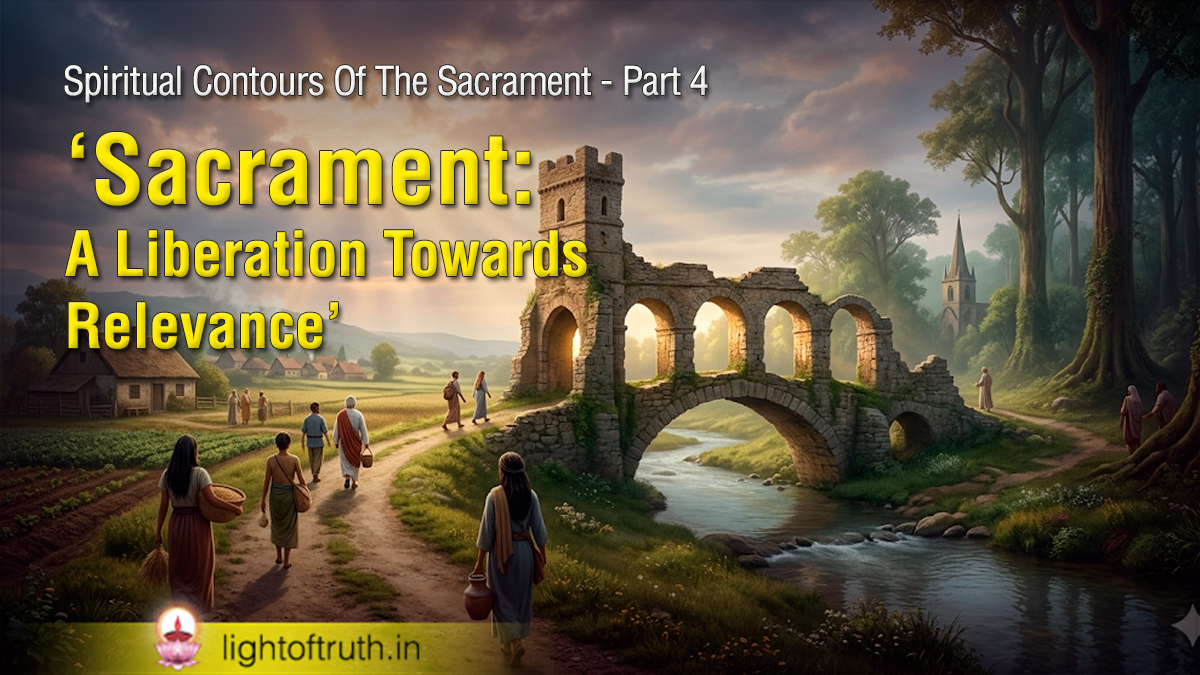
Jesus described himself as the ‘way’ (Jn. 14:6). As per the metaphors in the Sermon on the Mount, his is ‘the straight and narrow way’ that leads to life. The world is characterized by a contrary preference: for the ‘broad way’. But Jesus is also the incarnation of God’s love for the world. The ‘pattern’ of the world, however, is instinctively un-sacramental. Jesus becomes the bridge, the mediator, between the un-sacramental and the sacramental. This accounts for the spiritual power of the sacrament, understood and experienced aright.
In this respect too ‘brokenness’ is the essential condition. This brokenness has two aspects. It denotes a break with the past. It also heralds the advent of the new. The Sacrament is perforce transformative. It is as an intuition of this symbolic intuition that the Catholic Church evolved the doctrine of transubstantiation. The bread and wine becoming the body and blood of Jesus must eventuate into a transformation of human nature as world-oriented into human nature as God-oriented. This transformation must be as the shaping purpose of the transubstantiation of the bread and the wine. This potency, however, is a latent, or hidden, reality, analogous to the ‘hidden treasure’ that the farmer in Jesus’s parable stumbled upon. Staying stuck at the level of the transubstantiation of the elements and stopping short of the transformation of the communicant individuals is like perpetually laboring in the field with one’s eyes shut against the ‘hidden treasure’ that transforms the farmer.

“Jesus becomes the bridge, the mediator, between the un-sacramental and the sacramental… [T]he Eucharist is perforce transformative. The Sacrament encapsulates the ‘brokenness’ that makes us relevant to the human condition universally. In Jesus’s affirmation, “You are the light of the world”, ‘light’ is a marker of relevance. First, he says, ‘come’. Then he says, ‘Go’. The Sacrament is the integration of this ‘Come’, and ‘Go’. The ‘coming’ aspect of the Last Supper is the meal in the Upper Room. The ‘going’ part is at work in the feet-washing.”

As Hannah Arendt points out in The Human Condition, humankind’s relation to the physical began to be deformed as it disconnected itself from the metaphysical. In the Person of Jesus is manifest a reconciliation of the two: the Word became flesh (Jn.1:14). The spiritual-metaphysical is, hence, not a luxury, but a necessity for humankind. To be truly human is to be filled and empowered by the Spirit: an insight embedded in the baptism of Jesus. The sacrament of Baptism signals the restoration of the broken link between the human and the divine. With that, the communication between heaven and earth is prospectively restored.
Why is reconciliation necessary? The biblical doctrine of sin answers this question. Creation is the self-expression of the One as the many. Creating, ‘the many’ -the diverse life forms God created, including the human- were in a state of perfect unity, of which is. Sin introduced a jarring note into the music of the exemplar Edenic existence. ‘The many’, began to fall apart, for want of a coherent Centre: which can only be God alone. As a result, human nature became eccentric; literally, off-centre. Thanks to this existential eccentricity, human beings misconstrue diversity as a bane. In contrast, the apostles of Jesus, barring Judas, present a picture of unity-in-diversity. Appearance-wise. Truth-wise, he embodies disunity. He was an un-sacramental entity among the twelve.
It is obvious that the Sacrament implies a liberation towards relevance. Jesus came as the expression of God’s love for the world (Jn.3:16). To love is to be relevant. Love gone irrelevant becomes lust, partaking of the Satanic. “The thief comes,” Jesus said, “only to steal and kill and destroy; I have come that they may have life, and have it to the full.” (Jn.10:10). The Sacrament encapsulates the ‘brokenness’ that makes us relevant to the human condition universally. In Jesus’s affirmation, “You are the light of the world”, ‘light’ is a marker of relevance. This is subsumed in Soren Kierkegaard’s statement: Jesus calls us to send us out. ‘First, he says, ‘come’. Then he says, ‘Go’. The Sacrament is the integration of this ‘Come’, and ‘Go’. Or, it is ‘come-go,’ as inseparably one. The ‘coming’ aspect of the Last Supper is the meal Upper Room. The ‘going’ part is at work in the feet-washing.
It was a sacramental moment, of the sort we encounter here, when Jesus said to the paralytic, “Take up your bed and walk.” (Mk 2:9) Surely, what is administered to the bed-bound paralytic to maintain him in his paralysis is nowhere near the idea of the Sacrament. Being in existential paralysis together with being empowered to reach out to a world languishing in paralysis complete the sacramental outlook. We make the Sacrament walk only on one leg. The result? Alas, the paralysis remains. Jesus says “It shall not be so among you.” (Mk.10:43)