- Vincent Kundukulam
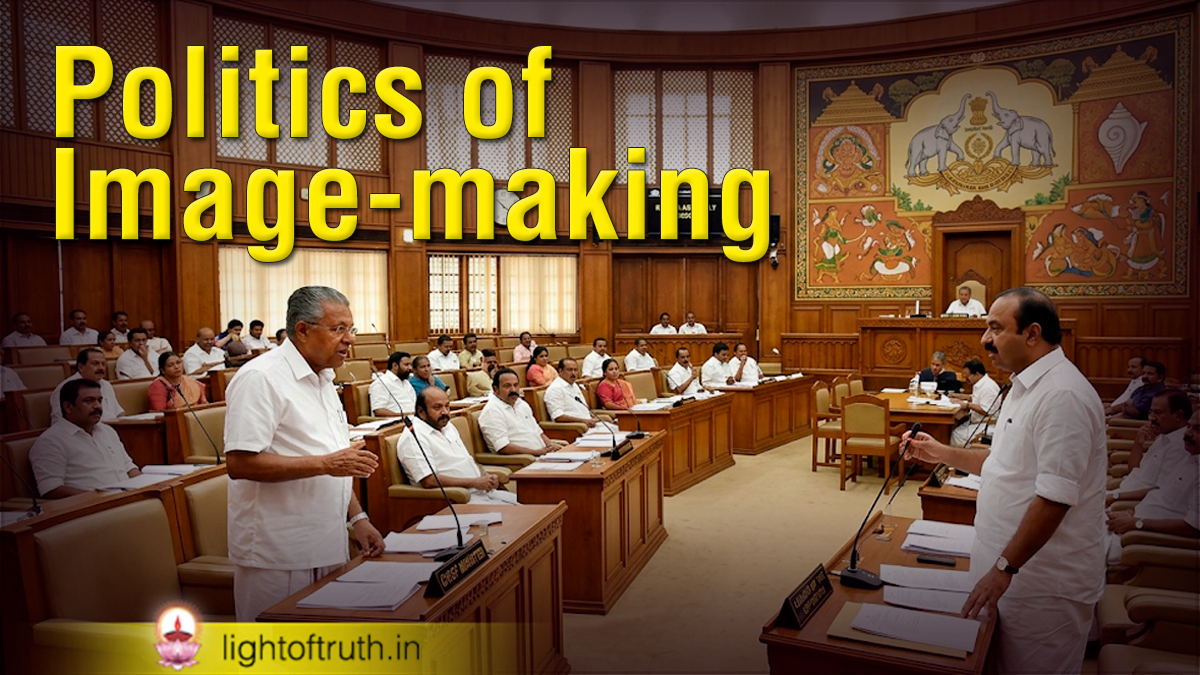
What Badri Narayan wrote, in the Economic and Political Weekly published on May 25, 2024, regarding the ‘image-politics’ is very much true with regard to the elections in India and the legislative assembly election, which is imminent in Kerala. The point he argued in the article was that we are living in an ‘age of images’ and that, given the debate on democratic values and the form of governance became stereotyped, the politics has turned out to be a war of the images between those of the political leaders.
The author of this article delved into the underlying meanings of the term image. The word ‘image’ has several meanings in language and life. The dictionaries generally translate it as ‘the impression that a person or an organization gives to public’ or as the mental picture we have of something or somebody. In life, it is commonly used in the sense of public opinion. When one says, ‘she has an image before the public’, it means that she has value or reputation in the eyes of people.

“The age of narratives is now being turned into an age of images. In the age of images, one ameliorates his/her public opinion not merely through the narrative of virtual stories or positive interpretation of leaders’ gestures and acts but also by creating positive image of the leaders through popular devices. It consists in simply amplifying the ideology of political party in and through certain images of political leaders’ acts, reaching out to the needs of the poor.”

The fame is acquired in two ways: naturally and artificially. A person can attain fame thanks to the talents and character. People appreciate those who speak sense and work efficiently. When one’s words and deeds become beneficial to the well-being of society s/he gets a reverential space in the hearts and minds of people, and the latter respond to them by way of support and praise. In the recent history of Kerala, a few political leaders who got respectful place in the minds of Keralites, irrespective of political alliances, are the late Omman Chandy and V.S. Achutanandan. The homage paid to them throughout Kerala during the burial-ceremonies witnessed how much the Malayalees appreciated their ways of interacting with people and resolving their issues.
Understanding the value of fame for the success in life, those who like to earn the good will of people but are not ready to do any sacrifice for them, search for the short-cuts. In the world of technology, plenty are the ways and means to artificially fabricate the image and get the appreciation of the public. In the last decade, Badri Narayan observes, the leaders improved their image in politics through positive narratives that were disseminated through visual, print and aural media. We can trace out so many examples that verify this fact. In the Kerala legislative election held in 2021, stories were cooked to describe the achievements of the Pinarayi-government in the fields of road-construction and health-care. In one speech, the chief-minister was quoting a child of emigrant Malayalee, who came to spend holidays in Kerala, saying that the roads in Kerala are better than those in America. Shrimati Shailaja teacher was quoting the consoling reply of certain unmarried aged women saying, ‘we are not afraid of the Covid-19, because we have an unborn child in the person of the chief minister Pinarayi Vijayan, who will take care of us in all of our needs.
But the age of narratives is now being turned into an age of images. In the age of images, one ameliorates his/her public opinion not merely through the narrative of virtual stories or positive interpretation of leaders’ gestures and acts but also by creating positive image of the leaders through popular devices. It consists in simply amplifying the ideology of political party in and through certain images of political leaders’ acts, reaching out to the needs of the poor. It can be grasped if we look into the advertisements of the three major political alliances in Kerala.
No discourse on image-making in politics could be finished without mentioning about the act of ‘image-breaking’, because the latter is inseparably associated with the first. Certain leaders sustain their dominance in politics by denigrating the image of their political opponents. Needless to cite examples. The constant allegations mutually raised by the ruling parties and opposition parties are often partly derived from the urge to curtain the political mileage of leaders in the other camps.
Badri Narayan divides images into two types: those that have shorter life and those with a longer life. The images that have long life may transform into symbols after some time by going through constant additions, deletions and modifications. The images of Mahatma Gandhi, Nehru, Patel and Ambedkar have become symbolic images of secular socialist and democratic India. They are often referred to by the political parties, which uphold the secular values in political arena.
The images reflect reality but the present-day virtual images create impressions that can even surpass the reality. The advertisements given by the political parties are such that the ordinary public easily become illusioned. In the world of artificial intelligence and robotic visualization, most of the visuals are virtual and unreal, and the real truth is seldom accessible to common public.
- kundu1962@gmail.com