- Vincent Kundukulam
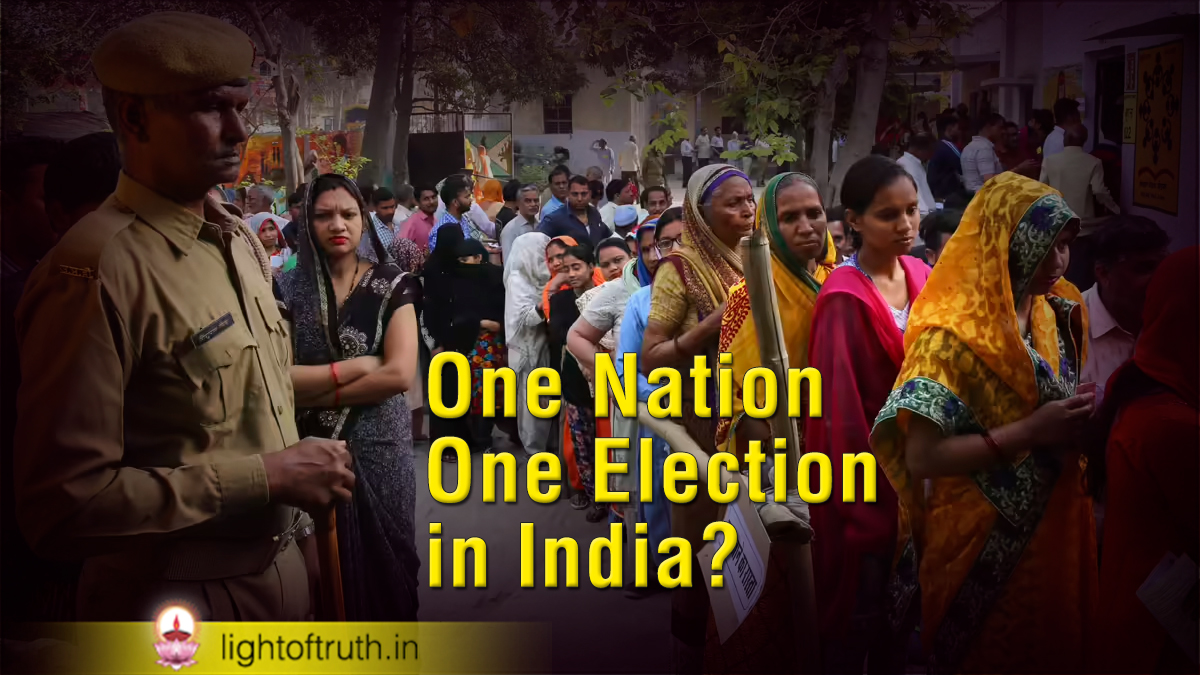
Since the advent of the BJP government at the center, the debate on the feasibility of conducting all elections—from local bodies to Parliament—at one stretch has become recurrent in India. On 1 November, the BJP constituted a committee named the Joint Parliamentary Committee (JPC) under the premiership of the former President Ram Nath Kovinth to explore the viability of implementing the policy of ‘One Nation, One Election’. The Committee submitted its report to the government recommending joint elections to Lok Sabha and State Assemblies and to the local bodies within 100 days after that. Later, the Union Cabinet chaired by Prime Minister Narendra Modi approved the report of Ram Nath Kovinth and suggested to implement it as early as possible. However, nothing decisive has so far happened because the government has to, for legitimate implementation, overcome the legal hurdles like the amendments to the articles 83, 172 and 327 in the Constitution and bring changes in the Representation of the People of the Act of 1951, which would not be easy as 15 out of 47 political parties oppose its execution.
Conducting simultaneous elections is not new in India. After the independence, this was so in 1957, 1962 and 1967. However, within this short period of time, it was interrupted once when fresh election had to be conducted in Kerala, due to the dismissal of EMS government by the Union Government in 1959. Interestingly, due to similar reasons, since the 1970s, joint elections were never held nationally in the country. G.K. Agney and Vineeth Thomas jointly published an article in the Economic and Political Weekly (November 11-18, 2023), summarizing the pros and contras arguments given by different experts and agencies regarding the application of the policy.
One of the main arguments raised in favour of promoting the synchronised election is that it shall reduce the number of frequent elections, and consequently, the financial burden. Another argument is that the staggered elections would adversely affect the development. Because, once the elections are announced, the Election Commission will ban the announcement of any new project. Besides, the administrative systems will be paralysed as the politicians assuming important responsibilities go for campaigns, including rallies and road-shows conducted in the concerned states. A third problem indicated is the burden of deploying an extensive troop of the security forces in the election-going states. The studies show that around 650 Central Armed Police Forces companies were deployed during the legislative-assembly elections in the five states of India in the year 2022. Their point is, if the elections are organized simultaneously, it shall relieve the executive, law enforcement, and security agencies from the continuous diversion, pressure and deployment.
Those who are against the ‘one nation one election’ proposal, give another series of reasons to legitimize their views. Firstly, they say, the joint elections will not necessarily reduce the cost of election because thousands of new EVM and VVPAT machines are to be purchased in addition. Secondly, the number of the additional staffs to be employed for the work will increase, and accordingly also the expenditure to be spent on salary. Thirdly, from the past experiences we know that due to one or another reasons, a certain number of state governments won’t be able to complete their tenures, and in such cases, they have to be dissolved on a premature date. It means that the by-elections will have to be conducted to avoid political stagnation in those states.
The most serious reason stated against the ‘one nation one election’ theory is regarding its negative impact on democracy and federal system. Why? When this policy is enacted, there is a chance that a crowd-puller politician manipulates the sentiments of the mases and conquer power by way of campaigning on themes of national interest. When the issues of national interest are highlighted, the voters become forced to ascribe priority to the national problems. Consequently, the real concrete issues of the ordinary people in the local regions are ignored and that adversely affects the development of states and rural areas. In a similar way, the fact that the populist model of politics depends not on the common will of the people but on the potential of one person, the strength of democratic politics gets weakened. Once the grass-root level connectivity is lost for the parties, then they cease to authentically represent the voice of the people.
Another issue is, what would happen if a state government is ousted of power by a vote of no-confidence? Either the President-rule should be imposed or the state-assembly election must be conducted. In the first case, there would come a care-taken government, which does not really represent the will of the common man, and in the second, the election-commission will have to conduct by-elections in that state; it means we come to repeat the present system. In conclusion, ‘the one nation one election’ slogan is a political gimmick of the BJP to retain power at the centre and at the regions at the expense of democratic principles and federal culture of India.