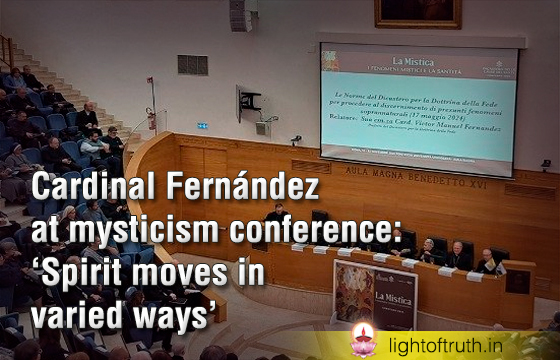
The free action of the Spirit—at times, as Saint Augustine said, “against nature,” blowing where He wills—is manifested in a mysticism open to all. Such experiences allow us to “taste” deeply the relationship with God, and can today serve as a “therapeutic path” in a world increasingly losing its “sensitivity toward God.” These were among the themes addressed on November 11, during the second day of the conference “Mysticism, Mystical Phenomena, and Holiness,” organized by the Dicastery for the Causes of Saints at the Pontifical Urban University.
Cardinal Víctor Manuel Fernández, Prefect of the Dicastery for the Doctrine of the Faith, spoke at the conference on 11 November, explaining the norms adopted by the Dicastery regarding the discernment of alleged supernatural phenomena. These norms rest on key principles, he said: “The Holy Spirit works in the Church with full freedom.”
In Catholic teaching, there is a firm conviction in the “freedom of the Spirit,” who may manifest in history in diverse ways, even through supernatural events such as apparitions or visions. In ordinary practice, the study of such cases often ends with a nihil obstat, which authorizes public devotion without pronouncing on the supernatural origin of the phenomenon.
Over the past fifty years, noted Cardinal Fernández, there have been about 3,500 cases of beatifications and canonizations. In the same period, however, only three or four declarations of supernatural origin have been issued—demonstrating the difficulty of reaching an official recognition of this kind.
A principal concern, added the Cardinal Prefect, is the risk that once a phenomenon is declared of divine origin, its messages may be taken as “revealed Word.” Such a declaration does not guarantee absolute certainty of authenticity. Even in cases recognized by the Church, they remain “private revelations,” which the faithful are free to believe or not.
The Church’s declaration therefore has a “prudential” nature, and in many cases is not even necessary: numerous manifestations have produced shrines and spiritual fruits without any official recognition.
Discernment, he said, helps distinguish genuine phenomena from those exploited for profit or control over others—situations that are “very, very concerning” and can lead to serious “abuses.”
The Dicastery’s norms propose possible “prudential conclusions” to be adopted before a phenomenon reaches proportions that make intervention more complex.
Some cases can be resolved locally, while others require direct involvement from the Dicastery when elements of confusion or potential risks emerge that demand careful discernment, concluded Cardinal Fernández.