
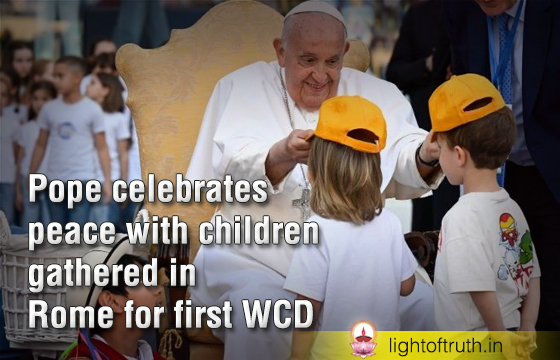
Some 50,000 children hailing from several countries around the globe gathered in Rome’s Olympic Stadium on May 25 to meet Pope Francis and reflect with him on their importance in the world’s future, as part of the first ever World Children’s Day (WCD). Peace was the main theme of the event.
The Pope addressed the young lively audience with a brief introductory speech in which he called for responses from the children. He opened his address by noting that in children “everything speaks of life and the future”, and by reaffirming that the Church, “as a mother”, welcomes them and accompanies them “with tenderness and hope.
He explained that he was inspired to convene the World Children’s Day by the meeting he held with children in the Vatican on November 7 on the theme “Let’s Learn from Boys and Girls.” “I realized that our conversation had to continue and extend to more children and young people,” he said.
The Pope then engaged in a series of questions with the children, starting from the many wars raging in several parts of the world. “Are you sad about the wars?”, “Is war a nice thing?”; “Is peace beautiful?” he asked, inviting the young audience to pray for children who suffer from wars, cannot go to school, are hungry, or neglected.
Category Archives: Uncategorized

Pope: Couples Need Church’s Help
“Your work is precious to the Church,” Pope Francis told the international leaders of the Teams of Our Lady International Catholic Movement for Christian Married Couples, as he thanked them for their commitment to help families, especially many “striving to live Christian marriage as a gift.”
The Christian family, the Pope warned, “is currently facing a true ‘cultural storm’ in this changing era, threatened and tempted on various fronts.” For this reason, the Holy Father emphasized the value of the efforts to accompany couples closely so that they do not feel alone in the difficulties of life and in their marital relationship. “In this way,” he said, “you are an expression of the Church ‘going out,’ which draws close to people’s situations and problems and spends itself without reserve for the good of families today and tomorrow.”
“It is a true mission today to accompany couples!” the Pope said. “To safeguard marriage, in fact, means to safeguard an entire family, it means to save all the relationships generated by marriage: the love between spouses, between parents and children, between grandparents and grandchildren.” It means, the Holy Father suggested, saving that witness of “a possible and forever love,” in which “young people struggle to believe.”
In Nigeria, kidnapping priests becomes a growth industry
Father Joseph Azubuike, a Nigerian priest who was kidnapped on July 10, has regained his freedom along with three other men travelling with him who were also taken.
Azubuike’s release, along with the three other kidnap victims, was confirmed to Crux by the Vicar General of the Abakaliki Diocese in Nigeria’s south-eastern Ebonyi state, Father Donatus O. Chukwu.
Chukwu explained that Azubuike had been kidnapped “in the evening hours of Monday, July 10, less than a kilometre from his rectory of St. Charles Parish, Mgbalaeze Isu, Onicha Local Government Area of Ebonyi State, Southeast Nigeria. He was returning from a pastoral engagement when the incident happened. They were taken into a forest.”
The kidnappers demanded a 50 million Naira ransom (roughly US $66,000) or Azubuike would be killed, Chukwu said.
In a report titled, “The Economics of Nigeria’s Kidnap Industry,” the research firm SBM Intelligence estimated that between July 2021 and June 2022, no fewer than 3,420 people were abducted across Nigeria, with 564 others killed in violence associated with abductions.
The Surprising Surge of Faith Among Young People
A greater share of young adults say they believe in a higher power or God. About one-third of 18-to-25-year-olds say they believe—more than doubt—the existence of a higher power, up from about one-quarter in 2021, according to a recent survey of young adults. The findings, based on December polling, are part of an annual report on the state of religion and youth from the Springtide Research Institute, a nonpartisan nonprofit.
Young adults, theologians and church leaders attribute the increase in part to the need for people to believe in something beyond themselves after three years of loss.
For many young people, the pandemic was the first crisis they faced. It affected everyone to some degree, from the loss of family and friends to uncertainty about jobs and daily life. In many ways, it aged young Americans and they are now turning to the same comfort previous generations have turned to during tragedies for healing and comfort.
Believing in God “gives you a reason for living and some hope,” says Becca Bell, an 18-year-old college student from Peosta, Iowa.
A Wall Street Journal-NORC poll published last month found that 31% of younger Americans, ages 18 to 29, said religion was very important to them, which was the lowest percentage of all adult age groups. A Pew Research Center study also released last month found that 20% of 18-to-29-year-olds attend religious services monthly or more, down from 24% in 2019.
Changing political scenario: Jesuits entrust Pakistan mission to Asia-Pacific region
Jesuit superior general Father Arturo Sosa has brought the congregation’s works in Pakistan under its Asia-Pacific region.
The general announced the change of jurisdiction for the mission in Pakistan in a March 28 message to Father Antonio Moreno, president of the Jesuit Conference of Asia-Pacific (JCAP). Father Sosa says the change will come into effect from April 1st.
The change has been done in view of the current political scenario in South Asia. The Pakistan mission has been served by the Jesuits in Sri Lanka, who come under the Conference of South Asia that comprises Ban-gladesh, Bhutan, India, Nepal, Pakistan and Sri Lanka.
The Jesuits’ global website says Pakistan currently has three Jesuits working in Lahore and five scholastics of Pakistan mi-ssion studying in Indonesia.
The general’s message says, “For several years now, the Paki-stan mission has been entrusted to the Sri Lanka Province. Re-cently however, difficulties have arisen that have made it extremely difficult for Sri Lanka to support the mission in Pakistan. First, geopolitical factors have severely restricted travel from Sri Lanka to Pakistan. Second, an acute shortage of Jesuit personnel in Sri Lanka has come to a point that the Province is no longer able to send Jesuits to Pakistan, now or in the near future.”
Father Sosa agrees that ideally other countries in South Asia should help Pakistan, given their geographical and cultural proxi-mity to Pakistan. “Unfortunately, neither is this possible, given the longstanding hostility between India and Pakistan, and the impossibility of travel between these two countries.”
The Asia-Pacific region will manage the Pakistan mission for three years on an experimental basis, the general says.
“I am confident, Fr. Moreno, that with your leadership and the assistance from the other Major Superiors of Asia Pacific, the mission in Pakistan will be able to carry on with its good work, and receive adequate guidance, sustenance, and support,” says Father Sosa’s letter to the head of the Asia-Pacific region.
Archbishop’s “assurance” to BJP unacceptable: Forum
An advocacy group for Catholic religious in India has termed as un-acceptable an archbishop’s conditional offer of support to the Bharatiya Janata Party saying it would have serious long term repercussions.
“We are shocked by the recent statement made by Archbishop Mar Joseph Pamplany of Tellicherry, given wide coverage by all sections of the media. According to media reports, “Archbishop Pamplany assured to extend support to BJP if the union government raises the price of rubber to 300 rupees,” says a statement of the Forum of Religious for Justice and Peace.
Indian state backs welfare benefits for Dalit Christians
A provincial government in southern India has urged the Indian federal govern-ment to award scheduled caste status to Christians who were former untouchables to enable them to claim welfare benefits.
The Andhra Pradesh government on March 24 passed a resolution in its legislative assembly to support Christians from the Dalit community becoming a Scheduled Caste (SC) which, if approved by the central government could one day allow them social benefits they are currently excluded from.
These benefits include reservations in legislative bodies, educational institutions, and job quotas in state-run institutions.
“Somewhere or somebody has to start it for this noble cause, hence we appreciate and thank the Andhra Pradesh govern-ment for taking such a step as it is in the right direction and at the right time,” Father Vijay Kumar Nayak, secre-tary of the Catholic Bishops’ Conference of India (CBCI) Office for Scheduled Castes and Backward Castes, told on March 27.
“The Andhra Pradesh government’s support will have an immense impact.”
“It’s the need of the hour,” he added.
Father Nayak said other states like Tamil Nadu, Bihar, Jharkhand, and West Bengal already support the claim by Dalit Christians to social benefits which are currently enjoyed by their counterparts from the Hindu, Buddhist and Sikh religions.
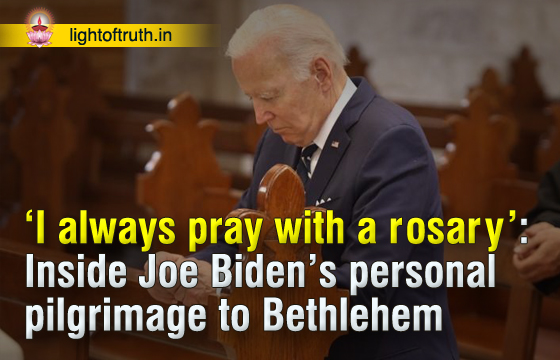
‘I always pray with a rosary’: Inside Joe Biden’s personal pilgrimage to Bethlehem
One part of President Joe Biden’s ultra-publicized trip to the Middle East took place in private, away from the eyes of any of the journalists who accompanied him on the five-day visit.
The president was accompanied only by a single Secret Service agent when, after meeting with Palestinian President Mahmoud Abbas in Bethlehem on July 15, he went on a personal pilgrimage to the complex containing the Basilica of the Nativity and the Church of Saint Catherine to pray.
Ibrahim Faltas, a Franciscan priest with the Custody of the Holy Land, first met Him, at the Jerusalem ceremony in which Israeli President Isaac Herzog awarded the U.S. president Israel’s highest civilian distinction, the Presidential Medal of Honour. Saint Catherine’s, adjacent to the basilica, is where the Latin Patriarch of Jerusalem traditionally holds the crowded midnight Mass on Christmas Eve. Last Friday, anticipating Mr. Biden’s visit, it was empty.
“After going to the grotto he came to Saint Catherine’s Church, where I received him,” Father Faltas said, in an exclusive interview with America. “He arrived with the Custos and only one Secret Service agent.”
“He took a rosary out of his pocket, saying, ‘I always pray with a rosary,’ and remembered his son Beau. He cried. He was very emotional,” Father Faltas said, about the moment in which Mr. Biden kneeled alone in a wooden pew, the rosary in his hands, and prayed.
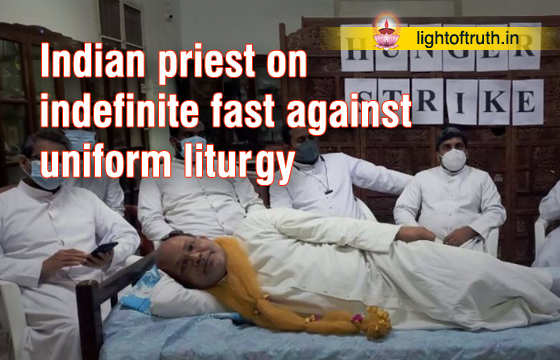
Indian priest on indefinite fast against uniform liturgy
A Catholic priest in India has launched an indefinite hunger strike against his Eastern-rite Church’s demand that all priests stop celebra-ting Mass facing the congregation in order to have uniformity in the liturgy. Father Babu Joseph Kalathil of Ernakulam-Angamaly archdiocese started his fast in the arch-bishop’s house on Jan. 12. He said the synod’s decision meant priests turning to the altar during Eucharistic prayer, which was not acceptable to him and his supporters. Fr Kalathil represented the priests of the archdiocese who pledge their full support to him. He followed by Fr Tom Mullanchira and two laymen Prakash P. John and N.O. Thomas continued the fast until Abp Kariyil CMI gave word that Mass facing the people will be followed in the archdiocese. Priests have accused Card. Alencherry and the bishops who support him of causing a rift between priests and the laity by insisting on a uniform liturgy. “If the synod continues with its adamant stand, the archdiocese with more than 500,000 followers will be in turmoil and the future of the church will also be at stake,” he said.
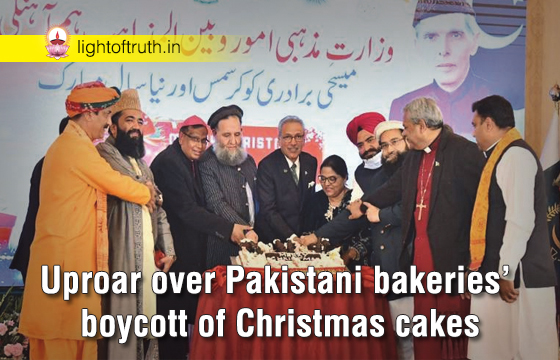
Uproar over Pakistani bakeries’ boycott of Christmas cakes
Two popular bakeries in the Pakistani city of Karachi have caused uproar on social media after refusing to decorate cakes with Christmas greetings.
The controversy began after Celestia Naseem Khan, a Kara-chi-based student, reported on social media that Delizia Bakery refused to write “Merry Christ-mas” on a cake she bought.
“So I recently went to Delizia to buy a cake and when I asked them to write “Merry Christmas” on it and they clearly declined me, the guy said he’s not allowed to write it and they have given an order from the kitchen about this,” Khan said.
Following her post, thousands sent Merry Christmas greetings to the bakery while some Christians projected the bakery’s refusal as an expression of increasing intolerance in the port city known for its inter-religious community.
The bakery management, however, said in a social media post the refusal was an individual action and not part of management policy.
“This is clearly the act of an individual and we do not discriminate on the basis of religion or creed. At the moment we are taking action against him. It was done in an individual capacity and is not company policy,” it said. “It may have been done due to lack of education and awareness that ‘Merry Christ-mas’ means wishing someone a happy Christmas, nothing else.”