Category Archives: National

Religion blamed for India’s poor gender equality grade

A global study of gender equality has placed India nearly at the bottom, with some research and rights groups accusing religion of playing a major role in Indians discriminating against women.

The Sustainable Development Goals Gender Index ranked India 95th out of 129 countries. The index measures how well nations are progressing toward achieving gender equality by 2030, which is part of the 17 sustainable development goals set by the United Nations.

The index, developed by U.K. based Equal Measures 2030 and released on June 4, is a joint effort of regional and global organizations. It placed Denmark at the top and Chad at the bottom.

However, India fared better than its neighbours, with Pakistan at 113, Nepal at 102 and Bangladesh at 110. China was in 74th position.

Gender equality progress is measured by a set of indicators including the proportion of seats held by women in national parliaments. India ranked 16th in the region as women made up only 1.8 percent of parliament in 2018. Another indicator is the extent to which a national budget is broken down by factors such as gender, age, income or region. India scored zero, the worst in the region.

The percentage of seats held by women in India’s Supreme Court was the fourth worst in the region.

Allen Frances, a women’s rights activist in New Delhi, said the gender gap in India is “deep and dreadful” as women comprise 48 percent of the nation’s population of 1.25 billion.

Discrimination against women results in social evils such as child marriage, Frances said. India has 24 million child brides, 40 percent of the world’s 60 million child brides.

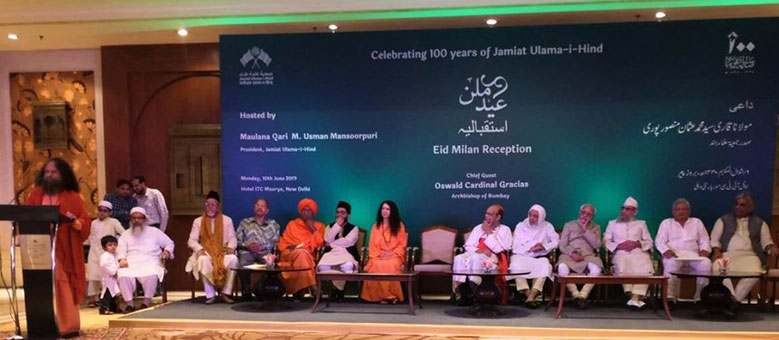
Gracias applauds Modi for “emphatic” election victory

The head of the Catholic Church in India has congratulated Prime Minister Narendra Modi for his emphatic victory in the just concluded general elections.

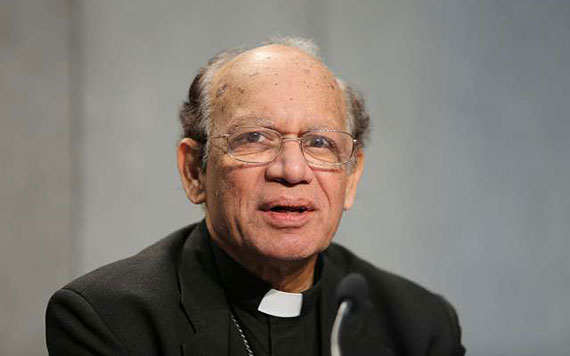
“On behalf of the Catholic Church in India, and on my own behalf, I extend my heartiest congratulations to you and to the Bharatiya Janata Party,” Cardinal Oswald Gracias, president of the Catholic Bishops’ Conference of India, said in a letter addressed to Modi.

The cardinal, who is also the archbishop of Bombay, the largest diocese in India, noted in the May 25 letter that the people of India have given “a clear mandate for a stable and effective government.”

The results of the general election, held in seven phases from April 11 to May 19, were announced on May 23. The National Democratic Alliance led by Modi’s Bharatiya Janata Party won 353 of total 543 seats in the Lok Sabha, the lower house of parliament.

The cardinal also congratulated Amit Shah, president of the Bharatiya Janata Party, who played the key role in the election victory.

“I want to assure you of our prayers and best wishes for you and your team as you lead our country in building a strong and inclusive India,” Cardinal Gracias.

He also said that a public function on May 25 had prayed for health, wisdom and strength for the prime minister to carry out the great responsibilities entrusted to him.

The Church leader also offered to collaborate with the government’s vision to create a new India.

“We are all eager to work together for …a New India which gives hope and energy to our youth, empowers our women especially in rural areas, opens new and sustainable opportunities for our farmers and strengthens our economy while leaving no one behind: a New India which enjoys peace and prosperity and continues to make progress.”

Vaidehi Vijayakumar is VC, Mother Teresa Women’s University

Tamil Nadu Governor Banwarilal Purohit appointed Vaidehi Vijayakumar as Vice-Chancellor of the Mother Teresa Women’s University at Kodaikanal.

Purohit, who is also the Chancellor of the University, said Vijayakumar would hold office for a period of three years.

Vijayakumar had served Anna University and several overseas universities including Ryerson University, Canada as professor and has presented 266 papers at international level research and academic events, a Raj Bhavan release said.

She was also the Head of Department for six years in Anna University and was also the Dean in VIT University.

She was a Member of Board of Studies of various universities and at the Academic Council of Anna University and Vellore Institute of Technology, it said.

Supreme Court suspends tax on priests, nuns

The Supreme Court of India has given temporary relief to priests and nuns who were asked to pay income tax for the salary they earn working in government-funded educational institutions.

The top court on May 9 asked authorities to maintain the status quo of not collecting such taxes and agreed to hear an appeal against an order of the Madras High Court in Tamil Nadu state.

The Supreme Court was hearing a challenge filed by the Institute of Franciscan Missionaries of Mary to a March 20 order of the state court that said missionaries, Catholic priests and nuns should not be exempt from paying tax on government-assisted salaries.

The top court posted the case for a final hearing on Aug 7.

“We are happy that we got temporary relief,” said Father L. Sahayaraj, deputy secretary of the Tamil Nadu Bishops’ Council.

He said the Church in the state was determined to fight the case.

He told ucanews.com that Catholic priests and religious serving in government-aided educational institutions did not have any income because their salary is contributed to their convents or houses “so they cannot be asked pay income tax.”

The state court ordered an end to this exemption on the basis that they received their salaries in their individual capacity and that surrendering salaries could only be treated as “application” of their income.

Their choice of application did not merit tax exemption, the court order stated.

Two-child norm for subsidies, government jobs urged

The Delhi High Court on May 28 was moved for implementation of the national commission to review the working of the Constitution (NCRWC) proposal on population control and ‘two-child norm’ as a criteria for government jobs, aid and subsidies.

A public interest litigation (PIL), filed by advocate Ashwini Kumar Upadhyay, sought direction to the Centre to ascertain the feasibility of implementing the 24th recommendation of the NCRWC (Justice Venkatchaliah Commission) on population control.

In his plea, Upadhyay said the right to clean air, drinking water, health, peaceful sleep, shelter, livelihood and education could not secured for citizens without effective population control.

Stating that the government has not implemented the NCRWC proposals, the petitioner sought withdrawal of statutory rights like the right to vote, contest, property, free shelter and free legal aid.

Upadhyay requested the court to direct the government to spread awareness on population explosion and provide contraceptive pill, condoms and vaccines to economically weaker section and below poverty line families.

He also sought direction to the law commission to prepare a comprehensive report on population explosion within three months and ways to control it.

Indian missionary finds great thirst for Gospel in Africa

Sister Carmel Madathiparampil began working in Africa as a missionary since 1993.

That was the year, the Daughters of St Paul, started the African mission project to commemorate the birth centenary of Servant of God Thecla Merlo, who founded the congregation along with Blessed James Alberione. It also coincided with Madathiparampil’s 25 years in the congregation. While in India, she worked in Mumbai, Delhi, Secunderabad and Shillong.

She began her African mission as community animator of Zambia. She shared with Lissy Maruthanakuzhy about her work in Africa.

It is 25 years since she has been working in Africa. In 1993, our congregation decided to launch a missionary project – open 15 new communities in countries where we were not yet present.

“The countries chosen were: Angola, China, Czech Republic, Dominican Republic, Ivory Coast, Paraguay, Puerto Rico, Romania, Russia, Singapore, South Africa, Thailand, Uruguay, Vietnam, and Zambia.

I was among many sisters who responded. I was chosen for Zambia. I was excited. But I had to search the world map to find its location. I was thrilled to go to Africa.

I felt a new enthusiasm surging in me, like the one I experienced when I first decided to become a Daughter of St. Paul. I truly wanted to be a true daughter of St. Paul, emulating the saint’s apostolic zeal. Like him I wanted to go to the whole world and proclaim the Good News of Jesus.

I always experience new challenges in my mission in Africa. I see in the people of Africa a great thirst for the Word of God and for spiritual matters. The more I see this thirst, the greater is my response to respond. Like St. Paul who made himself all things to all people, nothing can stop me from spending myself in the mission.”

“The African people are very welcoming of missionaries. They are very respectful, generous, supportive, kind hearted, ready to collaborate, open and receptive.”

Indian court suspends tax on priests, nuns

The Supreme Court of India has given temporary relief to priests and nuns who were asked to pay income tax for the salary they earn by working in government-funded educational institutions.

The top court on May 9 asked authorities to maintain the status quo of not collecting such taxes and agreed to hear an appeal against an order of the Madras High Court in Tamil Nadu State.

The Supreme Court was hearing a challenge filed by the Institute of Franciscan Missionaries of Mary to a March 20 order of the state court that said missionaries, Catholic priests and nuns should not be exempted from paying tax on government-assisted salaries. The top court posted the case for a final hearing on Aug.7.

“We are happy that we got temporary relief,” said Father L. Sahayaraj, deputy secretary of the Tamil Nadu Bishops’ Council. He said the Church in the state was determined to fight the case.

He told ucanews.com that Catholic priests and religious serving in government-aided educational institutions did not have any income because their salary is contributed to their convents or houses “so they cannot be asked pay income tax.”

The state court ordered an end to this exemption on the basis that they received their salaries in their individual capacity and that surrendering salaries could only be treated as “application” of their income.

Their choice of application did not merit tax exemption, the court order stated.

The case dates back to 2015 when Tamil Nadu’s income tax department instructed state-funded educational institutions to deduct tax from the salaries of priests, religious brothers and nuns, ending a long-standing convention exempting them.

“Arson” destroys church in Tamil Nadu

A church in Tamil Nadu was destroyed in a suspicious arson attack, Matters India learnt on May 11. According to Shibu Thomas, founder of Persecution Relief, the incident occurred on April 24 at Thittacherry, Nagapattinam.

Member of the “Jesus with us” had gathered in the church for a fasting prayer meeting.

The meeting ended late in the evening and after everybody had left, pastor Sachin Paneerselvam, locked the sanctuary and left for his home, 12 km away.

A few hours after reaching, Paneerselvam and his family were getting ready for bed when he got a call from the local Naneelan station at 11 pm that the church building was on fire.

Thomas, who heads Persecution Relief, an ecumenical church group, said Paneerselvam wanted to rush to the church, to help put out the fire and salvage the contents. However, the police were adamant that he should not come to the spot as fire-fighters were battling the blaze. Police said that they would investigate the cause of the fire to ascertain.

Persecution brought us religious vocation: Kandhamal sisters

Hundreds of Christians and Hindus attended a thanksgiving Mass for two sisters who became full-fledged Catholic nuns after suffering religious persecution as teenagers in Odisha’s Kandhamal district.

While Manjuta Pradhan professed final vows as a member of the Franciscan Sisters of St Joseph on April 27, her elder sister pronounced her vows in the Daughters of Charity two years ago.

However their village decided to honour both the sisters with a thanksgiving Mass on May 4 at Our Lady of Charity Church, Raikia, a major parish under the Cuttack-Bhubaneswar archdiocese.

More than 2,500 people, including some Hindus who had persecuted the two nuns’ family, attended the Mass.

The two nuns hail from Badingnaju (village built on rock), a substation of Raikia.

Assistant parish priest Father T. Francis Kanhar who led the Mass said, the two nuns lived up to the name of their village by remaining like or rock in their faith. “During the 2008 communal violence, they underwent pain, agony, persecution as their Hindu neighbours chased them from their native place. But they remained very strong in their faith in Christ and that has brought them to this state. They have now become an inspiration to many Hindu neighbours. Nothing is impossible in the eyes of God,” the priest told the gathering.

The sisters agreed with their parish priest.

Naga choir to represent India at Asian youth conference

A choir comprising of different Naga tribes and Churches would represent India at the Asia Baptist Youth Conference in the Philippines. The Cantamus choir would represent Nagaland Baptist Church Council (NBCC) at the May 21 -24 conference in Baguio city of the Philippines.

In this connection, Cantamus choir would organize a concert to raise funds in collaboration with NBCC and music task force on May 12, at Jotsoma. The choir had performed on the occasion of the 55th Nagaland statehood day along with 400 children. It also represented NBCC at the All Mizoram Baptist Church Youth Triennial Convention attended by more than 900 youths recently.