

Catholic dioceses in northern India plan to set up centres to help migrant labourers.
This was decided on August 7 during a virtual meeting organized by the Commission for Migrants under the Regional Bishops’ Council of the North (RBCN) in collaboration with its counterpart under the Conference of Catholic Bishops’ of India (CCBI).
The diocesan migrant resource centres along with helpline services to migrant workers will be prepared in collaboration with various CCBI commissions and coordinated by the conference’s secretariat based in Bengaluru.
The various commissions of CCBI will prepare a concept note on data collection, besides setting up the centres and launching helpline services to migrant workers.
The purpose of the centre is to collect data on migrants and make its services accessible and available to them. The concept note prepared at the online meeting has specified the quality of the data.
Other plans include engaging the migrants into mainstream society and encourage them to join the Church’s spiritual and welfare programs. It will also link them with the Church’s educational and healthcare insti-tutions that would accommodate and serve the migrants.
The migrant commission is to network with dioceses, reli-gious congregations, lay associa-tions and government for an integrated approach.
Category Archives: National
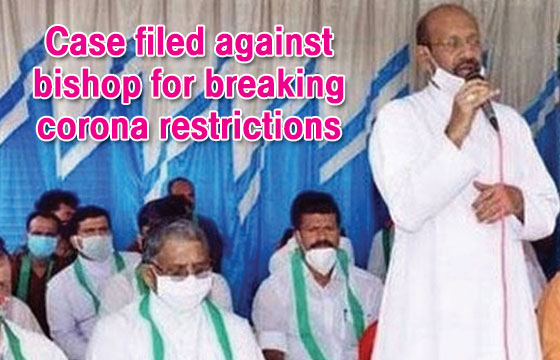
Case filed against bishop for breaking corona restrictions
Police in Kerala have registered a case against Bishop Remigiose Inchananiyil of Thamarassery for breaking coronavirus restrictions.
The Syro-Malabar prelate is among 40 people charged by the police for participating in a protest at the Forest Range Office in Thamarassery, near Kozhiko-de, a town in northern Kerala.
A collective of 15 farmer organizations under the banner of the Karshika Purogamana Samiti (KPS, Forum for the advancement of agriculture) staged a fast at Sulthan Bathery on June 25, raising a series of demands including effective steps to tackle the increasing wildlife attacks in the district.
Bishop Inchananiyil, who opened the protest, said that wildlife attacks had increased considerably in Kerala over the past decade, especially in hilly areas such as Wayanad.
Though a tribal youth was mauled to death by a tiger at Pulpally in Wayanad, the Forest department officials could not capture the animal, the bishop said. He said that successive governments in Kerala had not taken any steps to address the issue. The collective protest by the farming community against the escalating wildlife attacks was the need of the hour, he added.
The protesters demanded that the administration capture the man-eater, adopt scientific steps to divide forest areas and human habitations, amend Forest Acts, erect of hanging fences on the fringes of forests to curb man-animal conflicts, and increase the compensation for crop losses suffered in wildlife raids.
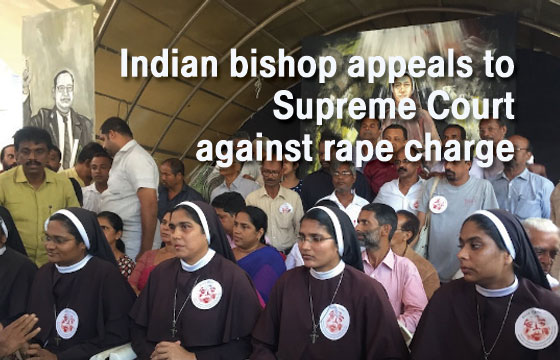
Indian bishop appeals to Supreme Court against rape charge
Bishop Franco Mulakkal of India’s Jalandhar Diocese, who is facing trial on charges of raping a Catholic nun, has appealed to the country’s top court to clear him, pleading innocence after two lower courts rejected a similar petition.
The Supreme Court of India registered Bishop Mulakkal’s discharge plea on July 24 and agreed to hear him, according to court records published on its website. However, the court has not given a date to hear the case.
Lawyers connected with the case told UCA News that the 56-year-old bishop moved the top court after the High Court in Kerala State dismissed his dis-charge plea on July 7.
His appeal in the High Court came after a district court in Kottayam in Kerala dismissed a similar plea on March 16.
Bishop Mulakkal’s applica-tion pleaded innocence. It said a 43-year-old nun, former superior general of the Missionaries of Jesus, a diocesan congregation under his patronage, complained against him with malafide inten-tion following his differences with her.
The nun, based in Kerala, filed a police complaint in June 2018 accusing the bishop of raping her 13 times from 2014-16. The crimes happened when the Bishop, based in northern India, visited her convent in the southern state.
The Supreme Court did not give the Bishop any immediate relief as both the prosecution and the petitioner nun had moved separate caveats before the Supre-me Court pleaded not to decide on the case without hearing them.

Rome gifts a basilica to Syro-Malabar faithful
The faithful of the Syro-Malabar rite now have a basilica for worship. The community coordinator, Fr Biju Muttathu-nnel, comments: “We are all celebrating, it is a great gift from the diocese and the Vatican.” An estimated 7 thousand faithful belonging to this rite live in the Italian capital and surrounding province: originating in Kerala (Southern India), they are now integrated within the Italian community.
According to Catholic tradi-tion, this Eastern rite church traces its origins to the preaching of St Thomas the Apostle on the subcontinent. For more than 25 years it was sui iuris, and there-fore has the right to erect its own communities where the faithful have emigrated.
There is a large presence of Syro-Malabarians in Chicago, Melbourne, Canada and the United Kingdom. In Europe the community has an apostolic Visitor, Msgr Stephen Chirappa-nath, who coordinates the com-munities of Zurich, Cologne, Frankfurt and Vienna.

Indian Protestant bishop breaks away, declares free church
A bishop of the Protestant Church of North India (CNI) has broken away and declared his diocese autonomous following differences with the church’s national administrative body. Bishop Basil B. Baskey of Chotanagpur Diocese in Jharkhand State was asked to go on leave soon after he announced the rebellious move.
The CNI synod, its top decision-making body, constituted a probe into the bishop’s move to decide what action to take.
“I have already declared the diocese as an autonomous church and have no link with the CNI to follow its order,” Bishop Baskey told UCA News on July 22.
The synod’s disciplinary action against him came on July 21, four days after the bishop declared his diocese independent of the mother church.
The synod has appointed Chotanagpur diocesan secretary pastor Joljas Kujur as diocesan administrator and formed a new committee to assist him until other arrangements are made for the management of the diocese.
Bp Baskey claimed to have the support of all the pastors ser-ving in the diocese’s 52 parishes.

Church joins to oppose coal mine auction in Jharkhand
Church leaders and activists have joined political leaders in opposing the federal government’s decision to auction coal blocks for commercial mining in the eastern Indian State of Jharkhand, which they say will disturb biodiversity and cause displacement.
Hearing the case on July 15, the Supreme Court asked the federal government’s opinion on Jharkhand State government challenging the federal decision to go ahead with the auction of coal blocks.
“Tribals in the state dependent on farming and forestry, so allotting land for mining will destroy vast areas of the forest as well as the farmland resulting displacement and migration,” said Father Vincent Ekka. He heads the department of tribal studies at the Jesuit-run Indian Social Institute in New Delhi.
“I even doubt the central government’s claim of job opportunities for locals. Mining goes on in several states for decades without concern about its impact. If it provides job for locals, why there is a mass migration from these states,” Father Ekka said.
“There are other ways for the government to generate income and stabilize the nation’s economic condition without disturbing the livelihood of tribal people, who are the protectors of the environment,” the Jesuit priest added.
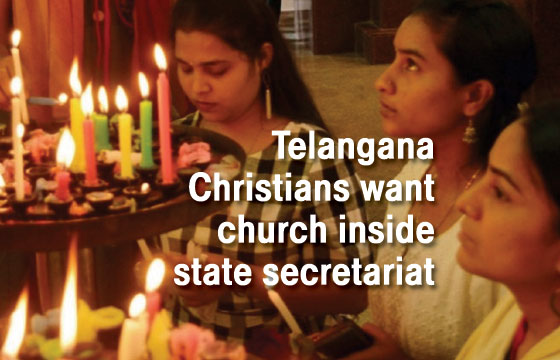
Telangana Christians want church inside state secretariat
A body representing prominent churches in the southern Indian State of Telangana has urged the state government to build a church along with a temple and a mosque in the new secretariat.
The Federation of Telugu Churches, a body of churches in the state, also reminded their Chief Minister K. Chandrashekar Rao about a regular prayer previously conducted in the old secretariat building.
“Christian workshops were conducted every Wednesday during the lunch break,” in the old secretariat, according to Father Anthoniraj Thumma, executive secretary of the Federation.
Father Thumma said in a press note on July 13 that “this time we have requested a different church building, which the mosque and temple had. “On previous occasions, we have requested the government for the allotment of land in the secretariat. This is a long-pending request.”
Tamil Nadu bishops launch online career guidance for Dalits
Catholic Bishops in Tamil Nadu have started an online program to provide career guidance to Dalit students in the southern Indian State.
Although the Tamil Nadu Bishops’ Council have conducted many career guidance programs in the past this is the first online career guidance program for Dalit Christians, said Bishop P. Thomas Paulsamy of Dindigul while launching the program on July 5.
The bishop is the chairperson of the council’s Commission for Scheduled Castes and Scheduled Tribes that conducts the program.
As many as 150 students from the state’s 18 Catholic dioceses attended the first-day program. The students will be guided in their desired area of study once a week, said Father Kulandainathan Adaikalasamy, the organizer and the secretary for the commission.
The program, he told Matters India, aims at providing “the best education possible for all the poor and the marginalized children.”
The commission hopes to instill new ideas and thoughts in Dalit students, to create new goals, and to make their dreams come true. No student would be deprived of higher education because of poverty, untouchabi-lity, and ignorance, he added.
The students sat in groups in villages maintaining the distance while attending the online pro-gram.
Archbishop, nuns among India’s spiralling Covid-19 cases
A Catholic archbishop and 12 nuns are among thousands of persons who have tested positive for Covid-19 in India in the past days.
The nuns work at a church-run hospital in the north-eastern State of Assam. State officials sealed off their hospital and moved them to a government facility for treatment.
Retired Archbishop Bernard Moras of Bangalore in southern India tested positive for Covid-19 on July 3 during a routine check-up at church-run St John’s Medical College. His condition is stable, the hospital said.
The prelate and nuns are among some 700,000 Covid-19 cases reported in India as of July 5. Some 24,000 people tested positive on July 5 in the worst single-day spike in the country. Close to 20,000 have already died.
India has been struggling to flatten the coronavirus curve since cases began to increase in mid-March. Since July, the country has been adding more than 20,000 infections each day, with more people testing positive even in villages.

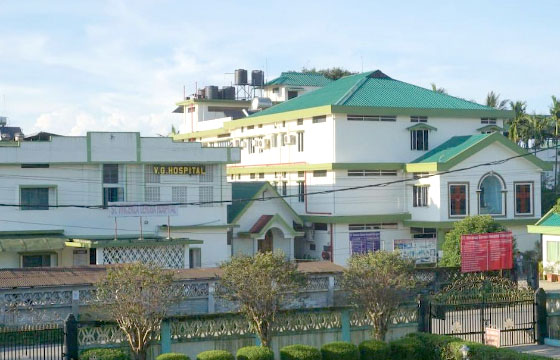
Covid-19: Mission hospital in Assam sealed, nuns infected
A mission hospital in Assam’s Dibrugarh town was sealed after 12 Catholic nuns, including a doctor, was tested Covid-19 positive. The nuns and a domestic support working in the St Vincenza Gerosa (VG) Hospital were on July 4 found to be infected with the coronavirus.
The first to test positive was the superior of the VG hospital community, who had traveled to Guwahati, Assam’s commercial capital, some 445 km southwest of Dibrugarh. On July 31, she showed mild symptoms of fever and a bad stomach. This led to the testing of all residents of the community.
Although four others have tested negative, the local administration has declared the entire hospital area a contaminated zone.
Samples of all other inmates, staff, primary contacts and regular visitors are being collected and sent for testing at Regional Medical Research Centre, Dibrugarh.
Four of the nuns are senior citizens – Sisters Antonia Mampilly, 85, Eileen Almeida, 72, Michael Serrao, 82, and Martha Kochuparambil, 83.
Expressing shock over the developments, Bishop Joseph Aind of Dibrugarh said, “It is sad that the lifeline hospital of people in Assam and Arunachal Pradesh has now been sealed. My heart goes out to all the Sisters and the inmates of VG Hospital and I invite everyone to pray for their quick recovery from the disease and for the reopening of the hospital.”
In a note to the people in his diocese, Bishop George Pallipparambil of Miao in Arunachal Pradesh has asked them to pray for the sisters and advised everyone to take extreme care to avoid the virus and comply with the lockdown restrictions.