
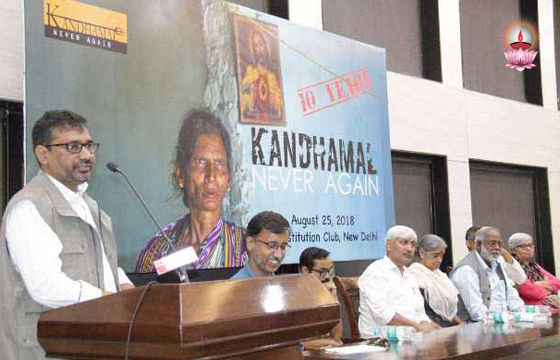
A Bharatiya Janata Party (BJP) leader has alleged that Australian missionary Graham Stuart Staines, who was murder-ed along with his two sons in Odisha in 1999, was involved in conversion activities among tribal people.
During his submission on the debate on the Foreign Contribution (Regulation) Amendment Bill, Satya Pal Singh told parliament that Staines’ organization, the Evangelist Missionary Society, was converting tribal people to Christianity.
“There was uproar over Graham Staines. What happened to him and his two children was wrong,” the BJP leader from the northern State of Uttar Pradesh said on Sept. 21.
“But agencies like the Central Bureau of Investigations, Odisha Crime Branch and the Justice D.P. Wadhwa Commission con-cluded that tribals were being converted there. It was the biggest reason that people turned against Staines.
Suspected Hindu fanatics burned Staines and his sons Philip, 9, and Timothy, 7, inside their jeep on Jan. 23, 1999, in Odisha State’s Keonjhar district.
However, Singh’s remarks have saddened Christian leaders and communities in India.
Category Archives: National
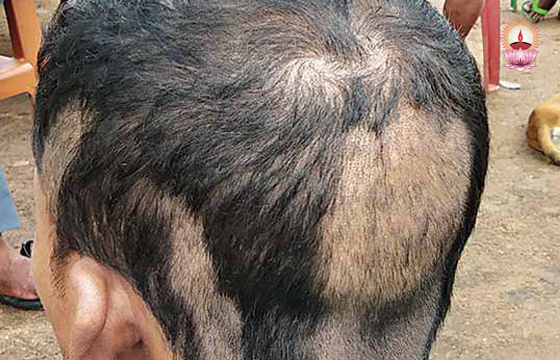
Tribal Christians tonsured in Jharkhand village
Seven tribal Christians were allegedly beaten, partially ton-sured and forced to chant “Jai Shri Ram.” (Hail Lord Ram) in a Jharkhand village for allegedly slaughtering a cow.
The September 16 incident, reported to the police the next day, came to public only on September 25 when former zilla parishad (district council) member and social activist Neel Justin Beck told a local news portal about it.
Police have confirmed the incident. Shams Tabrez, the superintendent of police in Simdega district where the attack took place, said four of the nine named as accused in the First Information Report have been arrested and the rest would be picked up soon. The FIR also mentions 10 unnamed accused.
Jharkhand had witnessed the lynching of several tribal people and Muslims on unsubstantiated charges of cow slaughter or beef possession during the tenure of its previous BJP-led government (2014-2019). This is the first reported communal attack since an alliance of various secular parties came to power last December.
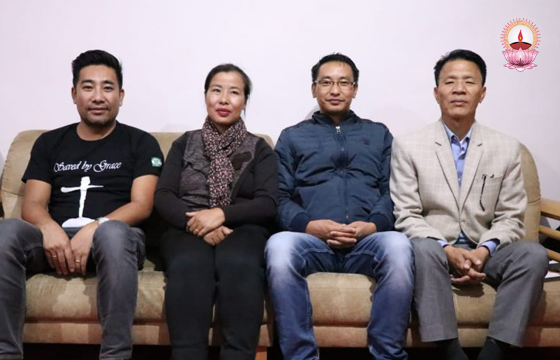
Tangkhul Churches fast, pray for Naga solution
Tangkhul Churches on September 24 fasted and prayed for Naga unity and for peaceful settlement of the Naga political issue. Briefing the media, Remember Rimai, convener of Tangkhul Community Inter-Denomination Churches leaders and a pastor of Union Baptist Church in Ukhrul town, highlighted the main objectives of holding the fasting prayer program across Tangkhul villages. The day is dedicated as “Tangkhul global one day, fasting prayer day” under the banner “Oneness in Christ with Trust,” he added. Rimai said that all the Tangkhul Christians took part in the fasting prayer program at their respective Churches to show support to the collective leadership of NSCN (IM) led by Muivah.
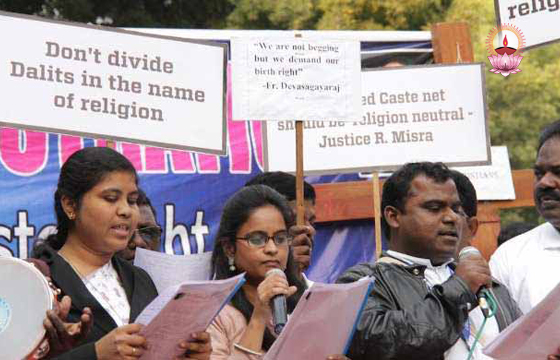
Dalit Catholics threaten to start new Indian church
Dalit Catholic leaders across India have threatened to start a new church if their demand to end casteism and discrimination against Dalits in the Catholic Church is not met. Around 30 speakers and 150 participants attended a virtual meeting on Sept. 5 organized by six Dalit Christian organizations from the southern State of Tamil Nadu.
“If the Vatican does not immediately remove the discriminatory process of bishop selection that neglects qualified Dalit priests, we could announce our own Indian Dalit Catholic Church or the Indian Dalit Catholic Rite,” Franklin Caesar Thomas, coordinator of the National Council of Dalit Christians (NCDC), told.
“The new church will separate Dalit Catholic Christians from the Indian Catholic Church’s casteist leadership.”
During the virtual meeting, Dalit leaders appealed to the Catholic Church, the apostolic nuncio to India and Pope Francis to curb the visible and invisible untouchability practices that exist in the selection of bishops.
They said that none of India’s four cardinals and 31 archbishops have a Dalit background. Similarly, among 188 bishops, only 11 are from the Dalit community. In caste-ridden Tamil Nadu, only one of 18 bishops is from a Dalit background.
Dalits, formerly untouchables, are the lowest caste within Hindu society. Huge numbers of Dalits have converted to Christianity and Islam over the decades, though the religions offer limited protection from societal prejudice.
The word Dalit means “trampled upon” in Sanskrit and refers to all groups once considered untouchable and outside the four-tier Hindu caste system. Government data shows 201 million of India’s 1.2 billion people belong to this socially deprived group. Some 60 percent of India’s 25 million Christians are of Dalit or tribal origin.
Vincent Manoharan, national convener of National Dalit Christian Watch (NDCW), told that years of protests by the Dalit Christian community had not brought any positive changes. He said protest marches are planned near the nuncio’s office and the headquarters of the Catholic Bishops’ Conference of India (CBCI).
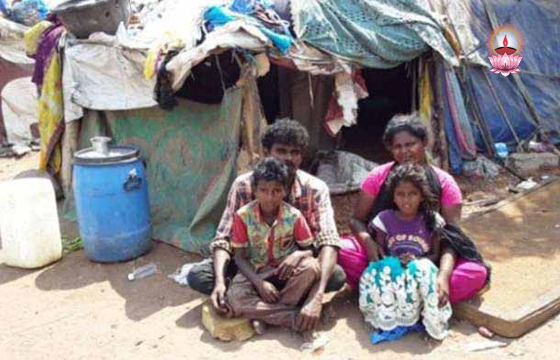
Minorities make up more than half of India’s prisoners
Muslims, Dalits and tribal people are more likely to be imprisoned in India than Hindus, according to a new report. The National Crime Records Bureau (NCRB) report also says that that these groups make up around 52% of inmates across the country.
“Minority groups have been subject to suppre-ssion for several years, so it is nothing new. There is prejudice among people that crime is always committed by minorities,” Father Vijay Kumar Nayak, secretary of the Indian Catholic bishops’ office for Dalits and lower classes.
“It is obvious that their number is more because of their illiteracy, financial crises and lack of means to engage lawyers, plus police bias to file charges against them freely without fearing a backlash.”
The priest said these minorities are poor, vulnerable and easy prey for authorities. Muslims, Dalits and tribal people together account for 39 percent of India’s population, according to the 2011 census, Muslims make up 14.2%, scheduled castes 16.6% and scheduled tribes 8.6%.
According to the NCRB, at the end of year 2019, Muslims formed 16.6%, Dalits 21.7% and tribal people 13.6% of India’s prison population. Muslim leader Muhammad Arif, chairman of the Centre for Harmony and Peace, told that the poor are “left at the mercy of God to fend for themselves.”
“The so-called media, which claims that it is secular, is least bothered to raise its voice at national level as it is more concerned with the activities of the elite group,” said Arif, whose organization is based in Uttar Pradesh.
“There are several cases in our country where the police arrest poor people in the name of solving the problem.”
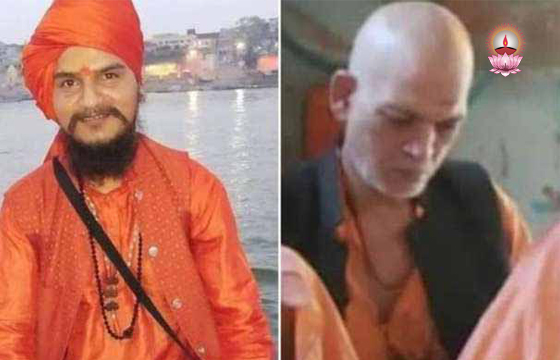
Hindu-led inquiry blames Indian Christians for lynching of priests
A fact-finding team led by a Hindu nationalist group in the western Indian State of Maharashtra has blamed Christians and left-wingers for violence that led to the killing of two Hindu priests.
The report by Vivek Vichar Manch, an NGO affiliated to Hindu nationalist group Rashtriya Swayamsevak Sangh (RSS), said the lynching was “anything but spontaneous.”
Vivek Vichar Manch has demanded federal investigation agencies such as the National Investigation Agency (NIA) or the Central Bureau of Investigation (CBI) handle the case.
“It has become fashionable these days to demand a CBI/NIA investigation. The demand made by the so-called fact-finding inquiry would have been more credible had it not come from an RSS-backed organization,” Joseph Dias, founder of the Mumbai-based Catholic Secular Forum, told.
“After targeting Muslims, it is now the turn of the left and Christians. Our community is known internationally for being non-violent and turning the other cheek and loving even our enemies as Jesus commanded.“
The lynching was fuelled by rumours circulating on Whats-App of thieves operating in the area during India’s nationwide lockdown to stem Covid-19.

Kerala records lowest male-female literacy gap in India
With 96.2 percent literacy rate, Kerala became India’s most literate state, according to the latest figures released by the National Statistical Office. Delhi came in second with 89 percent literacy rate. Uttarakhand with 87.6 percent and Assam with 85.9 percent are placed in third and fourth positions in the list. Earlier, south Indian states had topped as the most literate states. But the latest figures show a different story. Andhra Pradesh marked the worst literacy rate of 66.4 percent. Bihar with 70.9 percent, Telangana 72.8 percent and Karnataka 77.2 percent are the other states which marked low literacy rate compared to Kerala and Delhi.
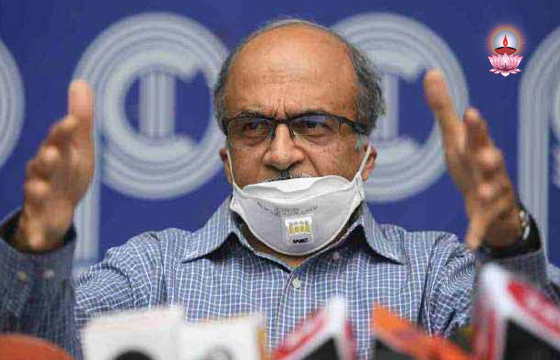
Priest-lawyers regret Indian court punishing activist
The decision of India’s top court to punish an activist lawyer for his criticism of the court raises concerns about free speech in the country, say activists including some Catholic priest-lawyers.
The Supreme Court on Aug. 31 imposed a token fine of one rupee on Prashant Bhushan after he was convicted of contempt of court for two tweets that question-ed the functioning of the court.
“Such a punishment is uncalled for,” said a statement from the National Lawyers Forum of Religious and Priests, a body of more than 200 Catholic priests, brothers and nuns.
The punishment may not be severe “but it could be perceived as an outcome of egotism,” said the forum of priests and nuns who practice law in different courts.
The court “in the name of protecting the institution of the constitution has let down the constitutional tenets,” the statement said.
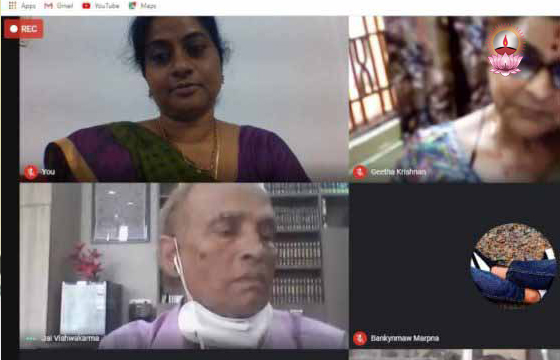
Telangana people’s assembly presents eight-point demands
Revival of grant-in-aid to Christian minority schools, land for cemeteries and stringent action against those attacking Christians are in an eight-point charter of demands that the Telangana State People’s Assembly on September 7 submitted to opposition parties in the southern Indian state. The assembly that met on September 4-7 in the state capital of Hyderabad also demanded that the state government allot necessary budgets to help Christians face problems from Coronavirus pandemic.
More than 3,000 people attended the webinar that heard eminent activists, academicians and legal luminaries address issues of social protection and welfare, rights of vulnerable sections such as minorities, women, transgenders, Aadivasis, Dalits, the disabled and children. The assembly approved the charter of demands presented by Montfort Brother Varghese Theckanath, director of Montfort Social Institute in Hyderabad. Brother Theckanath, one of the organizers, told Matters India that a delegation from the assembly presented the charter to the opposition parties so that they can take them up in the state legislative assembly sessions that began on September 7.
He said the charter stressed democratic rights and the state’s responsibility.

Cardinal Cleemis offers churches to beleaguered Jacobites
Cardinal Baselios Cleemis, head of the Syro-Malankara Church, has come to the aid of the Jacobite faction of the Syrian Orthodox Church that has lost its places of worship in a legal battle.
“With great joy, we are offering you the Syro-Malankara places of worship to conduct services until you have made your own alternative arrangements,” says a letter from the cardinal addressed to Joseph Mar Gregorious Metropolitan, the metropolitan trustee of the Malankara Jacobite Syrian Church.
The August 24 letter began by expressing the Catholic Church’s respect and love for the Jacobite Church, its leaders and the faithful.
“We are painfully aware of the recent anguish the Malankara Jacobite Church. We also pray for the Church before the Lord,” Cardinal Cleemis says.
The Jacobites’ decades-old feud with the Syrian Orthodox faction reached the climax on August 17 when the Kerala government took over the Jacobites’ mother church, the ancient Cathedral in Mulanthuruthy near Kochi, Kerala’s commercial capital.
The Mulanthuruthy Church, built in 1200, has been managed by Jacobite faction, but the Supreme Court verdict of July 3, 2017, gave its ownership to the Orthodox Church. The church is a fine example of Gothic architecture. The carvings, sculptures, symbolic icons and wall paintings, are a blend of Indian, West-Asian and European architecture. Most parishioners belong to the Jacobite faction.
The takeover was part of implementing a 2017 Supreme Court order that granted possession of more than 1,100 Jacobite churches to their rival.