Category Archives: National

Indian state imposing patriotic slogan worries church leaders

A directive for government school students in India’s Madhya Pradesh State to and with a patriotic slogan called ‘Jai Hind’ (hail India) during attendance roll calls has been criticized by Catholic Church leaders.

On May 15 the education department said the government had decided to make the slogan compulsory for government schools from the start of a new academic year in June.

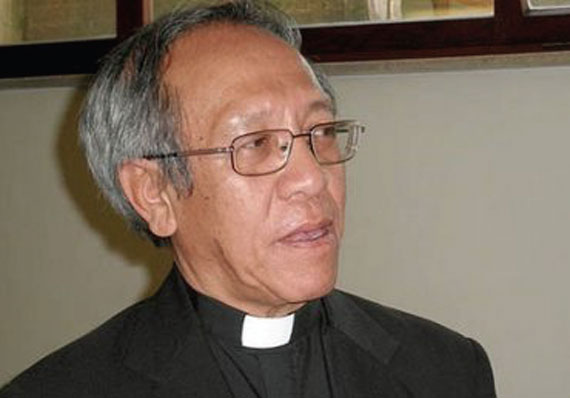
“This is a misplaced idea of patriotism,” said Archbishop Leo Cornelio of Bhopal, head of the bishops’ council in the region.

The commonly used slogan Jai Hind emerged during India’s independence struggle and continues to be raised at the end of national anthem. However, Hind is a shortened form of Hindustan (land of Hindus) that excludes India’s religious minorities such as Christians and Muslims.

The central Indian state’s government, run by the pro-Hindu Bharatiya Janata Party (BJP), has exempted privately managed schools such as Church schools from the new practice.

But an official source seeking anonymity told the government exempted private schools fearing a backlash as state elections are due in December this year. The nine Catholic dioceses in the state run some 500 schools.

“But in this case, a particular ideology is promoted in the name of patriotism,” he said.

‘Honour’ killing in Catholic family shocks Indian state

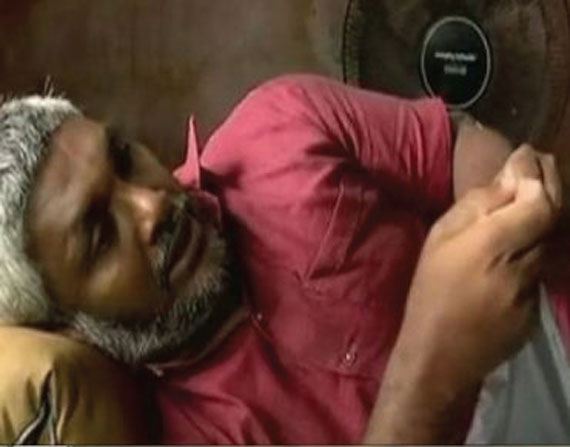
The victim’s father and wife told media that they had approached police soon after he was kidnapped but officers refused to entertain them, saying they were busy arranging security for a visit by Pinaryi Vijayan, the state’s chief minister.

Neenu named her brother Shanu Chacko and 11 people as responsible for the crime. Most gang members belong to the Democratic Youth Federation of India (DYFI), a youth wing associated with Kerala’s ruling communist alliance.

The crime comes amid allegations that Communist Party of India leaders use police to meet their ends.

However, police have arrested some DYFI members in connection with the murder.

The government is to suspend local police officers including Kottayam district police chief V.M. Mohammad Rafik.

Widespread protests have been held by Dalit Christian groups in the state recently against the discrimination they face from upper-caste Christians, commonly known as Syrian Christians because of their ancient link with the Syrian Church and its liturgy.

A Syrian Christian bishop recently rattled the community by saying that discrimination against Dalit Christians was due to the “myth” that their forefathers were upper-caste Brahmins.

Kerala court quashes case against Cardinal in land scam

Priests in India are pinning their hopes on the Vatican after the High Court of Kerala dismissed a case against Cardinal George Alencherry over a land deal that has rocked the church for more than a year. Chief Justice Antony Dominic dismissed the case on May 22 on grounds that the court made jurisdictional errors in allowing the investigation against the cardinal and petitioners had rushed to the court before waiting for a police investigation.

The court’s move has “not given us any justice. The moral and ethical violations and the related frustrations continue,” said Father Kuriakose Mundadan, secretary of the presbyteral council, a canonical body of priests in the cardinal’s Ernakulam-Angamaly Archdiocese.

The court dismissed the case, filed by lay Catholic Shine Varghese, on grounds of legal infirmity because the petitioner approached the court complaining of police inaction within hours of filing a police complaint. “The court has not quashed the police complaint. It has not said there is no case against the cardinal, nor that the police should not investigate. However, we continue with the problem without a solution,” Father Mundadan said.

Indian govt accused of ignoring religious violence

The United States Commission on International Religious Freedom has accused the Indian government of doing little to prevent violence against religious minorities and socially poor Dalit people.

The commission’s latest report, released on April 25, said the government run by the pro-Hindu Bharatiya Janata Party (BJP) has not addressed the problem of sectarian violence despite government statistics showing that sectarian violence has increased sharply over the past two years.

It categorized India in its Tier 2 countries along with Afghanistan, Azerbaijan, Bahrain, Cuba, Egypt, Indonesia, Iraq, Kazakhstan, Laos, Malaysia and Turkey.

Tier 2 countries are those with at least one of the elements of the “systematic, on-going and egregious” standard in a set of criteria the commission uses to gauge violations of religious freedom.

Ten countries including Pakistan are in the worst category.

The report noted that at least 10 Indians were lynched by Hindu groups in the name of cow protection.

“In 2017, religious freedom conditions continued a downward trend in India. India’s history as a multicultural and multi-religious society remained threatened by an increasing exclusionary conception of national identity based on religion,” the report said.

Hindu nationalist groups working to turn India into a Hindu-only nation stepped up their actions through violence, intimidation and harassment against non-Hindus and Hindu Dalit people. Both public and private actors pursued this effort, the report said.

About one third of state governments enforced “anti-conversion and/or anti-cow slaughter laws against non-Hindus, and mobs engaged in violence against Muslims or Dalits whose families have been engaged in the dairy, leather or beef trades for generations, and against Christians for proselytizing,” stated the report.

Even government records, presented on Feb. 6 in parliament, show increased sectarian violence. In 2017, 111 persons were killed and at least 2,384 injured in 822 communal clashes across the country.

In 2016, 86 persons were killed and 2,321 injured in 703 incidents. In 2015, there were 751 incidents.

India’s indigenous people rally for religion

Thousands of indigenous people marched through the streets of Gumla town in India’s Jharkhand State demanding recognition of their traditional religions.

The rally of about 10,000 people on April 24 aimed to put pressure on the eastern state’s government run by the pro-Hindu Bharatiya Janata Party (BJP), which considers indigenous people as Hindus and refuses to give official status to the animist Sarna religions.

Church leaders and acti-vists working for indigenous people said the rally succeeded in bringing together indigenous people of diverse groups and religions.

The government is counting Sarna followers as Hindus as part of a political game, said Father Cyprian Kullu, vicar general of Gumla Diocese, which supported the rally.

“It is certainly a positive move because this was the first time in the region that indigenous people of all religions have come on a single platform and demanded their rights,” Father Kullu told ucanews.com.

Pentecostal pastors abused in a Tamil Nadu Hindu temple

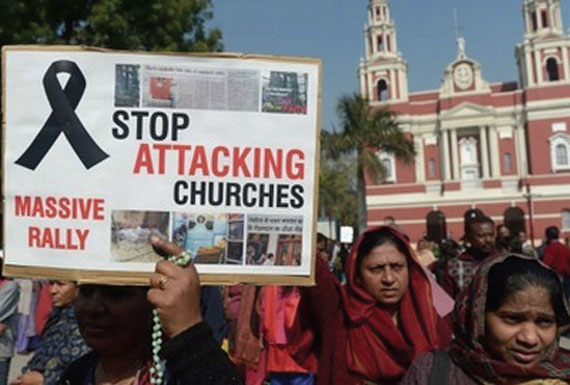
Two Pentecostal Christian pastors were dragged into a Hindu temple, seated in the corridors and covered with ash on their faces. Sajan K.George, president of the Global Council of Indian Christians (GCIC), told AsiaNews that the violence took place on April 22nd in Kanyakumari district, Tamil Nadu. The GCIC, states its leader, “is embittered by the deplorable [gesture] of humiliation and repeated harass-ment against the faithful and places of worship.”

The Christian leader complains that at least 15 similar inci-dents have occurred in the southern State of Tamil Nadu in the last three months. All of them had Pentecostal Christians as their target. Specifically, the aggression suffered by the two pastors “was filmed by criminals, who then posted the images online. The video shows that the religious leaders being forced to cover themselves with the sacred ashes inside the Mutharamman temple in Sandhaivalai. Then they were insulted despite one of the two sang the Bharat Mata ki jai [song typical of the Indian tradition that celebrates India as Mother Earth, ed].”

Goa church officials agree to give basilica for adoption

After initial opposition to a government plan to involve private companies in the maintenance of heritage sites in India, church officials in Goa have agreed to accept the scheme for the famous Basilica of Bom Jesus.

A meeting between church and state officials on May 7 resolved differences and the church has agreed to let a private firm take over the management of the 16th century Portuguese church, Minister for Archives Vijay Sardesai said.

The agreement came after it was “clearly understood that the scheme is not about taking over the monument but rather its preservation under international standards,” he said.

Church officials in the former Portuguese colony earlier express-ed their dismay when media reported a federal government plan to have private players manage ancient religious sites under its “Adopt a Heritage” tourism project announced last September.  The federal and Goa governments, both run by the pro-Hindu Bharatiya Janata Party, listed six heritage sites in Goa under the plan, including the Basilica of Bom Jesus that holds the remains of St Francis Xavier.

Church officials have accepted the plan “unanimously because it is beneficial to the monument,” said Father Loila Pereira, secretary to Archbishop Filipe Neri Ferrao of Goa.

Anger over adoption plan for ancient Goa religious sites

Church leaders in Goa are upset over a federal government plan to offer ancient religious sites to private companies for maintenance under its new “Adopt a Heritage” tourism project.

The project launched last September by the government, run by the pro-Hindu Bharatiya Janata Party (BJP), plans to entrust heritage sites across India to private firms for the development of tourist amenities.

Six heritage sites in former Portuguese colony Goa, including the Basilica of Bom Jesus that holds the remains of St Francis Xavier, have been listed for adoption but the state government was not consulted, local media reported.

The state government, which is also run by the BJP, has been kept completely in the dark about the plan, state Archives Minister Vijai Sardesai said.

Sites in Old Goa, the 16th century Portuguese capital, are assets of the state, and the church has to be taken into confidence, he said.

Church leaders are equally upset after learning about the plan from the media.

“It pains me to know that our religious monuments are in danger of being privatized, reducing significantly their universal ownership,” said Father Victor Ferrao, professor of philosophy at Rachol Major Seminary.

Hindu influence tips India’s scales of justice

For the first time since the British left and India became a free country, its judicial system is being questioned, with opposition and civil society groups accusing the pro-Hindu ruling Bharatiya Janata Party (BJP) of using the judiciary for its own political purposes. On April 21, seven opposition parties led by Congress met Vice-President Muppavarapu Venkaiah Naidu and handed him a notice to impeach Chief Justice Dipak Misra, accusing him of misbehaviour and abuse of authority.

“We have mentioned in our notice how the chief justice is choosing to send sensitive matters to particular benches by misusing his authority as master of the roster with the likely intent to influence the outcome,” Congress leader Ghulam Nabi Azad told reporters in New Delhi.

ABOLISH HATE-MONGERING ORGANIZATIONS: GOA CHURCH

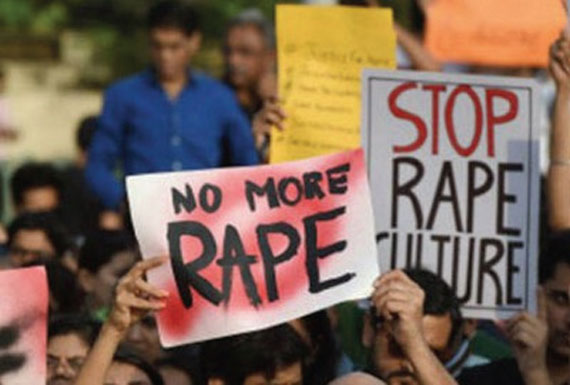
In the backdrop of Kathua and Unnao rape cases, the Goa Church sees a growing trend in India to justify crimes committed against some sections of society by using the garb of nationalism. The trend has generated fear and insecurity among the citizens, it adds.

The Council for Social Justice and Peace (CSJP), the social arm of the Goa archdiocese, appealed to Prime Minister Narendra Modi to eliminate the “growing ideology of hate” and “subjugation of women” in the country.

The council expressed concern over the recent cases of rape of minor girls in Kathua (Jammu and Kashmir) and Unnao (Uttar Pradesh) and what it called killings of fellow citizens in the name of community honour, religion and nationalism.

The actual response for these incidents should be to abolish organisations that advocate the “ideology of hate” and “subjugation of women,” CSJP Executive Secretary Fr Savio Fernandes said in a statement. The council is deeply agonized over the horrendous rapes of an eight-year-old girl in Kathua, a teenager in Unnao and other such cases reported over the last few days in the country, he said.