The Vatican auditor general said he was surprised by the lack of ethical standards demonstrated by officials considering in-vestment opportunities, including a failed London property development deal.
During the Vatican trial of 10 defendants accused of various charges related to financial malfeasance, Alessandro Cassinis Righini, auditor general of the Holy See and Vatican City State, criticized the mismanagement of funds as well as the Vatican’s association with people “with clear conflicts of interest,” which resulted in the loss of millions of euros.
“That was not the way to manage funds from Peter’s Pence,” Cassinis told the court Sept. 30, referring to the papal fund used for charity and to support the running of the Roman Curia and Vatican embassies around the world.
Category Archives: International
New poll finds 4 in 10 non-Catholic Latinos were once Catholic and left
A new NBC News/Telemundo poll focusing on the Latino electorate found that 41% of Latinos who do not currently claim Catholicism as their religion said they had previously been Catholic.
Jonathan Calvillo, an assistant professor of Latinx studies at Emory’s Candler School of Theology, said the flip side of that statistic is just as important: the growing number of non-Catholic Latinos who were never Catholic to begin with (58%).
Some were raised Protestant, of course, but increasingly, he said, many are raised non religious.
While Calvillo said there are some who go from being Protestant to being Catholic, it’s a smaller percentage than the larger number of those who leave the Catholic Church. “But it does exist,” he said.
The poll, which consisted of interviews with 1,000 Latino registered voters, found that 48% identified as Catholic, 25% as Protestant, 1% as Muslim, 1% as Jewish and 18% said they didn’t identify with a religion.
The nationwide survey, conducted Sept. 17–26 in English and Spanish, queried respondents on a number of political issues in the run-up to the 2022 midterm elections. Overall, the survey found that while Democrats lead Republicans by more than 20 points among Latino voters, that number is down from past NBC/Telemundo over-samples of Latino voters. The lead, for example, was by 26 points in October 2020 and by 42 points eight years prior to that in October 2012, according to NBC News.
Those who stand outside of the Catholic Church, by birth on one hand or by choice on the other, likely move toward opposite poles on the political spectrum, said Calvillo, whose research has focused on how religious affiliation influences ethnic identities among Latinos.
Knights of Malta Consider Quitting Church
Knights across the world are considering leaving the Catholic Church because of Pope Francis’ reforms, the former grand chancellor of the Sovereign Military Order of Malta revealed.
In a confidential letter obtained by Church Militant, Albrecht von Boeselager lamented that many confreres had expressed to him “their great dis-appointment in the Holy Father – they could no longer regard him as the father he promised to be for the order.”
Boeselager sent the letter to an elite group of knights after Pope Francis issued a September 3 decree that makes sweeping changes to the Order of Malta and undermines the ancient order’s sovereignty. The Associated Press described the papal action as tantamount to “one sovereign country annexing another, if on a very small scale.”
In his decree, the Pope order-ed the dismissal of the order’s four highest-ranking officers, including Boeselager. Invoking papal authority, Francis also dissolved the order’s Sovereign Council and established a provisional council to oversee governance.
Francis also approved a new constitutional charter and code, while appointing his own men to the highest offices and the provisional council. These actions triggered questions about the sovereignty of the institution, founded in 1048.
Vatican cardinal cancels trip amid backlash over synodal way remarks
A Vatican cardinal cancelled a weekend visit to Germany after reportedly receiving threats re-lated to his recent remarks about the country’s “synodal way.”
Cardinal Kurt Koch was due to celebrate Mass and give a lecture on Oct. 2 in the southern German city of Schwäbisch Gmünd. He was also expected to celebrate Mass in the nearby town of Ellwangen on Oct. 3.
But local media reported that the president of the Pontifical Council for Promoting Christian Unity pulled out of the trip for “security reasons.”
The 72-year-old cardinal pro-voked anger in Germany when he invoked the Nazi era while criticizing the synodal way, a controversial initiative bringing together bishops and lay people to discuss hot-button issues.
Bishop Georg Bätzing, chair-man of the German bishops’ con-ference, called on Koch to apolo-gize publicly after the cardinal referred to the virulently anti-Semitic “German Christian” movement in a Sept. 29 interview with the newspaper Die Tage-spost.
He said that if the cardinal did not withdraw his remarks, he would make an “official com-plaint” to Pope Francis.
In the interview, Koch argued that the synodal way was seeking to establish “new sources” for Catholic teaching, “in addition to the sources of revelation of Scripture and Tradition.”
He added that it frightened him “that this is happening again in Germany.”
Synodal way has no power “to compel the bishops …to adopt new ways of governance” German bishops’ ad limina visit
Germany’s bishops are meeting in Fulda, a town in the centre of the country, this week ahead of a crucial trip to the Vatican.
Their fall plenary meeting, which began on September 26, is dedicated to two major themes: the controversial “synodal way” and the bishops’ November ad limina visit to Rome. The stakes are high: The Vatican has repeatedly expressed misgivings about the synodal way – the multi-year German initiative bringing together bishops and lay people to discuss four main topics: power, the priesthood, women in the Church, and sexual morality.
In July, the Vatican’s Secretariat of State underlined that the synodal way has no power “to compel the bishops and the faithful to adopt new ways of governance and new approaches to doctrine and morals.”
Earlier this month, the bishops attended an acrimonious session of the synodal way at which they endorsed documents propo-sing new ways of governance and new app-roaches to doctrine and morals.
The votes pave the way for a potential showdown between the German bishops and Vatican officials in Rome.
Subscribe The nuncio emphasized that “secret voting is one of the Church’s methods, practiced for centuries in important votes, in elections of superiors in many orders and congregations, right up to the election of the Pope in a conclave.”
“A high level of approval of draft reso-lutions in a secret ballot depends on the depth of dialogue in the assembly hall and the working groups, as well as on the willingness to accept changes in the draft texts,” he said.
Eteroviæ is not a lone voice: last weekend, the Swiss Vatican official Cardinal Kurt Koch expressed alarm at the proceedings in Frankfurt. “This is the papal magisterium on the synodal way,” Francis said in July.
He has made it clear that the letter is the baseline by which the initiative will be judged. If he feels the German bishops have ignored it, they could have a frosty reception in November.

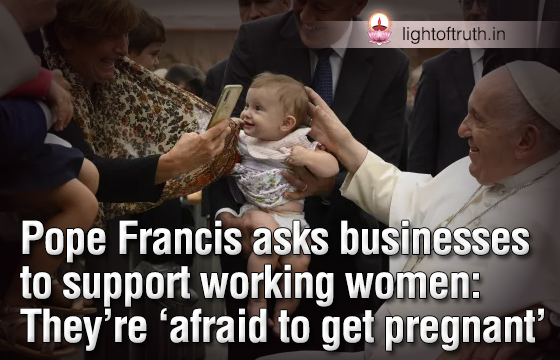
Pope Francis asks businesses to support working women: They’re ‘afraid to get pregnant’
Pope Francis is stressing the importance of accommodating pregnant women as employees — and calling on the business world to find a solution.
“Please, this is a problem for working women: Study it, see how to make sure that a pregnant woman can go on, both with the child she is expecting and with her job,” he said on Monday in the Vatican’s Paul VI Hall.
The 85-year-old pontiff addressed a group of entrepreneurs — the General Confederation of Italian Industry — and the world of business in general during his remarks. He sounded the alarm on low birth rates and encouraged companies to support pregnant employees.
“Still on the subject of the birth rate: Sometimes, a woman who is employed here or works there is afraid to get pregnant be-cause there is a reality — I am not saying among you — but there is a reality that as soon as the belly begins to show, you get booted out: ‘No, no, you can’t get pregnant,’” he cautioned. Countries depend on families for prosperity and a future, he said.
“There is an urgent need for concrete action to support families and the birth rate,” Pope Francis said. “This is what we need to work on, to get out of the demographic winter in which Italy and other countries are living, as soon as possible. It is a bad demographic winter, which goes against us and prevents us from the possibility of growth.”
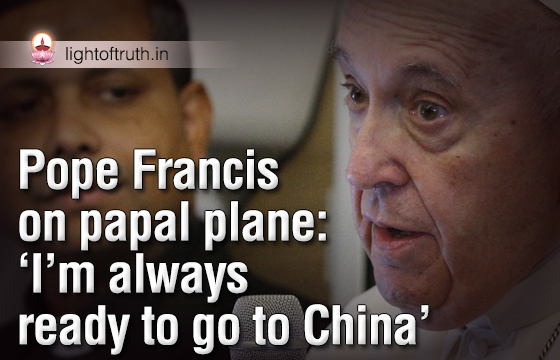
Pope Francis on papal plane: ‘I’m always ready to go to China’
Pope Francis told journalists on the papal plane on September 13 that he is ready for the first papal trip to China. In a conversation with reporters on the flight from Rome to Kazakhstan on Sept. 13, the pope said: “I’m al-ways ready to go to China.”
Chinese President Xi Jinping is expected to visit Kazakhstan on Sept. 14, midway through Pope Francis’ three-day trip to the Central Asian country. Reuters reported that the pope said he did not “have any news” about the speculation that he might meet Xi during the trip.
The coinciding visits of Francis and Xi come as the Holy See and China determine the renewal of a provisional agreement on the appointment of bishops in China and a Catholic cardinal is preparing to stand trial in Hong Kong for his role in a pro-democracy legal fund.
A source in the Kazakh Parliament told CNA last week that “theoretically it is possible” that the pope and the president could meet during the trip. But such a meeting would be un-precedented.
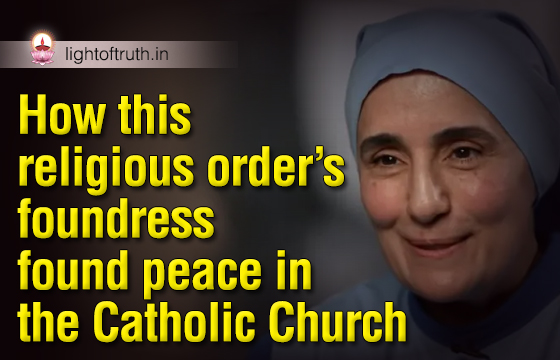
How this religious order’s foundress found peace in the Catholic Church
Mother Olga grew up in war-torn Iraq but found peace within the Catholic Church, establishing a new religious order to share Christ’s light with others.
Montse Alvarado, host of EWTN News In-Depth, recently spoke to the foundress of the Daughters of Mary of Nazareth about her childhood in war-torn Iraq, her steadfast devotion to Our Lady, and her community in Boston.
Originally a part of the Assyrian Church of the East, Mother Olga joined in full communion with the Roman Catholic Church on Sept. 8, 2005. She talked about what led to that moment in her faith, which happened around the time she was sent to the United States for school.
“I was really very drawn to the …strong devotion to the Blessed Mother and the Holy Eucharist,” she said. “I was really drawn to adoration, to the daily Communion, daily Mass, and all the beautiful devotions … when I got to learn about Our Lady of Guadalupe, Our Lady of Lourdes, [and] our Lady of Fatima.”

Study: Christianity may lose majority, plurality status in U.S. by 2070
If trends of the past 30 years continue for the next 50, Christianity will lose its majority status in the United States by 2070, according to a new demographic study by the Pew Research Centre.
If those trends, first identified in 1990, accelerate over the next half-century, Christianity will have fewer adherents than Americans who are not affiliated with any church, according to the study, “Modelling the Future of Religion in America,” released Sept. 13.
Even with the demographic modelling used by Pew, the numbers vary widely. Christians, put by Pew currently at 64% of the U.S. population, could slide to 54% — or plunge to 35% — by 2070.
By the same token, the religiously un-affiliated — called “nones” in some circles — currently at 29%, could rise to 34% of the population in the next half-century, or soar to 52%.
Pew used four different scenarios in making its projections. One was “no switching,” meaning that Americans would not switch from religious affiliation to disaffiliation, or vice versa. It counterpart was “steady switching,” in which 31% of Christians become unaffiliated, while 21% of the unaffiliated become Christian.
The other two models are “rising disaffiliation.” One model put limits on the share of Christians who leave the faith at 50%. The other model set no limits on disaffiliation.
Only the no-switching model, which Pew called “counterfactual,” allowed Christianity to retain its U.S. majority. The steady-switching scenario gave Christians a 46%-41% plurality. Under the rising-disaffiliation models, Christianity was relegated to minority status, with less than 40% of all Americans.
Pew did four alternative scenarios, in which every mother transmitted their faith to each of her children; if religious groups had equal birthrates; if immigration stopped after 2030; and if older Christians stopped switching from belief to unaffiliated status. Christianity would lose its majority status but retain plurality status through 2070 under all four scenarios.
“It is possible that events outside the study’s model — such as war, economic de-pression, climate crisis, changing immigration patterns or religious innovations — could reverse current religious switching trends, leading to a revival of Christianity in the United States,” the report said.
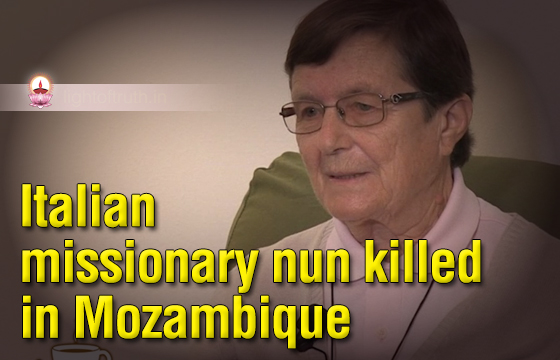
Italian missionary nun killed in Mozambique
Sister Maria De Coppi, a Comboni missionary sister, was murdered by Islamist terrorists on Tuesday in Mozambique, where she had served as a missionary for nearly 60 years. The attack in which Sister Maria de Coppi, 83, was shot and killed was carried out the night of Sept. 6 in Chipene. In the attack on the mission, which lasted five hours, the terrorists ransacked and burned the mission’s church, school, health center, dwellings, library, and vehicles. Damage at the Chipene mission in Mozambique following a Sept. 6 terrorist attack.
“They destroyed everything,” Bishop Alberto Vera of Nacala told the pontifical charity Aid to the Church in Need.
“The attackers broke open the tabernacle and vandalised part of the sacristy, looking for whatever they could find – probably money,” he added.
Mozambican president Filipe Nyusi said that “On the 6th of September, as a result of terrorist attacks, six citizens were beheaded, three kidnapped, six terrorists were captured and dozens of houses torched in the districts of Erati and Memba, Nampula province.”