Category Archives: International

MINORITY REPORT: BEING A COPTIC CHRISTIAN IN AN ‘ISLAMICISED’ COUNTRY LIKE EGYPT

They trace their origins back to the age of the Apostles, yet still the Copts are treated as second-class citizens in their own county.

When Islamic State extremists attacked Saint Mark’s Coptic Orthodox Cathedral in Alexandria on Palm Sunday, they struck at the historic heart of Egypt’s Christian community. The Coptic Patriarch, Pope Tawadros II, was leading a service inside when a suicide bomber was challenged at the church gates.

Forty-five people were killed in two separate attacks on Coptic churches that Sunday: one of the bloodiest days of violence against Christians in Egypt in decades. Earlier at St George’s church in the city of Tanta, 60 miles north of Cairo, at least 28 people died and another 80 were injured when another attacker slipped past security and blew himself up near the front pews of the church. The Patriarch later issued a statement declaring that “these acts will not harm the unity and cohesion of the people.”

Pope Francis shuns bullet-proof vehicle for Cairo visit

Pope Francis has chosen not to travel in a bullet-proof vehicle for his first trip to Egypt this week, despite a recent spate of terrorist attacks targeting the country’s Christians.
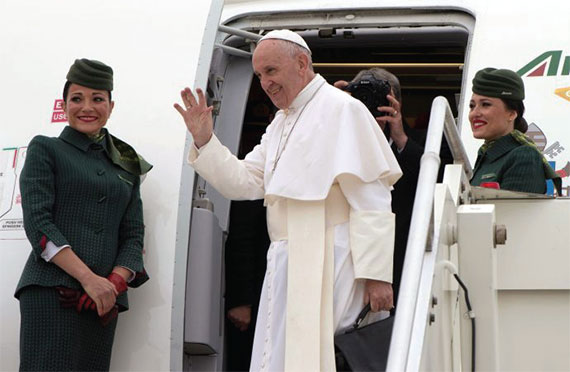
The Pope will fly from Rome to Cairo on April 28 for a two-day visit intended to build on inter-faith dialogue with Muslim leaders and to show solidarity with beleaguered Christian communities in the Middle East.

Despite his vulnerability as a potential terrorist target, the Pope will not travel through the streets of Cairo in an armoured vehicle, the Vatican said. “The Pope will use a closed car to move around, but not an armoured one,” said Greg Burke, the Vatican spokesman. “That’s how he wanted it.”

16 nations named ‘egregious’ religious-freedom violators

In its newly released annual report, the United States Commission on International Religious Freedom (USCIRF) is urging the State Department to designate or re-designate 16 nations as “countries of particular concern” (CPCs) because they are nations in which there are “particularly severe violations of religious freedom that are sys-tematic, ongoing and egregious.”

The nations include ten current CPCs—Burma, China, Eritrea, Iran, North Korea, Saudi Arabia, Sudan, Tajikistan, Turkmenistan, and Uzbekistan—as well six other nations: the Central African Republic, Nigeria, Pakistan, Russia, Syria, and Vietnam.

The federal commission found that in 12 other nations—Afghanistan, Azerbaijan, Bahrain, Cuba, Egypt, India, Indonesia, Iraq, Kazakhstan, Laos, Malaysia, and Turkey— “religious freedom violations are severe but do not fully meet the CPC standard.”

Egyptian bishop: we have no need of Western protection

Following a surge of attacks on Egypt’s Christians, a Coptic Catholic bishop said that there is no need for Western nations to come to their defence. “If there were oppression on the part the State or government, these sorts of remarks might make sense,” said Bishop Antonios Aziz Mina, according to a Fides report. “But now it is clear that these terrorists carry out attacks to destabilize the country, and aim to break Egypt’s Christian-Muslim harmony.” He added: “We have no need of outside protection. All we need is not to be divided from our Muslim brothers. They are the ones who can defend us, and we must help them and help the police resist against these groups which sow death, hiding behind pseudo-religious ideologies.” The prelate made his remarks after the Palm Sunday church bombings but before the attack on historic St Catherine’s Monastery.

Between election rounds, French cardinal deplores ‘democracy gone mad’

France’s Catholic primate has condemned the current presidential campaign as his country’s “worst ever” and urged Christians to help prevent democracy from “losing its sense.” “Left and right rivalled each other and had their radical wings, but there was also a centre. Now, left and right have stepped back, and the main candidates are divided by other unclear criteria. I have the impression our voters are totally lost,” said Cardinal Philippe Barbarin of Lyon.

FRANCIS GRANTS SSPX RIGHT TO CELEBRATE MARRIAGE IN SIGN OF RECONCILIATION

Pope Francis has granted permission for priests of the traditionalist Society of Saint Pius X to celebrate valid marriages, in another sign that the quasi-schismatic group are on the verge of being reconciled back into the Church. In a ruling approved by Francis, the Congregation for the Doctrine of the Faith has said that SSPX clergy can celebrate wedding liturgies providing they are assisted by a priest from the local diocese who would act as a witness to the vows. However, if there are no diocesan priests available the CDF states that a priest of the society can conduct the ceremony on his own.

The latest move, authored by Cardinal Gerhard Muller and by Arcbishop Guido Pozzo, who is in charge of the Vatican body tasked with reconciling the group back into the Church, states it is part of the process of “institu-tional regularisation” of the SSPX. Significantly, the state-ment says the group is in a “canonical irregular” situation” only “for the time being.”
Known as the Lefebvrists after their founder- a French missionary Archbishop Marcel Lefebvre -the society broke away from the Church in protest at the reforms of the Second Vatican Council.

This split occurred definitively when Archbishop Lefebvre ordained four bishops for the society without Holy See approval.

Today the group, which celebrate the sacraments solely according to the old rite, remain in a sort of canonical limbo: al-though excommunicated Arch-bishop Lefebvre’s ordinations of his bishops were valid because he himself was a legitimate bishop.

Odd Text from Cardinal Sarah Is Often Praiseworthy, Some-times Questionable, Unfortunate and Downright Mistaken

Over the weekend, Cardinal Robert Sarah, who runs the Congre-gation for Divine Worship and Discipline of the Sacraments, argued in a message sent to commemorate the tenth anniversary of the publi-cation of the Motu proprio Summorum Pontificum by Pope Benedict XVI that those promoting a “modern liturgy” had caused disaster, devastation and schism by trying to reduce the Mass into a “simple convivial meal.”

Here Fr Anthony Ruff, who is a Benedictine monk and liturgical expert, gives his opinion on the text. “This is an interesting, rather odd talk by Cardinal Sarah. It is at times praiseworthy, at times questionable, and at times unfortunate and downright mistaken.

But Cardinal Sarah attaches excessive weight to Summorum Pontificum as if it is the fulfilment of Vatican II, when it is contrary to the intent and clear directives of the Vatican II liturgy constitution. His claim that Vatican II did not abandon the Missal of Pius V is simply mistaken.

His interpretation of Vatican II in general is questionable, for it emphasises only continuity (which of course is there) and underemphasises how much rupture is involved in the liturgy constitution’s paradigm shift.

It’s unfortunate that Cardinal Sarah is so unrelentingly negative about the liturgical reform. It seems that in his mind the reformers have brought only “disaster, devastation, schism, destruction, self-destruction, liturgy wars, and superficial, devast-ating subjectivism.”

It would be good if he could study the reforms more deeply and understand, for example, what “mystery” means in Catholic theology, or how “sacrifice” and “meal” are not opposed to each other in some sort of zero-sum game.

And this is odd: Cardinal Sarah strongly supports Liturgiam Authenticam and the botched new English Missal. That’s a risky move when his boss seems to be going in another direction.”

Catholics surge in Africa but priest shortages persist in other parts of the globe

The number of Catholics worldwide is rising fastest in Africa while the church continues to suffer from a shortage of priests in some parts of the world.

According to the Vatican’s latest statistics, released on April 6, the number of Catholics globally rose 1%, to 1.3 billion, in 2015.

In Africa, the number of baptized Catholics rose 19% – to 222 million, from 186 million in 2014. The Vatican noted that America — North, Central and South — had the greatest concentration of Catholics, while numbers in Europe remained relatively stable.

Despite an increase in the number of Catholics, there was a fall in the number of priests called to ministry in some parts of the world. The number of priests rose by more than 1,100 in Africa and 1,100 in Asia but fell by 2,502 (6 percent) in Europe between 2014 and 2015. There were a total of 47 new priests in the Americas in 2015.

“After reaching its highest in 2011, the number of seminarians has been undergoing a gradual contraction,” the Vatican said. “The only exception is Africa, which does not seem affected by the vocation crisis for the moment and will remain the region with the greatest potential.”

Worldwide, there were 466,215 ordained Catholics, including 5,304 bishops, 415,656 priests and 45,255 deacons. Brazil had the highest number of Catholics – 172 million – accounting for 1 in 4 Catholics in the Ameri-cas, while Mexico had 110 million and the U.S. recorded 72 million Catholics. Colombia had 45 million, Argentina 41 million.

German bishops divided on diaconate for women

A German theologian-bishop has called for the ordination of woman deacons, saying it is more important than relaxing mandatory celibacy or ordaining married men of proven virtue (viri probati) to the priesthood. “Women should be ordained deacons. It is a sign of the times,” said Bishop Gebhard Fürst of Rottenburg-Stuttgart.

He told a 27 March gathering of the German Catholic Women’s Association (KDFB) the time had come for women deacons. The association, which has been demanding the move for over twenty years, was marking its 100th anniversary.

In his keynote address to the group, Bishop Fürst said the faithful had been waiting for decades for the Church to answer the question of women deacons. He said the answer was therefore long overdue and now imperative.

The 68-year-old bishop, who succeeded Cardinal Walter Kasper some seventeen years ago as head of the diocese, said he interpreted Pope Francis’ silence on the issue was a sign that the Pope was “not totally opposed” to the subject.

Bp Fürst said he intended to campaign for the women’s diaconate in German bishops’ conference since its members were divided on the issue. How-ever, his spokesman Uwe Renz told the German daily Stuttgarter Nachrichten (27 March) that the bishop would not be appealing directly to the Vatican.

Germany dismisses ‘Islam law’ as integration debate resurfaces

Germany has no plans to introduce an ‘Islam law’ codifying the rights and obligations of Muslims, a government spokesman said on Monday (April 3), dismissing an idea floated by allies of Chancellor Angela Merkel ahead of federal elections in September.

Merkel, who will seek a fourth term in what is expected to be a close-fought ballot, has come under fire for opening Germany’s doors to refugees, more than one million of whom – mostly Muslims – have entered the country over the past two years.

Seeking to boost support for the chancellor’s conservatives, senior Merkel ally Julia Kloeckner stoked the integration debate at the weekend by calling for stricter rules for Islamic preachers and a ban on foreign funding of mosques.

Merkel’s spokesman Steffen Seibert dismissed the idea, which Kloeckner – who is deputy leader of the chancellor’s Christian Democrats (CDU) – and other senior party members want to enshrine in an Islam law.

“Such a law is now not an issue for government business,” Seibert told a news conference, stressing the high regard Merkel’s ruling coalition has for religious freedom in Germany.