Category Archives: International

Retired pope says criticism against Pope Francis is ‘foolish prejudice’

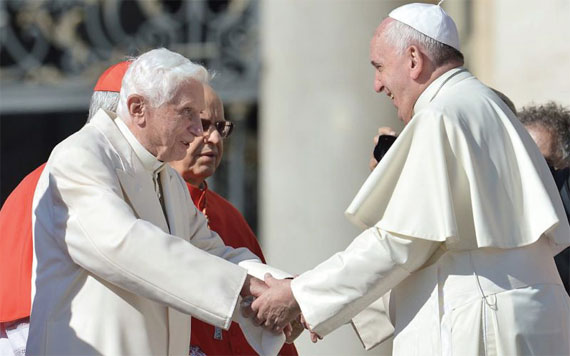
On the eve of the fifth anniversary of Pope Francis’ election, retired Pope Benedict XVI defended the continuity of the church’s teaching under his successor and dismissed those who criticize the Pope’s theological foundations.

In a letter sent to Msgr. Dario Vigano, prefect of the Vatican Secretariat for Communication, Pope Benedict applauded the publication of a new book series titled, “The Theology of Pope Francis.”

“It contradicts the foolish prejudice of those who see Pope Francis as someone who lacks a particular theological and philosophical formation, while I would have been considered solely a theorist of theology with little understanding of the concrete lives of today’s Christian,” the retired pontiff wrote.

Msgr. Vigano read the letter during a presentation of the 11-volume series March 12.

Before reading the letter, Msgr. Vigano said he sent a message to Pope Francis and Pope Benedict regarding the publication of the book series.

He also asked if Pope Benedict would be “willing to write a page or a page and a half of dense theology in his clear and punctual style that would have liked to read this evening.”

Instead, the retired pontiff “wrote a beautiful, personal letter that I will read to you,” Msgr. Vigano said.

Pope Benedict thanked Msgr Vigano for having given him a copy of “The Theology of Pope Francis” book series, which was authored by several notable theologians.

“These small volumes reasonably demonstrate that Pope Francis is a man with profound philosophical and theological formation and are helpful to see the interior continuity between the two pontificates, even with all the differences in style and temperament,” he wrote.

Pope Benedict has made no secret of his affection for and admiration of Pope Francis.

Pope Francis has ‘high rating’ in Asia, may travel to India in 2018

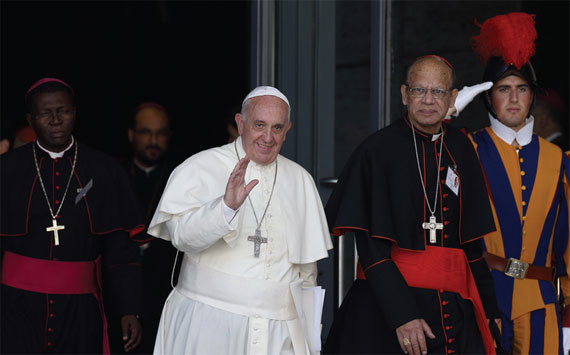
Pope Francis “is very popular in Asia, a continent where two-thirds of humanity lives. Among the Catholics… I would say he has a very, very high rating, over 90% accept-ance. Among other Christians, he has also a high rating; they are very appreciative of him, sometimes I’ve even heard them say, ‘He is our Pope too.’ Among the non-Christians, even some may know about him, some may not have heard of him or may not know enough, but he comes out as a good strong, moral influence; his position on climate change has made an impression on people; and he’s known to be a person who reaches out to those on the peripheries and that’s made an impression too.” On the eve of the fifth anniversary of the election of Pope Francis, that is the assessment of Cardinal Oswald Gracias, 73, the first church leader ever to head the Catholic Church in Asia and in India at the same time.

In this exclusive interview he also talked about the possibility of the Pope visiting India and China, as well as the work of the Council of Cardinal advisers.

“I see the Pope can really touch the heart of Asia, a continent where the people are basically spiritual even though they are now also becoming somewhat secularized.”

“Prime Minister Narendra Modi told us he would very much like for the Pope to come. The difficulty is to find an appropriate time, partly because many other distinguished people are coming and because we are having so many elections. The Holy Father would not want to get involved in local politics. So, we are trying to find a time that is neutral for him to come, without people instrumentalizing his visit. I am hopeful that in 2018 we will be able to arrange this visit, maybe between September and November.”

“I am almost confident that he’s coming to India. When you speak of China, I see a glimmer of light, of this possibility. It’s not ruled out; his desire to go is strong.” “We’re coming to the end of one project—the reform of the Roman Curia. I hope we can finish it this year.”

Ukraine prelate on China: Dialogue ‘at all costs,’ but respect clandestine voice

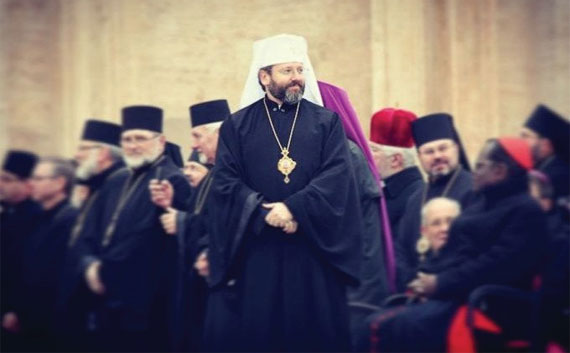
As the Vatican appears to be on the brink of an historic deal with an officially atheistic and Communist regime in China hostile to religious faith, the leader of a Church in Ukraine that has suffered more under Communist control than any other religious body on earth says he now embraces a philosophy of “dialogue at all costs.”

“We need to pursue dialogue at all costs,” said Major Arch-bishop Sviatoslav Shevchuk of the Greek Catholic Church in Ukraine in a Feb. 27.

“That can seem a bit crude, but really, what alternative is there to dialogue? Only confronta-tion, a war of sorts,” Shevchuk said.

“Today’s world doesn’t know how to dialogue, it only knows how to write on Facebook. Dialo-gue is mystery, it’s a sacrament of encounter. Dialogue is some-thing to which I’ve been comple-tely converted,” he said.

At the same time, Shevchuk said he deeply respects the per-spective of clandestine and under-ground believers who’ve paid a price in blood for their fidelity to the faith.

“I have to say that in these situations, the clandestine church has a hard time understanding,” he said. “Its suffering flesh isn’t capable of running behind these initiatives. That’s not only under-standable, but I’d say it merits respect.”

“I don’t believe the Holy See is indifferent to the suffering of the clandestine church [in China], but it also can’t negate the possi-bility of pursuing whatever dialo-gue it can with the authorities and the Patriotic Church.

I have to say that in these situations, the clandestine church has a hard time understanding. Its suffering flesh isn’t capable of running behind these initiatives. That’s not only understandable, but I’d say it merits respect.

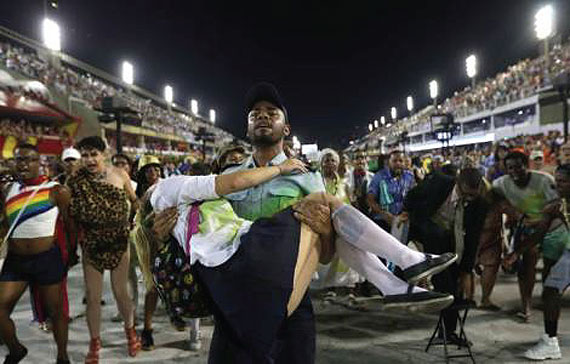
Cardinal da Rocha: “Too much aggression in social media”- Also Carnival highlighted the violence

There is too much violence in social media and aggression “is shared by many Catholics present in social networks”: this is the alarm launched by Cardinal Sergio da Rocha, Archbishop of Brasilia and president of the Brazilian National Episcopal Conference (CNBB). “It is a grave sin to use the name of God or any religion to practise or justify violence,” said the Cardinal commenting on the message of the Campaign for Fraternity (CF) which this year proposes the slogan “You are all brethren.” As Fides learns, the Cardinal emphasizes that many initiatives can be developed to achieve the objectives of the Campaign and that every baptized person can give his contribution in order “to overcome violence and build fraternity and peace in the environments in which he lives.” But we must deplore the growing violence “shared by many Catholics in social net-works,” he remarked.

“It is urgent to say no to violence on social media” he said, especially addressing young people.”

Nun dies in court pleading against convent sale

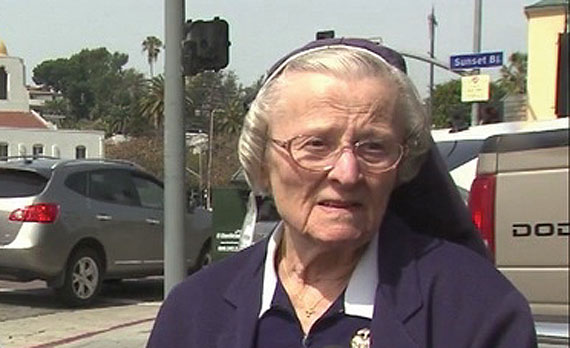
After 89 years on Earth, Sister Catherine Rose Holzman looked into a camera on March 11 and addressed what would turn out to be some of her last words to Katy Perry, the pop star. “Katy Perry, please stop,” the nun said on Fox 11 in Los Angeles. Please stop trying to buy the Sisters of the Immaculate Heart of Mary’s convent, even though the nuns had gone to court to block the sale.

“It’s not doing anyone any good,” Holzman said, then walked into a courtroom, collapsed and died.

The sisters have owned the sprawling Roman-villa style con-vent for 40 years, the Associated Press reported. Only a small handful of nuns were still alive when they vacated the complex several years ago, as the diocese looked for someone to buy it.

Survey: Pope Francis is still popular, but warm feelings waning among conservatives

Five years after Pope Francis ascended to the papacy, a new survey of U.S. Catholics reports that most still harbour warm feelings toward the pontiff — but his popularity is waning among political conservatives.

According to a new study from the Pew Research Centre, the first Latin American pope retains a soaring 84 % favourability rating among Catholics overall, with only a 1-point drop since 2014. A majority (58 %) also still believe he represents a major positive change for the Roman Catholic Church.

But there are signs Francis’ honeymoon period has ended in some circles. Roughly a quarter (24 %) of American Catholics say he is naive, up from 15 % in 2015, and 34% now say the pontiff is too liberal, compared with 19 % who said the same three years ago.

The divisions appear to be more political than theological. According to the survey, the share of Republican and Republican-leaning Catholics who say Francis is too liberal has more than doubled since 2015, jumping from 23 % to 55 %. Similarly, while only 16 % of Republican Catholics surveyed in 2015 said Francis is naive, roughly a third say so today.

Church of England bans security cameras during services

In a sweeping new move to protect people’s privacy, the Church of England has ruled that CCTV cameras must be switched off during services.

The precedent-setting case by the consistory court came in response to a petition by a Canterbury vicar to install two cameras at his historic 13th century church to ward off vandals.

The commissary general of the diocese authorized the move but said the cameras must be switched off during services, Sunday worship, secluded prayer areas and weddings, The Telegraph reported on Feb. 23.

“Funerals and baptisms, in particular, are examples of occasions on which people are likely to be very sensitive,” said Morag Ellis, adding that any recorded footage should be kept for a maximum of four weeks.

“Similarly, in any churches where sacramental Confession or other ministries of individual pastoral support, such as healing, are practiced, there should be no filming in the part or parts of the church set aside for that purpose.”

Stop Exploiting Nuns for Cheap Church Labour, Vatican Magazine Urges

A Vatican magazine denounced widespread exploitation of nuns for cheap or free labour in the Roman Catholic Church on March 1, saying the male hierarchy should stop treating them like lowly servants.

The article in the monthly “Women, Church, World”, remarkable for an official Vatican publication, described the drudgery of nuns who do work such as cooking, cleaning and waiting on tables for cardinals, bishops and priests.

The article, based on the comments of several unnamed nuns, described how some work in the residences of “men of the Church, waking at dawn to prepare breakfast and going to sleep once dinner is served, the house is in order and the laundry cleaned and ironed”.

It said their remuneration was “random and often modest”.

In many cases, the nuns, who take vows of poverty, receive no pay because they are members of female religious orders and are sent to the residences of male Church officials as part of their assignments.

In the past, most of the nuns working as domestic help in male-run residences or institutions such as seminaries were local nationals.

The Egyptian government “legalizes” 53 churches built before the law on Christian places of worship

The Egyptian government has provided full legal certificates to 53 churches with annexed service buildings already built before the new law on the construction of Christian buildings of worship passed by the Egyptian Parliament on August 30th 2016. A meeting of the government Commission set up specifically to conduct a census and examine the legalization of church buildings built before 2016 ratified the full compatibility of the 53 “legalizied” places of worship with the parameters defined by the new legal provisions. The Egyptian Premier, Sherif Ismail, in addition to technicians and representatives of the ministries of construction, interiors and justice, took part in the meeting, which took place on 26 February.

The 53 legalized” churches represent only a first “block” of the more than 3 thousand Christian places of worship that must be taken into examination by the Government Commission to verify whether they meet the standards established by the new law.

Will Pan-Amazonian Synod Result in End to Clerical Celibacy?

The Vatican announced on March 8 that Pope Francis has appointed members of a pre-synodal council who will collaborate with the secretariat of the Synod of Bishops in preparation for the Pan-Amazonian synod next year. Also announced was the theme of the October 2019 synod: Amazonia: new pathways for the Church and for an integral ecology.

Of particular, though not unexpected, interest are the appointments of Cardinal Claudio Hummes and retired Bishop Erwin Kräutler to the council. Both have advocated a change in discipline to allow married clergy in the Latin rite, and the Pan Amazonian synod is expected to provide a forum to at least discuss the matter.

Although some exceptions already exist to allow married priests in the Catholic Church (the Eastern rites and the Ordinariate for former Anglicans for example), the Amazonian case could be used to allow for married clergy wherever priest shortages might exist, and therefore permit a far wider provision.

Bishop Kräutler, an Austrian who headed the Xingu diocese in Brazil from 1981-2015, has long argued for viriprobati (ordination or married men of proven virtue) to make up for a shortage of priests in remote Amazonian regions.

A supporter of the ordination of women despite Pope Francis and his predecessors definitively ruling it out, Bishop Kräutler said in an interview last year that he thinks the Pan-Amazonian synod might consider the issue of viriprobati, and disclosed that after meeting Pope Francis in 2014, the Holy Father had encouraged him to “courageously” explore the matter.

Francis reportedly wanted the issue discussed at the next synod this October, but the theme was voted down by the majority of members on the ordinary council of the Synod of Bishops, the body charged with drawing up the theme. Instead, they opted for a synod on “Young People, the Faith and the Discernment of Vocation.”

Cardinal Hummes, meanwhile, has made comments in the past advocating for a change in the discipline.

A friend of the Holy Father who gave him the inspiration to choose the name Francis, the Brazilian cardinal made headlines back in 2006 when he argued that “even though celibacy is part of Catholic history and culture, the Church could review this question, because celibacy is not a dogma but a disciplinary question.”