Category Archives: International

RUSSIA WITHOUT FUTURE IF IT FOLLOWS EUROPE’S EXAMPLE IN ISSUES OF RELIGION – DEPUTY SPEAKER TOLSTOY

Situations in which feelings of believers are insulted require special attention and cannot be ignored, State Duma Deputy Speaker Pyotr Tolstoy said.

“I want to caution against another danger: one cannot not take into account the opinion of people who are insulted by this or that action on faith,” Tolstoy said at a parliamentary hearing in the State Duma on January 25.

“Insults based on faith are unacceptable. It’s one of the worst sins, it’s one of the hardest situations, and our society now doesn’t now know a way out because neither the authorities nor society can understand how goto behave in such a situation,” he said.

“I am now talking not only about the conflict over the scandalous film ‘Matilda,’ but also about other situations to which we, unfortunately, have not found a clear answer today,” Tolstoy said.

The search for an answer “is also our common task, because without that it is impossible to broadcast our unique experience of the co-existence of different religions in one country, different ethnicities, people with different philosophies, who are working for the good of our common great Russia,” he said.

Kachin bishops meet Myanmar military chief

Four Kachin bishops have met Myanmar’s military chief Min Aung Hlaing to talk prospects for peace in the country’s north, where fighting between the military and armed ethnic groups has intensified. Retired Abp Paul Zinghtung Grawng of Mandalay and Bishops Philip Lasap Za Hawng of Lashio, Francis Daw Tang of Myitkyina and Raymond Sumlut Gam of Banmaw attended a meeting at Bayintnaung Parlor in Naypyidaw on Jan. 16.

For one hour and 45 minutes, the bishops and Min Aung Hlaing discussed the situation in Kachin and Shan states, where intense fighting has erupted in recent months between ethnic armed groups and Myanmar’s military.

Since late last year, the military has conducted an offensive using airstrikes and heavy artillery, resulting in thousands of internally displaced persons fleeing their camps.

“We conveyed the message on the Catholic Church’s stance of getting a durable peace through dialogue instead of arms, and the church stands ready to take part in nation building in collabora-tion with all stakeholders,” he told ucanews.com.

Bishop Gam said the military chief reaffirmed its commitment to ending civil wars in Myanmar while opening the door to all armed ethnic groups to negotiate.

Since the situation deteriora-ted in 2011, more than 100,000 people have been displaced. Most of the state’s 1.7 million Kachins are Christians, including 116,000 Catholics.

Serving isolated parishes may mean ordaining married men, cardinal says

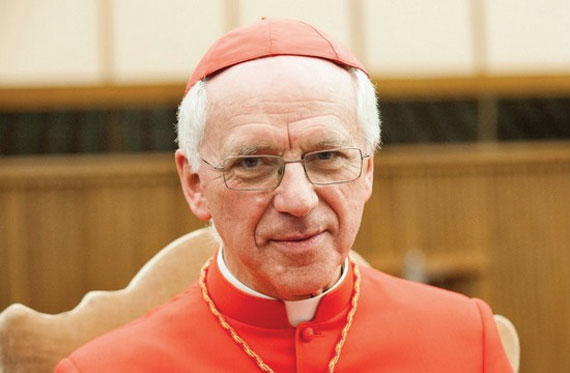
The idea of exceptionally ordaining older married men of proven virtue to celebrate the Eucharist in isolated Catholic commu-nities is something that should be discussed, said Cardinal Beniamino Stella, prefect of the Congregation for Clergy.

“It is not about being in favour of or against something, but about attentively evaluating various possibilities without being closed or rigid,” the cardinal said in a new book in Italian, “Tutti gli Uomini di Fran-cesco” (“All Francis’ Men”) released Jan. 22 by Edizioni San Paolo.

The book, by Italian journalist Fabio Marchese Ragona, includes interviews with churchmen named to the College of Cardinals by Pope Francis.

Francis was asked by the German news-paper Die Zeit last year about whether, in the Latin-rite church, he could see allowing married “viri probati” — men of proven virtue — to become priests.

“We have to study whether ‘viri probati’ are a possibility. We then also need to determine which tasks they could take on, such as in remote communities, for example,” Francis said.

The issue is expected to come up in the 2019 special gathering of the Synod of Bishops to study questions related to the church’s pastoral work in the Amazon. Already at Synods in 1990 on the priesthood and 2005 on the Eucharist some bishops — especially from Brazil’s Amazon region — suggested ordaining married men as the only way to ensure Catholics in isolated villages could receive the Eucharist regularly.

One possibility to explore is the exceptional ordination of older married men in remote communities, he said. “Continuing to maintain their family and jobs and receiving a formation contextualized for their environment, they could offer part-time service to the community they come from in order to guarantee the sacraments, especially by presiding at the eucharistic celebration.”

Pope marries couple on flight during Chilean trip

Love was literally in the air as Pope Francis performed an impromptu wedding ceremony at 36,000 feet aboard his flight in Chile.

During his flight to Iquique Jan. 18, the Pope was approached by LatAm flight steward Carlos Ciuffardi Elorriaga and asked for a blessing for him and his wife, stewardess Paula Podest Ruiz.

The couple were supposed to be married in their home parish in Santiago February 27, 2010. However, tragedy struck when an earthquake destroyed the church. Eight years later, they remained only civilly married.

Ciuffardi told journalists aboard the flight that, after he explained their story, he asked the Pope for their blessing.

At that moment, the Pope surprised the couple with offering to marry them right there on the plane.

Ciuffardi said the Pope asked the couple, “Well, do you want to get married?”

“I said, ‘Well, yes. Are you sure?’ Then the Pope said, “Are YOU sure?’ I told him, ‘Yes! Let’s get married,’” Ciuffardi recalled excitedly.

THE ‘CRADLE TO GRAVE’ STRATEGY OF CHRISTIAN PERSECUTION: REPORT

The UK “should lead the way” in tackling unprece-dented levels of Christian persecution a Conservative MP said on January 17. Teresa Villiers, MP for Chipping Barnet was speaking at the launch of the annu-al World Watch List, a survey of global Christian compiled by the Christian Charity Open Doors.

The report reveals that 3,000 Christians were killed for their faith last year, more than double the number recorded in the previous survey. It also states that more than 200 million Christians in the top 50 countries experience high levels of persecution or worse. Eleven of the countries in the list are now places of extreme persecution, the highest number ever recorded.

Mrs Villiers said more should be done to tackle Christian persecution: “The UK must encourage other countries, particularly those experiencing high levels of persecution, to tackle the problem.”

Citing the Commonwealth Heads of Govern-ment meeting, which will be held in London this April, she said: “The meeting is a chance for the UK to set the agenda on this issue and encourage those countries to do more.” This is particularly pertinent given that nine of the countries attending the meeting are listed on the World Watch List.

The event featured speakers Michael and Hannah from Egypt and Pakistan respectively, talking about the levels of persecution endured by Christians in their native countries.

Michael, an elder in one of Cairo’s local evangelical churches, works for the leadership team of a national ministry and with partners to strengthen the church and teach Christians in Egypt to stand strong through persecution and pressure.

Hannah, from Pakistan, described how the country of her birth is being “violated by extremist ideologies” that “treat Christians as foreign enti-ties” and encourage “the vast majority of Muslims to believe that Pakistan is only for Muslims.”

In Eritrea Clinics and schools closed: the regime prohibits Christian social activities

“In Eritrea, the regime has begun to persecute religious confessions and, in particular, the Catholic Church. The object-ive is clear: to try to prevent its influence on society: not by prohibiting worship, but social activities.” This is the alarm launched by Mussie Zerai, a priest of the eparchy of Asmara, for years a chaplain of the Eritreans in Europe and active in saving migrants in danger in the Medi-terranean. “Since 1995 – explains the religious to Fides – there has been a law in force in the country according to which the State wants to carry out all social activities. Therefore, the latter cannot be carried out by private or even by religious institutions. So far, the law has been applied in a bland manner and has not seriously affected the network of services offered by Christians and Muslims. In the last few months, however, there has been an acceleration.”

Public officials have decreed the closure of five Catholic clinics in various cities. The minor seminary (which served both the diocese and the religious congre-gations) was closed in Asmara.

Study asks: Why are young Catholics going, going, gone?

A new report on young adults who no longer identify as Catho-lic is attempting to understand why so many have “disaffiliated” from the faith they were born into. It comes at a time when more young people than ever before are leaving the church, even as those losses are being off set by His panic immigration to the U.S.

We looked at a sample of former Catholics, aged 15 to 25. This group is often characterized as “nones” because they claim no particular religious affiliation. The “Going, Going, Gone” rep-ort notes 2015 Pew research on all Americans that puts the number of disaffiliated young millennials (ages 18-24) at 36% and disaffiliated older millennials (25-33) at 34%. Approximately 12.8% of young adults in the U.S between 18 and 25 are former Catholics.

• Approximately 6.8%of U.S teenagers between 15 and 17 are former Catholics.

• 74% said they stopped identifying as Catholic between ages 10 and 20, with a median age of 13.

• About one-third (35%) are “done” with religious affiliation but still believe in something bigger, perhaps even God.

The Catholic priest who was Robert Louis Stevenson’s spiritual father

Mention of the name Robert Louis Stevenson instantly brings to mind his three enduring classics: Treasure Island, Kidnapped and Doctor Jekyll and Mr Hyde. I should add a fourth: A Child’s Garden of Verses, a charming reconstruction in verse of a child’s imaginative world. What most lovers of his fiction will not know, however, is that he also had one significant encounter with the Catholic Church.

Born into the narrow, pious world of Edinburgh Presbyterianism, Stevenson was too intelligent a man to dismiss Christianity in adult life – though he certainly rejected its conventional and social aspects within the rigid hierarchies of Scottish society. Recently reading Robert Louis Stevenson in Samoa by Joseph Farrell, an account of the final four years of his life, 1890-1894, it was interesting to learn that he ran his unconventional household in an old-fashioned, paternalistic style – which included leading prayers every evening for his family and the Samoan staff.

Now the CTS has reprinted Fr Damien by RLS, first published in 1956, as part of its new CTS Heritage series which has been devised to celebrate 150 years of publishing. This is a superb idea and I hope to highlight other booklets in the series in due course. Father Damien, now St Damien of Molokai, Hawaii, is famous for the self-sacrificial and practical charitable work he did among the lepers of Molokai, dying among them in 1889. Stevenson, in his quest to find a permanent home in the South Seas for the sake of his health, visited the lazaretto a year later, spending a week among the people, weeping at their suffering and making notes of their memories.

Stevenson’s “Open Letter” of 25 February 1890 has given the unfortunate Hyde an immortality he would not have wished, revealing all the latter’s petty prejudices and calumnies. Hyde described Fr Damien as a “coarse, dirty man, headstrong and bigoted.” With a skilled writer’s relish at demolishing this pompous, self-important man, RLS goes through each of Hyde’s criticisms in turn in his devastating critique, concluding with the resounding statement: “Well the man who tried to do what Damien did, is my father… and the father of all who love goodness; and he was your father too, if God had given you grace to see it.” The man who once wrote “We lepers” had undergone an unusual metamorphosis – to become the spiritual father of the renowned Scottish writer.

Poll shows a strong majority of Americans want restrictions on abortion

As of 2017, public support for legal abortion remains as high as it has been in two decades of polling. Currently, 57% say abortion should be legal in all or most cases, while 40% say it should be illegal in all or most cases.

Though abortion is a divisive issue, more than half of U.S. adults take a non-absolutist position, saying that in most–but not all cases, abortion should be legal (33%) or illegal (24%). Fewer take the position that in all cases abortion should be either legal (25%) or illegal (16%).

Seven-in-ten white evangelical Protestants (70%) think abortion should be illegal in all or most cases. By contrast, 80% of religiously unaffiliated Americans say abortion should be legal in all or most cases, as do two-thirds of white mainline Protestants (67%). Black Protestants and Catholics are somewhat more divided. Among black Pro-testants, 55% say abortion should be legal in all or most cases, while 41% say it should be illegal. And, among Catholics, 53% say abortion should be legal in all or most cases and 44% say it should be illegal.

About two-thirds of Republicans (65%) say abortion should be illegal in all or most cases. By contrast, three-quarters (75%) of Democrats say abortion should be legal in all or most cases. Among independents, 60% say abortion should be legal in all or most cases. Conservative Republicans are far more likely to say abortion should be illegal in all or most cases than to say that it should be legal (71% vs. 27%). Among moderate and liberal Republicans, opinion is more evenly divided: 54% say abortion should be legal, while 45% say it should be illegal.

Hundreds of Muslims convert to Christianity in Austria

The on-going refugee crisis has indirectly led to Austria recording a significant number of Muslims who converted to Christianity.

Three quarters of the 750 baptized adults in 2017 are immigrants from Muslim countries, citing the official spokesman for the Archdiocese of Vienna. Only in the Austrian capital, 260 people representing 15 different nations have been baptized.

Fredericke Dostal, who is responsible for the baptism of adults in the archdiocese, says the claim that migrants change their religion in order to increase the chances of getting an asylum are groundless.