Category Archives: International

Minorities languish in Indian jails

A disproportionate number of India’s minorities such as Muslims, tribal people and socially poor Dalits formerly known as ‘untouchables’ are imprisoned or sentenced to death. This is a central finding of research carried out by the National Dalit Movement for Justice, the Centre for Dalit Rights and the Social Awareness Society for Youths (SASY). A report on the investigation is to be presented to a session of the United Nations Human Rights Committee (UNHRC) in the first week of July.

The study quoted federal government data showing that by the end of 2015, India had 282,076 people incarcerated in various jails awaiting trial. Of that number, at least 21 percent were Dalits, officially called ‘Scheduled Caste’, and 12 percent were tribal people, the report said. Tribal people comprise only 8.2 percent of India’s population of 1.2 billion and Dalits make up 16 percent, according to the 2011 census.

That represents an over-representation of 33.33 percent for Dalits in relation to the number behind bars pending trial and and over-representation for tribal people in this situation of 51.22 percent.

Pakistan honours priest for promoting Christian-Muslim dialogue

A Catholic priest has been honoured by the Pakistan government for his “exemplary services” to promote interfaith harmony and peace in his own country and worldwide.

Father James Channan, a Dominican who has spent 50 years following the spirituality of St. Dominic, received an award at the Interfaith Conference 2019 in Lahore on May 17 that was attended by more than 300 people including Muslims, Christians, Hindus and Sikhs.

Noor-ul-HaqQadri, Pakistan’s federal minister for religious affairs and interfaith harmony, presented the award.

“Many people helped me to reach this place. I praise God, the Church, my community of Ibn-e-Mariam Vice Province of Pakistan, and all my friends,” said Father Channan.

“I especially thank my Muslim friends who always supported me and my work and keep on appreciating me to continue my mission to promote peace and harmony among the people of Pakistan.

“I am actively serving in this mission to build bridges between Christians and the people of other religions, especially with our Muslim brethren, but still I see there is an urgent need for interfaith dialogue.”

Father Channan said his work to promote peace and interfaith harmony brings him peace and mental satisfaction.

“I keep on thinking about ways to bring people of various faiths together, to help them to nurture and strengthen peace among them,” he said.

“Everybody is my neighbour, and being a follower of Jesus Christ I have to love everybody—it keeps me motivated and zealous. We always have to share this message that we are one human family, following different religions and faiths but living our faiths we have to promote love, unity and peace.”

Father Channan is the director of Lahore’s Peace Center, which was inaugurated by the late Cardinal Jean-Louis Tauran, then president of the Pontifical Council for Interreligious Dialogue.

“I work to provide facility to the people of various professions and age groups to come together for dialogue, which helps to remove discrimination, fundamentalism and extremism from our society,” he said.

Father Channan also serves as a regional coordinator of United Religions Initiative (URI) in Asia. URI is serving in 109 countries including Pakistan. “We have 63 active groups of religious leaders, lawyers, journalists, youth, women and children. Our Peace Center is always available for programs or events to promote peace, interfaith harmony, interreligious harmony and Christian-Muslim dialogue,” he said.

Facing terminal cancer, Polish man ordained priest in hospital bed

The ordination of Fr. Michal Los, FDP, a member of the Orionine Fathers, was far from typical ordination. Los was diagnosed with cancer a month ago, and is now in critical condition. On May 24, Los was ordained a priest in his Warsaw hospital bed.

Pope Francis granted a dispensation allowing him to be ordained both a deacon and a priest in the same Mass, and Los was ordained by Bishop Marek Solarczyk of the Diocese of Warsaw-Praga.

The day before his ordination, Los made perpetual vows in his religious community. Permission was granted to the director general of the congregation, Fr. Tarcisio Vieira, to whom Pope Francis sent a letter.

“The ceremony took place in an atmosphere of great and profound spirituality. After the initial prayer, the litany for the intercession of the saints followed for the life of Michal and for his congregation,” said Fr. Fornerod in a Facebook post about the event. The day after his ordination, Los celebrated his first Mass from his bed.

Pope Francis urges Catholics to help children by supporting adoption

Adoption is often a difficult and bureaucratic process, but there are many children who need homes and the Church should step up to help them, Pope Francis said. Speaking on May 24 to employees and patients of an Italian hospital for abandoned children, he said, “so many times there are people who want to adopt children, but there is such enormous bureaucracy,” such as high fees or, at worst, corruption.

“There are many, many families who do not have children and would certainly have the desire to have one with adoption,” he continued. “Go forward, to create a culture of adoption, because there are so many abandoned children, alone, victims of war and so on.” Pope Francis spoke about adoption in unprepared remarks during a Vatican meeting with 70 employees and children from the 600-year-old Hospital of the Innocents in Florence.

Francis also said there must be a goal, at various levels of responsibility, of ensuring “no mother finds herself in a position of having to abandon her child. We must also ensure that in the face of any event, even tragic, that may detach a child from her parents, there are structures and paths of welcome in which childhood is always protected and cared for, in the only way worthy: giving children the best we can offer them,” he said.

Pope Francis appoints new head of Vatican’s interreligious dialogue

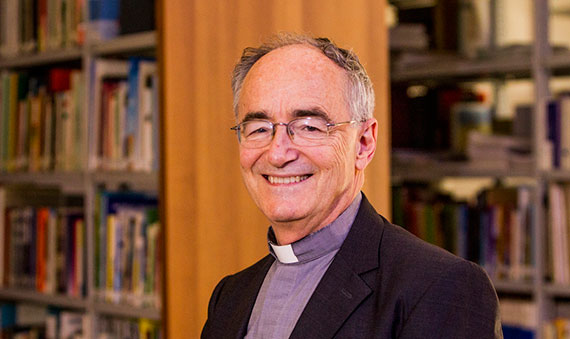
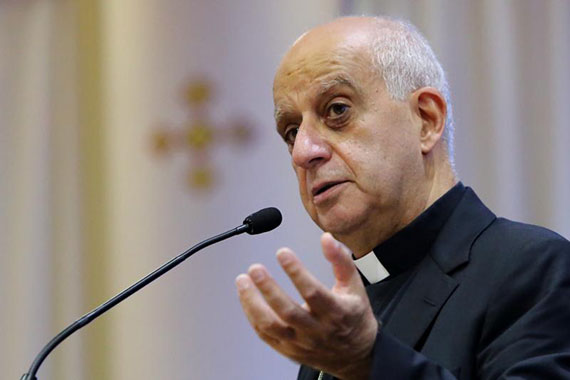
Pope Francis appoint-ed Spanish Bishop Miguel Ayuso Guixot Saturday as president of the Pontifical Council for Interreligious Dialogue. Guixot succeeds Cardinal Jean Louis Tauran, who led the Vatican dicastery for over ten years until his death in July 2018.

As a priest in the Comboni Missionary of the Sacred Heart of Jesus, Guixot served as a missionary in Egypt and Sudan. He has degrees in Arabic and Islamic studies, in addition to a doctorate in dogmatic theology from the University of Granada. Guixot, 66, served as the dean of the Pontifical Institute of Arabic and Islamic Studies in Rome until Pope Benedict XVI appointed him as secretary of the Pontifical Council for Interreligious Dialogue in 2012. In 2016 Pope Francis consecrated Guixot as a bishop. Originally from Seville, Guixot, speaks Arabic, English, French, and Italian, in addition to Spanish.

Interreligious dialogue has been a focus of Pope Francis’ pastoral visits in 2019. His trips to the United Arab Emirates, Morocco, and Bulgaria all included interreligious meetings. In Abu Dhabi, Pope Francis signed a joint-statement on human fraternity with the Grand Imam of al-Azhar, Ahmed el-Tayeb, which he called “a new page in the history of dialogue between Christianity and Islam.”

Former airline pilot appointed to lead diocese of US

Pope Francis Friday named Bishop Robert D. Gruss of Rapid City, South Dakota, the next bishop of the Diocese of Saginaw, Michigan. Gruss, 63, was bishop of Rapid City since 2011. A native of Arkansas, he was ordained to the priesthood for the Diocese of Davenport, Iowa in 1994, after a career as a commercial airline pilot and aviation instructor. During his seminary formation, Gruss studied sacred theology and also received a master’s degree in spiritual theology. The Diocese of Saginaw spans 11 counties and 6,955 square miles in mid-Michigan, and has around 100,000 Catholics.

Attempt to legalize abortion, gay marriage fails in Mexican Congress

The portion of a constitutional reform initiative seeking to legalize abortion and same-sex marriage in Mexico did not advance in the nation’s legislature. A gender parity bill was debated and approved in both houses of the Mexican Congress May 23. The bill would require that half of the country’s public service sector be women.

Porfirio Muñoz Ledo, president of the Chamber of Deputies and a member of the National Regeneration Movement, had proposed that the bill establishes rights to abortion and same-sex marriage. These proposals were not included in the bill’s final version, however, for lack of widespread support.

Francis mandates clergy abuse reporting worldwide, empowers archbishops to do investigations

Pope Francis issued sweeping new laws for the Catholic Church on the investigation of clergy sexual abuse May 9, mandating for the first time that all priests and members of religious orders worldwide are obligated to report any suspicions of abuse or its cover-up.

The pontiff has also established a new global system for the evaluation of reports of abuse or cover-up by bishops, which foresees the empowering of archbishops to conduct investigations of prelates in their local regions with the help of Vatican authorities.

We met our Spring Fund Drive goal, thanks to your generosity! If you still want to contribute, it’s not too late.

The new norms, contained in a brief apostolic letter titled Vosestis lux mundi (“You are the light of the world”), are exhaustive in scope, applying in some way to every ordained or vowed member of the 1.3 billion-person church. They also encourage lay people to make reports of abuse, and provide for involvement of lay experts in investigations.

In his introduction to the document, which goes into effect from June 1, Pope Francis says he has created the new laws so that the church will “continue to learn from the bitter lessons of the past, looking with hope towards the future.”

“The crimes of sexual abuse offend Our Lord, cause physical, psychological and spiritual damage to the victims and harm the community of the faithful,” the Pope states. “In order that these phenomena, in all their forms, never happen again, a continuous and profound conversion of hearts is needed, attested by concrete and effective actions that involve everyone in the Church.”

The new procedure essentially contains five steps:

1. A person alleging abuse or cover-up by a prelate makes a report to their bishop, the Vatican, or the church’s ambassador in their country.

2. If that abuse or cover-up involves a prelate, the bishop or superior receiving the report is obligated to forward it to both the Vatican and the metropolitan archbishop of their regional province.

3. Once that report has been filed, the metropolitan archbishop is to ask the Vatican for authority to conduct an investigation.

4. After receiving proper authority, the metropolitan conducts the investigation, sending reports to the Vatican on its status every thirty days. The initial time-frame for investigation is ninety days, but can be extended.

5. Once the investigation is finished, the metropolitan is to communicate its results and his opinion on the matter to the Vatican for a final determination of the outcome for the bishop in question.

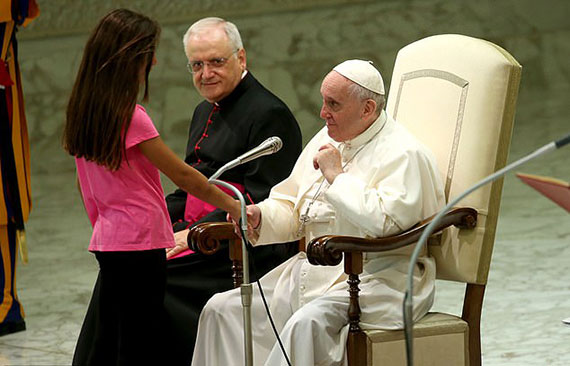
Pope discusses deaconesses, need for nuns to be servants not ‘maids’

She thanked the Pope for being a source of inspiration and helping the church fight the abuse of minors and vulnerable people.

“We are also grateful for your having faced the painful issue of abused religious,” she said, noting that many forms of abuse occur world-wide, including cases of religious abusing their fellow sisters.

National conferences of religious orders “are facing this scourge with courage and determination,” she said, listing a number of UISG initiatives to help congregations in raising awareness, training superiors and establishing protocols and codes of conduct.

The Pope said he was very much aware of the abuse of religious, calling it “a serious and grave problem.” Some religious face not just sexual abuse, he said, but also the abuse of power and conscience.

“We have to fight against this,” which must include the superiors general making sure they send their members where they will be in service, not servitude, the Pope said.

Fighting abuse, he continued, has been a slow process, especially seeing how it is only now that people are understanding the problem with “lots of shame.”

He said that he under-stood some victims’ groups were not satisfied with the outcome of a February summit at the Vatican on safeguarding children and vulnerable adults, “but if we had hung (to death) 100 priest abusers in St Peter’s Square, everyone would have been happy, but the problem would not have been solved.”

German Catholic women begin boycott over lack of reforms

A grassroots Catholic women’s movement – using the motto of the Virgin Mary who should be given her voice – launched a week of disobedient non-service on May 11 – with the backing of major lay organizations and even singular bishops.

The women planned to hold rites outside churches, without priests, and withhold services inside parishes until May 18 at least 50 locations to back their call that the Vatican open the priesthood to women and drop celibacy.

Left undone will be attendances at mass and committees, parish housework and the liturgical readings – tasks left typically to regular churchgoing women. The central protest was outdoors in the northwestern city of Münster on May 12.

One of the initiators, Andrea Voss-Frick, said the Maria 2.0 movement – conceived early this year at a women’s parish bible meeting in Münster, a hub of German Catholicism – had received endorsement from Berlin, Hamburg and Vienna. The Virgin Mary is referred to as Maria in German.

The impulse came as the initiators realized that the Vatican’s pronouncement and church teachings of hope “didn’t come across at all” amid abuse and cover-ups, said Voss-Frick.

On May 10, two nationwide groups – the Catholic German Women’s League (KDFB) and the Catholic Women’s Community of Germany (KfD) – described the strike call as an “important signal” and urged bishops not to ignore it.

KDFB president Maria Flachsbarth said abuse cases and cover-ups by priests had slid the church into deep crisis and credibility loss. Striking women wanted to show how much the church and its evangelical “gospel” meant to them, said Flachsbarth who is also a federal parliamentarian and member of Chancellor Angela Merkel’s Christian Democrat (CDU) party.

“Without the women nothing happens,” said Thomas Sternberg, president of the Central Council of German Catholics (ZdK) at its lay convention in Mainz on May 10.