
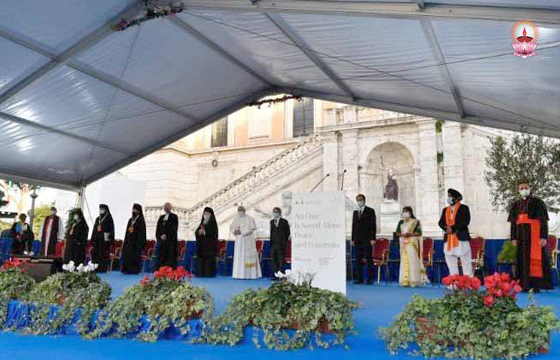
Pope Francis set the tone of his speech on October 20 by recalling the historic Assisi Meeting desired by Saint Pope John Paul II on October 27, 1986, in which for the first time in Church history the Pope invited leaders of other religions to join him in prayer for peace for the human family. That meeting, he said, contained a prophetic seed “that by God’s grace has gradually matured through unprecedented encounters, acts of peacemaking and fresh initiatives of fraternity.” He noted that since that meeting many painful events have taken place, at times in the name of religion, but that we also acknowledge the fruitful steps undertaken since then in interreligious dialogue.
Category Archives: International
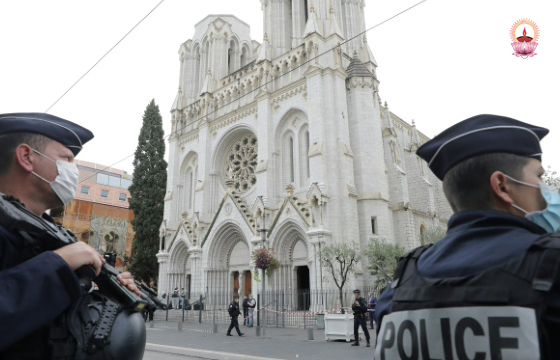
Jihadi Kills Catholics in Nice’s Notre-Dame
A Muslim jihadi has gone on a stabbing spree in Nice’s Notre-Dame Basilica, killing the male sacristan, beheading an elderly woman at the baptismal font and knifing a fleeing third woman who died in a nearby café.
The assailant in his 20s, identifying himself as “Ibrahim,” stabbed and wounded several others around the neo-gothic Basilica of the Assumption of our Lady around 9 am on Oct. 29.
Police shot and severely wounded the killer, who was heard repeatedly shouting “Allahu Akbar” [God is greatest] as he was taken away in an ambulance.
Just over a week ago, Emanuel Macron said he wanted to end ‘Islamic separatism’ in France because a minority of the country’s estimated six million Muslims risk forming a ‘counter-society’. We saw yet another example of this when a history teacher was decapitated in the street on his way home in a Paris suburb. M Paty was murdered, Macron said, “because he taught the freedom of expression, the freedom to believe or not believe.” The president is now positioning himself as the defender of French values, determined to drain the Islamist swamp.
That Macron even gave an anti-Islamism speech was itself a sign of how fast the debate is moving in France. Five years ago, when Fox News referred to ‘no-go zones’ in Paris, the city’s mayor threatened to sue.
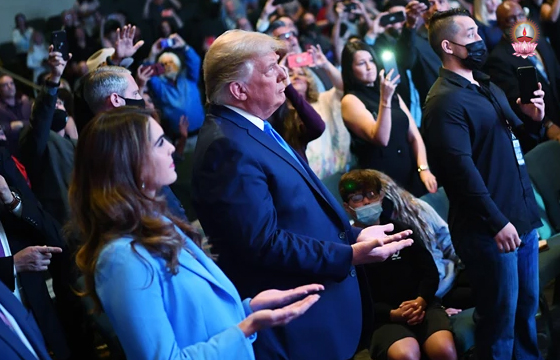
Trump Becomes the First President Since Eisenhower to Change Faiths in Office
More than 180,000 people have stopped identifying with the Presbyterian Church (USA) in the past four years, according to official church numbers. Now there’s one more: President Donald Trump. Trump told Religion News Service in a written interview mediated by spiritual advisor Paula White-Cain that he doesn’t consider himself to be Presbyterian. He was confirmed in the church and has called himself Presbyterian numerous times over the years. But no more. “I now consider myself to be a non-denominational Christian,” Trump said in the statement. “Melania and I have gotten to visit some amazing churches and meet with great faith leaders from around the world. During the unprecedented COVID-19 outbreak, I tuned into several virtual church services and know that millions of Americans did the same.”
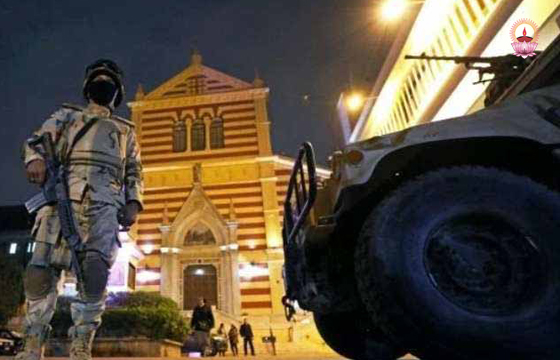
Latest attack on Coptic Christians highlights religious violence in Egypt
On October 5, 2020, a mob of Islamic extremists attacked the homes of Coptic Christians in the Egyptian village of Dabous, located in the Upper Egypt region of Minya. According to International Christian Concern, two young Muslim adults beat up a ten-year old Coptic Christian child. Some Christian adults retaliated, triggering the attack the next day. Christians make up about 10% of Egypt’s 100 million people, making the country home to the largest Christian population in the Arab world. The vast majority of Christians belong to the Coptic Orthodox Church, the largest Church in the Oriental Orthodox communion – However there are about 350,000 Eastern Orthodox Christians, 300,000 Protestants, and just under 200,000 Catholics.
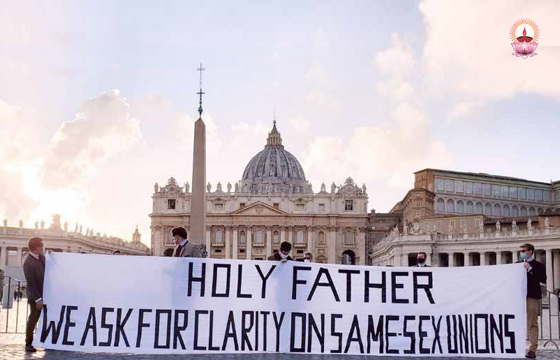
Banner in St. Peter’s Square asks Francis for clarification
Austrian Catholic Alexander Tschugguel took Vatican police by surprise on October 24 afternoon as the “Pachamama slayer” unfurled a massive banner in St Peter’s Square asking Pope Francis for “clarity on same-sex unions.”
Tschugguel led a band of faithful Catholics from Castel Sant’Angelo — where the Catholic convert had dumped five Pachamama idols into the Tiber River during the Amazon Synod — to the Vatican in protest agai-nst the pontiff’s repudiation of Catholic teaching.
As over 50 Catholics knelt praying the Rosary in front of St Peter’s Basilica, hundreds of onlookers gathered to witness the demonstration.
A veteran Vaticanist who was at the scene told Church Militant he’d never seen anything like it before and commented how long police took to clear the protest.
“On a previous occasion when a much smaller banner was raised, police ordered it taken down in less than a minute,” he remarked. “Today, it took them over 15 minutes to bring the demonstration to a halt.”
In an interview at Castel Sant’Angelo, Church Militant asked Tschugguel why he was asking for clarity when the pontiff was on record declaring his support for gay civil unions on multiple occasions.
Bottomline on pope movie mystery: ‘If you don’t fix it, you bought it’
When I was a child growing up in a small Western Kansas town, my mom from time to time would take me to Main Street to visit the shops. Most had some version of the following sign on display, meant as a warning to be careful with the merchandise: “You break it, you bought it.”
There’s a PR corollary that could be said to go like this: “No matter who breaks it, if you don’t fix it you bought it.” It means that no matter what a leader actually says or does, if he or she allows an impression to be created and doesn’t publicly disown it, then it belongs to them.
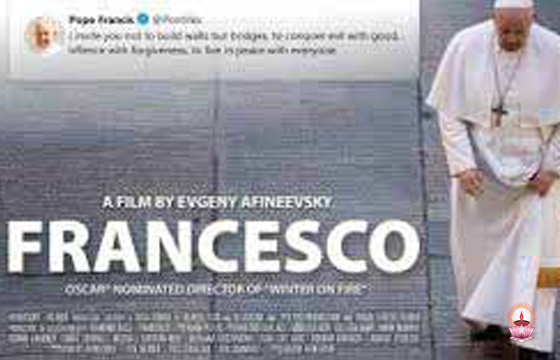
The thought comes to mind in light of the emerging mystery surrounding the new Pope documentary “Francesco” by Evgeny Afineevsky, which debuted and already is a candidate to contain the most-dissected 20 seconds of imagery about a major world leader since the Zapruder film.
In those twenty seconds, Pope Francis makes comments about civil unions for same-sex persons that created a global media frenzy, reported as the first time a Pope explicitly had endorsed civil unions. It also appeared to directly contradict a 2003 document from the Vatican’s Congregation for the Doctrine of the Faith, prepared by the future Pope Benedict XVI and approved by St John Paul II, warning that such laws are “gravely unjust” and insisting that Catholics may never support them.
Over 20 “caliphate builders” exposed in North Caucasus
The Russian Federal Security Service (FSB) has uncovered two extremist cells in Russia’s internal republics of Karacha-yevo-Cherkessia and Dagestan comprising adherents of the Al-Takfir wal Hijra movement, banned in Russia, seeking to establish a caliphate in the North Caucasus, the FSB press centre told.
“The Federal Security Ser-vice of the Russian Federation dismantled the activities of two cells of the Al-Takfir wal Hijra international extremist religious movement, banned in Russia, in the Malokarachayevsk District of the Republic of Karachayevo-Cherkessia and in the cities of Makhachkala, Kaspiysk, and Izberbash of the Republic of Dagestan. In all, they had more than 20 members,” it said.
The cells’ members were actively involved in promoting the radical ideology, recruited new members to this extremist religious sect, called on adherents to renounce secular laws and civil society institutions, “and also sought to set up a theocratic Islamic state – a caliphate – in the territory of the North Caucasus,” it said. “The following items were found and seized at their places of residence and the places of their secret meetings: three grenades with live primers, three PM pistols, cartridges of different calibres, a sawed-off hunting rifle, bladed weapons…” the press centre said.
Cardinal says Pope’s new encyclical is a warning: The world is ‘on the brink’
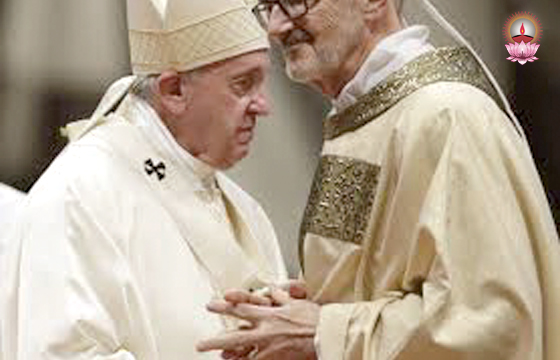
One of Pope Francis’s top advisers said that the pontiff sees the current world situation comparable to that of the Cuban missile crisis, World War II, or 9/11 – and that to fully understand the papal encyclical released on Sunday, October 4, it’s necessary to acknowledge “we’re on the brink.”
“Depending on your age, what was it like to hear Pius XII deliver his Christmas messages during World War II?” said Cardinal Michael Czerny. “Or how did it feel when Pope John XXIII published Pacem in Terris? Or after the 2007/2008 crisis, or after 9/11? I think you need to recover that feeling in your stomach, in your whole being, to appreciate Fratelli Tutti.”
“I think Pope Francis feels today the world needs a message comparable to what we needed during the Cuban missile crisis, or World War II or 9/11 or the big crash of 2007/2008,” he said. “We’re on the brink. We need to pull back in a very human, worldwide and local way. I think that’s one way to get into Fratelli Tutti.”
Fratelli Tutti is the encyclical the Argentine Pope released on the feast of St. Francis of Assisi, after signing it the previous day in the Italian town where the Franciscan saint lived most of his life.
According to the cardinal, if Pope Francis’s previous encyclical, Laudato Si’, on the care of creation, “taught us that everything is connected, Fratelli Tutti teaches us that everyone is connected.”
“If we take responsibility for our common home and for our brothers and sisters, then I think that we do have a good chance, and my hope is re-kindled and inspired to keep on going and do more,” he said.
Czerny, head of the Vatican’s migrants and refugees section of the Dicastery for Promoting Integral Human Development, made his comments during a “Dahlgren Dialogue” session organized online by the Initiative on Catholic Social Thought and Public Life of Georgetown University.
The prelate said that Fratelli Tutti “brings some big questions and brings them home to each of us,” with the pontiff attacking a theory that most subscribe to without realizing they’re doing so: “We believe to be self-made, without recognizing God as our creator; we’re prosperous, we believe we deserve everything that we have and consume; and we’re orphans, disconnected, totally free, and actually alone.”
What Lessons Do Americans See for Humanity in the Pandemic Humanity in What Lessons Do
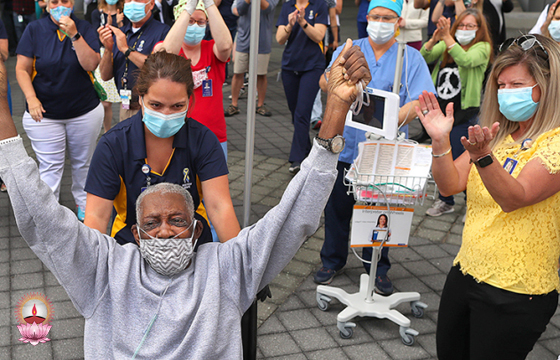
When an event has as much impact as the coronavirus outbreak – disrupting billions of lives and leading to more than 1 million deaths around the world – it’s natural for people to ponder big questions. Is this just a random occurrence, or is there something more at play? Is it all part of God’s plan? Or, at a more worldly level, can this experience teach us any truths about humanity?
We sought to explore these questions in a recent Pew Re-search Centre survey, conducted in mid-July on the Centre’s American Trends Panel. First, we asked people: Do you believe there is a lesson or a set of lessons for humankind to learn from the coronavirus outbreak? And if so, do you think these lessons were sent by God, or not?
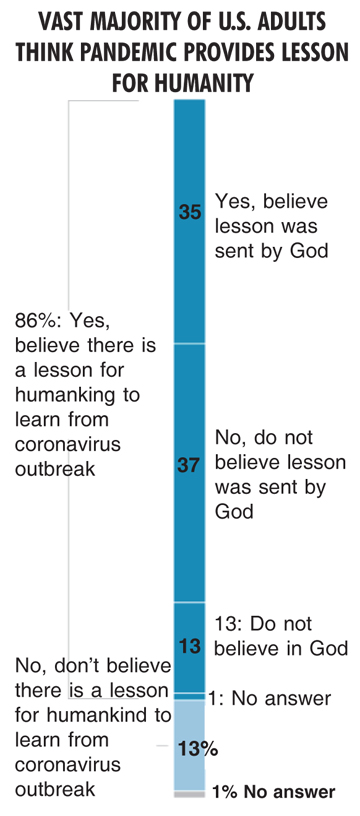
A large majority of U.S. adults (86%) say there is some kind of lesson or set of lessons for humankind to learn from the pandemic, and about a third of Americans (35%) say the lessons were sent by God. The remainder say the lessons were not sent by God (37%), they do not believe in God (13%), or there is no lesson to be learned (13%).
Then, we asked half the respondents who said yes to the first question to describe, in their own words, what lessons they think humankind should learn. This prompted more than 3,700 people to write their answers, which ranged from a few words to several sentences.
The rest of this essay looks at a sampling of responses – including many examples presented exactly as respondents wrote them. Some responses have been lightly edited for spelling and clarity. Due in part to the great variety of responses we received, we did not attempt to quantify what percentage of Americans believe there is a certain type of lesson to be learned.
Americans who say God is using the pandemic to send a lesson to humanity often highlight religious lessons. Those who do not think the lessons of the pandemic were sent by God mention a variety of topics – though rarely religious ones.
Among those who say there is a lesson about religion within the pandemic, some respondents point to the role God has in humans’ lives. For instance, a 53-year-old woman writes that “whether you believe it or not, God is in control and we must have God at the centre of our lives. He is our saviour.”
A 58-year-old man feels God wants people to reflect on their lives: “God is telling us that we need to change our ways or He will send a virus that will make us be alone so that we have time to think about how we live our lives. We all need to live as one we are all children of God. God did not create mankind to live as we do. And He is not going to let this virus end until He knows that we have learned our lesson.”

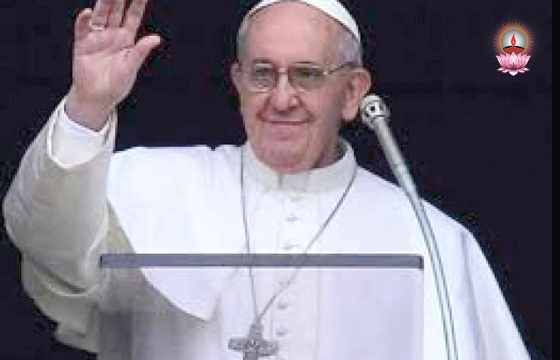
Pope calls for greater space for women in positions of ‘responsiblity in the institutions of the Church’
Let us pray that “the lay faithful, especially women, may participate more in institutions of responsibility in the Church, without falling into clericalism that nullifies the lay charism.” This was Pope Francis reflection after the Angelus, when he also appealed for a ”resumption” of the truce between Armenia and Azerbaijan and recalled the beatification of 15-year-old Carlo Acutis, indicating him as a “model” for today’s young people.
Pope Francis recited the Marian prayer together with a few thousand people present in St Peter’s Square on a drizzly Sunday on Oct. 11. Commenting on that day’s Gospel passage on the parable of the wedding banquet, the Pope underlined that twice in the story, the king’s servants are sent to call the guests “but they refuse, they don’t want to go to the celebration, because they have other things to think about.”
Pope Francis underlined that “often we too put our interests and material things before the Lord who calls us. But the king of the parable does not want the room to remain empty, because he wishes to donate the treasures of his kingdom and extends the invitation to even the most distant, “without excluding anyone,” because “no one is excluded from the house of God.” The king in fact says: “Call everyone, good and bad. Everyone.” “God calls the bad, too.”
In this way the Church too “is called to reach today’s crossroads, that is, the geo-graphical and existential peripheries of humanity,” all those places where “shreds of humanity without hope” live. “It is a question of not settling on the comfortable and habitual ways of evangelization and witness to charity, but of opening the doors of our hearts and of our communities to all, because the Gospel is not reserved for a select few. Even those who are marginalized, even those who are rejected and despised by society, are considered by God worthy of His love.”
It was after the Angelus that Francis said he “appreciated that a ceasefire for humanitarian reasons was agreed between Armenia and Azerbaijan, with a view to reaching a substantial peace agreement. Although the truce proves to be too fragile, I encourage it to be resumed and I express my participation in the pain of the loss of human lives, the suffering, as well as the destruction of homes and places of worship. I pray and invite you to pray for the victims and for all those whose life is in danger.”