
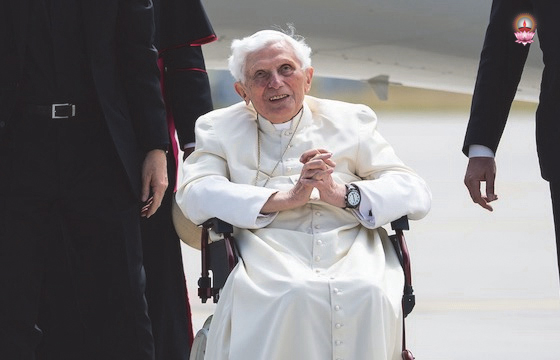
The week after Pope Francis toughened up the rules on setting up new orders it became clear that Pope Emeritus Benedict XVI distanced himself from an order that he helped establish and recognised in 1977 when, as Cardinal Joseph Ratzinger, he was Archbishop of Munich and Freising.
Now Pope Emeritus Benedict XVI has expressed regret for his original support for the Catholic Integrated Community (CIC).
Category Archives: International
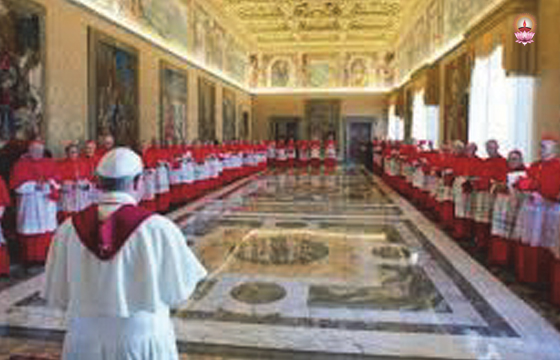
Crisis is healthy for Church, Pope tells Curia
In his Christmas address to the Roman Curia, Pope Francis said that crisis can be beneficial to the Church, but conflict is always destructive. The annual address to the Vatican leadership has become a key indicator of papal priorities, and in past years Pope Francis has surprised his listeners with blunt criticism of what he has seen as deficiencies in the Curia. This year, his lengthy address took a different approach, advising against internal conflicts.
“Crisis generally has a posi-tive outcome, whereas conflict always creates discord and competition, an apparently irreconcilable antagonism that separates others into friends to love and enemies to fight,” the Pope said.
“Every crisis contains a rightful demand for renewal,” the Pontiff explained. The key to successful renewal, he said, is to see the problems facing the Church from the perspective of the Gospel. “Those who fail to view a crisis in the light of the Gospel simply perform an autopsy on a cadaver,” he said.
Authentic renewal, the Pope continued, requires “the courage to be completely open.” He contrasted that open attitude with the attitude of those who see a crisis in terms of conflict between different viewpoints.
One in 9 Russians curses frequently, over 60% do so from time to time – poll
Moscow, on December 15, Interfax – Eleven percent of Russians curse frequently; the share is the highest in the group aged from 31 to 45, the Public Opinion Foundation said in a statement seen by Interfax. The number of frequently cursing men is two times higher than the number of such women, 15% and 7%, respectively, the pollster said.
Sixty one percent of Russians use foul language on rare occasions, mostly in the group aged from 18 to 30 (71%).
According to the Public Opinion Foundation, 56% of Russians curse only if they experience strong emotions, 12% do not need such emotions to swear.
A quarter of respondents (26%) told the pollster that they never used foul language; the share was the biggest in the group aged 60 and up (46%), the statement said.
Over a third of respondents (37%) allowed for the occasional use of foul language in fiction books, 60% said that was inadmissible under any circumstances, and 3% were undecided.
The Public Opinion Foundation noted that 43% of Russians often heard foul language on the street, in public areas, and in public transport, and 51% heard people swearing from time to time. Three percent said they had never heard foul language being used in such places, and 3% could not say whether what they heard was cursing or not.
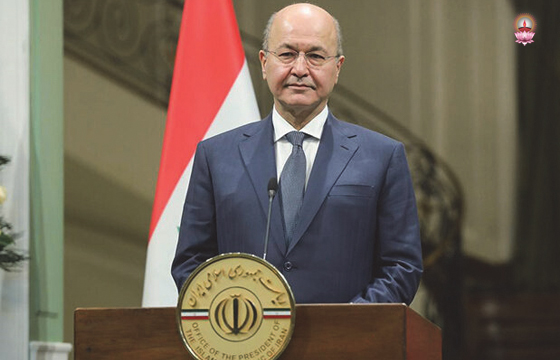
Iraqi parliament formally declares Christmas a national holiday
In a move some have said is already a direct result of Pope Francis’s highly anticipated visit to the country in March, Iraqi parliament earlier voted to establish Christmas as an annual national holiday.
The vote, which took place on Dec. 16, was unanimous and goes into effect this year, meaning that for all of its woes, 2020 will have at least one silver lining for the Iraqi Christian community.
Previously, Christians had been given the day of Dec. 25 off, but it was not considered a holiday for the rest of the population in the Muslim-majority nation.
In 2008, the Iraqi government declared Christmas a “one-time” holiday, but the provision was not renewed.
In recent years, Christmas has only been a public holiday in the province of Kirkuk.

Pope Francis proclaims a year dedicated to St Joseph
Marking the 150th anniversary of St Joseph being declared patron of the universal church, Pope Francis proclaimed a yearlong celebration dedicated to the foster father of Jesus. In a Dec. 8 apostolic letter,” Patris Corde” (“With a father’s heart”), the Pope said Christians can discover in St Joseph, who often goes unnoticed, “an intercessor, a support and a guide in times of trouble.”
“St Joseph reminds us that those who appear hidden or in the shadows can play an incomparable role in the history of salvation. A word of recognition and of gratitude is due to them all,” he said.
As Mary’s husband and guardian of the son of God, St Joseph turned “his human vocation to domestic love into a superhuman oblation of himself, his heart and all his abilities, a love placed at the service of the Messiah who was growing to maturity in his home.”
Marking the 150th anniversary of St Joseph being declared patron of the universal church, Pope Francis proclaimed a yearlong celebration dedicated to the foster father of Jesus.
Despite being troubled at first by Mary’s pregnancy, he added, St Joseph was obedient to God’s will “regardless of the hardship involved.”
“In every situation, Joseph declared his own ‘fiat,’ like those of Mary at the Annunciation and Jesus in the Garden of Gethsemane,” the Pope said. “All this makes it clear that St Joseph was called by God to serve the person and mission of Jesus directly through the exercise of his fatherhood and that, in this way, he cooperated in the fullness of time in the great mystery of salvation and is truly a minister of salvation.”
St Joseph’s unconditional acceptance of Mary and his decision to protect her “good name, her dignity and her life” also serves as an example for men today, the Pope added.
“Today, in our world where psychological, verbal and physical violence toward women is so evident, Joseph appears as the figure of a respectful and sensitive man,” he wrote.
Pope Francis also highlighted St Joseph’s “creative courage,” not only in finding a stable and making it a “welcoming home for the son of God (who came) into the world,” but also in protecting Christ from the threat posed by King Herod.
The Apostolic Penitentiary, a Vatican tribunal that deals with matters of conscience, also issued a decree on Dec. 8 stating that plenary indulgences will be granted to Catholics not only through prayer and penance, but also through acts of justice, charity and piety dedicated to the foster father of Jesus.
Among the conditions for receiving an indulgence are a spirit detached from sin, receiving sacramental confession as soon as possible, receiving Communion as soon as possible and praying for the Holy Father’s intentions.
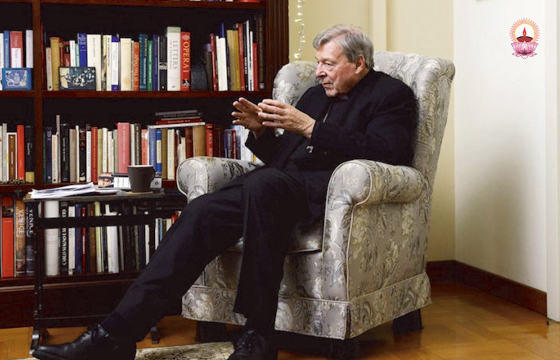
Vatican risks going broke slowly, former treasurer Cardinal Pell says
Cardinal Pell, 79, was cleared of sex abuse charges in his native Australia in April. His book “Prison Journal,” published this month, recounts his 13 months in solitary confinement in tiny cells following one of the most divisive trials in the country’s history.
In a 90-minute interview with Reuters in his Rome apartment across the street from a Vatican gate, Cardinal Pell discussed his darkest moments, how his faith kept him from falling into despair, the harm the worldwide sexual abuse scandal had done to the Church and the current state of affairs in the Vatican. “Look, it was bad, it wasn’t like a holiday, but I don’t want to exaggerate how difficult that was. But there were many dark moments,” he said, wearing a black clergyman suit with a silver cross around his neck.
Pope Francis appointed Cardinal Pell, the former archbishop of Sydney, in 2014 to head the newly-created Secretariat for the Economy and mandated him with cleaning up the Vatican’s murky finances.
Cardinal Pell ran into resistance from some Vatican officials, particularly Italian Cardinal Angelo Becciu, then deputy secretary of state who wanted Vatican departments to continue controlling their own funds.
Cardinal Becciu forced out external auditors brought in by Cardinal Pell as well as the Vatican’s first auditor general.
In September, Pope Francis fired Cardinal Becciu, accusing him of nepotism and embezzlement. Cardinal Becciu, who also has been caught up in a scandal involving the Vatican’s purchase of a luxury property in London, denies all wrongdoing. “I think we are much, much better placed than we were,” Cardinal Pell said of the state of reform of Vatican finances, including new accounting and controls.
“The great challenge that lies before the Vatican is that it’s slowly going broke. Now that’s a bit of an exaggeration (but) it’s slowly happening,” he said, adding that he was basing his comments on public information.
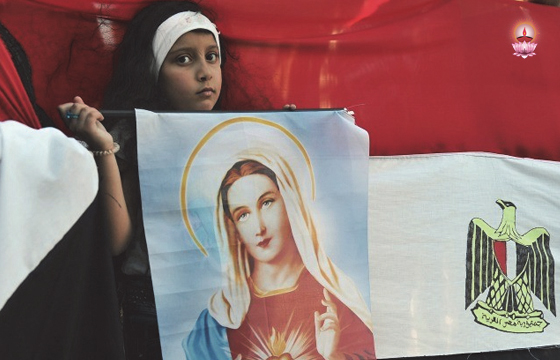
100 Arrested in Egypt After Muslim Mob Attacks Coptic Christians over ‘Insulting’ Facebook Post
A mob of Muslim villagers in Egypt attacked a church and assaulted Coptic Christians in retaliation for a Facebook post published by a young Coptic man, which Muslim locals considered insulting to the Prophet Muhammad. Egyptian authorities made a number of arrests in the village of al Barsha, located in the Minya governorate, after the mob began hurling stones and Molotov cocktails at the homes of Copts while others stormed the Abu Siffin Church during a church service, the Middle East Monitor reported on November 27.
The rioters also ransacked a number of shops owned by Christians and an elderly Coptic woman was hospitalized for burns suffered in a fire after her home was torched.
Christian persecution around the globe reached an unprecedented level at the end of 2019, with over 260 million Christians facing “high levels of persecution.”
Initial reports said that police had arrested eight people but later reports said they had arrested a hundred people, including 35 Copts.
One video recording circulating on social media showed a group of people chanting: “There is no God but Allah, and Muhammad is his messenger,” as they pelted a crowd of Christians with stones.
General Osama Al Qadi, Governor of the Minya Province, called a meeting at which he said that measures will be taken against “anyone who offends others,” reiterating that “no one will be allowed to sow discord between people who belong to the same nation,” while inviting local imams to focus their sermons in mosques on the themes of peaceful coexistence and tolerance.
Jihadists with ties to the al-Qaeda terror network executed a Christian missionary after four years in captivity in the African nation of Mali, Swiss authorities reported.
International Christian Concern (ICC) reported that free speech is suffering in Egypt as a number of human rights activists associated with the Egyptian Initiative for Personal Rights (EIPR) have been arrested and blasphemy charges against Christians are on the increase. On November 11, Egyptian police arrested a young Christian teacher named Youssef Hany in northeastern Egypt on charges of insulting Islam in a Facebook post. Mr Hany posted comments responding to a Muslim who had expressed her opposition to criticisms of Islam by the president of France and other French citizens.

Pope Lauds African Rite ‘Invoking Ancestors’
“The Zairean rite suggests a promising way also for the possible elaboration of an Amazonian rite,” writes Francis in his preface for a new book titled Pope Francis and the Roman Missal of the Dioceses of Zaire: A Promising Rite for Other Cultures.
The Zairean Mass, sometimes called the “Congolese Mass,” is “until now the only inculturated rite of the Latin Church approved after the Second Vatican Council,” claims Vatican News — although the Vatican also approved “Twelve Points of Adaptation” for a Hinduized “Indian rite Mass” in 1969.
Commending the Zairean rite for its cultural vibrancy and spirituality, Pope Francis says that the liturgical inculturation in the Democratic Republic of the Congo (DRC) is an invitation for enhancing the different gifts of the Holy Spirit, thus enriching humanity.
“Animated by religious songs with an African rhythm, the sound of drums and other musical instruments constitute real progress in the rooting of the Christian message in the Congolese soul. It is a joyful celebration. It is a true place of encounter with Jesus,” observes Francis. This is not the moment to include half-baked theological speculations in the liturgy.
The pontiff insists that liturgical inculturation in Africa and the Amazon is possible “without upsetting the nature of the Roman Missal, to guarantee continuity with the ancient and universal tradition of the Church.” Francis’ commendation of the Zairean Mass comes a year after the pontiff celebrated a special Mass for Rome-based Congolese Catholics in St Peter’s Basilica using the Zairean rite.
Liturgists, however, are disturbed by pagan elements in the Zaire Mass, especially the rite of the “Invocation of the Ancestors of Upright Heart (invocation ancetres au coeur droi),” together with the saints in the opening rites of the Holy Mass — particularly as the congregation may even invoke their pagan ancestors.
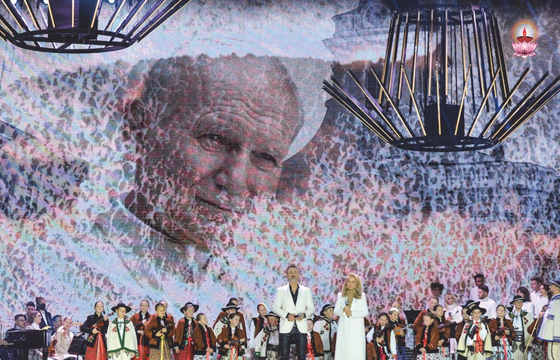
Polish academics warn against ‘slandering’ St John Paul II after McCarrick report
Nearly 1500 academics in Poland have written an appeal against “slandering and rejecting St John Paul II” after the publication of the McCarrick report by the Vatican on November 10.
The report documented the rise of dis-graced former Cardinal Theodore McCarrick, who was laicized by Pope Francis in 2019 after he was credibly accused of abusing minors, after rumours had for decades swirled around both the United States and the Vatican about his sexual misconduct with seminarians.
St John Paul played a significant role in McCarrick’s rise, appointing him a Bishop of Metuchen, Archbishop of Newark, and Archbishop of Washington before creating him a cardinal in 2001.
“We appeal to all people of goodwill for reflection. St John Paul II, as every other person, deserves to be discussed with honesty,” said the letter by the group of academics. “By slandering and rejecting St John Paul II we not only do harm to himself, but also to ourselves.”
Among the signatories were Krzysztof Zanussi, and award-winning director and teacher to a generation of filmmakers; Adam Daniel Rotfeld, former Minister of Foreign Affairs; and Hanna Suchocka, who served as Polish ambassador to the Holy See from 2001-2013.
“Unsupported attacks on the memory of St John Paul II are motivated by a preconceived thesis, which we view with sadness and deep disturbance,” the appeal reads.

Council of Cardinals studies Vatican constitution amendments
Pope Francis’ Council of Cardinals met online on December 1 to continue work on the new apostolic constitution to govern the Roman Curia, according to a Vatican statement.
The seven cardinals and an archbishop secretary are studying “observations, amendments, and proposals received from the dicasteries consulted in recent months” regarding the draft of the new constitution, known as Praedicate evangelium, a brief press release said.
Pope Francis also participated in the Dec. 1 meeting, connecting virtually from the Vatican guest-house where he lives.
The group of cardinal advisers, referred to as the C9 for its original nine members, was established by Pope Francis in 2013, with the aim of revising the text of the 1988 apostolic constitution Pastor bonus. At one of the council’s first meetings, it was decided that projected revisions to Pastor bonus would be substantial enough to warrant an entirely new constitution.