
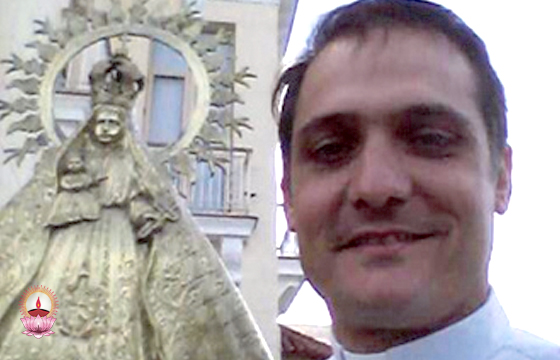
Reports are emerging of religious leaders being among those detained amid unprecedented nationwide protests in Cuba…
Protests erupted across the country on 11 July in response to Cuba’s ongoing and severe economic crisis and a record surge in corona-virus cases, before expanding to criticisms of the Cuban Communist Party (CCP)’s decades-long hold on power, crackdown on human rights and pro-democracy movements, and management of the Covid-19 pandemic.
In response, the government appears to have disconnected the internet in most of the island’s major cities, but reports of violations targeting protesters and religious leaders have continued to emerge. Cuban President Miguel Díaz Canel also made public calls for ‘revolutionaries’ to take to the streets to defend the Revolution by fighting protestors.
Category Archives: International
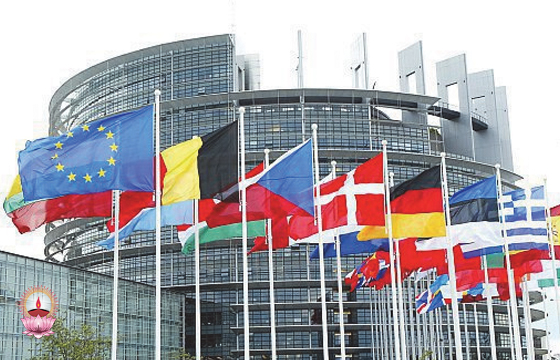
EU Parliament condemns repression of Turkish opposition
The European Parliament has adopted a resolution condemning the ongoing repression the Peoples’ Democratic Party (HDP), a formation that unites Kurdish forces and the left by the Turkish government. The signatories of the document stress that this retreat “reveals the dire human rights situation in Turkey and the continued erosion of democracy and the rule of law.”
The text was approved with 603 votes in favour and only two against. Promoted by Christian Democrats, Social Democrats, Greens and Leftists, it condemns “the repression of opposition political parties, particularly the HDP, and urged the government to ensure that all parties can freely and fully exercise their legitimate activities in accordance with the basic principles of a pluralist and democratic system.”
The European politicians express “deep concern” about “this serious backsliding on the freedom of the opposition parties to function” in Turkey.
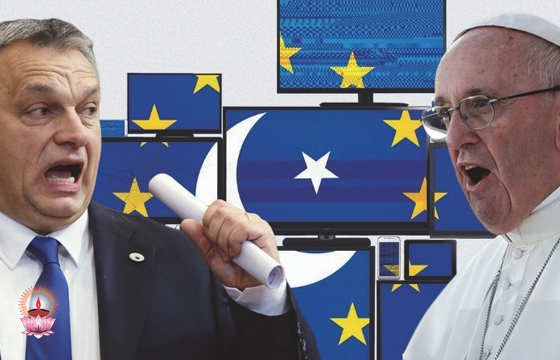
Orbán Baits Francis on Islamic Immigration
In a June 20 inter-view with Croatian Catholic weekly Glas Koncila, the Christian politician, who has been disparaged by Pope Francis as a populist and nationalist, dismissed reports of Francis’ refusal to meet him on the Hungary papal visit as “false news.”
Attributing media reports first published by faithful Catholic Vaticanist Edward Pentin to “anti-Church and anti-Christian circles,” the prime minister went on to claim that a lack of clarity regarding protocol was responsible for the breakdown in diplomacy.
Pope Francis is visiting Hungary not as head of state but as head of the Catholic Church attending the Eucharistic Congress, which is not a Hungarian event, Orbán noted.
Nevertheless, Orbán remarked that “what hurts [him] the most,” is that he would “not be able to attend the beatification of Cdl. Stefan Wyszyñski, which takes place on the same day in Poland as the World Eucharistic Congress in Hungary.”
A Vatican expert told Church Militant that “Orbán’s considerable regret at not being able to attend Wyszyñski’s beatification is likely a dig at Francis and his handlers for planning a papal visit to Budapest lasting just a few hours and, at first, even refusing to meet the nation’s leaders.”
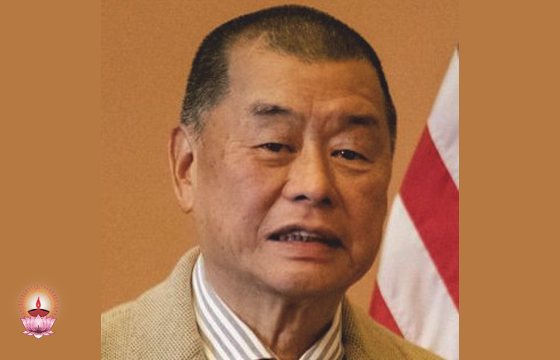
Modern-Day Martyr: Meet The Self-Made Billionaire Who Is Sacrificing It All For God
In Hong Kong right now, Jimmy Lai is sacrificing all — his fortune and possibly his life — for his God, his fellow man, and for freedom.
Lai is a billiona-ire, although he wasn’t always one. Born two years before the Communists defeated the nationalists in China’s civil war, his father fled and his mother was sent to a labor camp when he was a young child. Carrying bags for train passengers and getting by as a street vendor, he first tasted freedom when a man from British Hong Kong gave him a bar of chocolate.
Lai is a British citizen, al-though he wasn’t always one. Having seen a glimpse of prosperity and freedom, he chased it to the then-free British island colony, stowing away aboard a ship when he was just 12 years old and working on the floor of a clothing factory.
Lai is a Catholic, although he wasn’t always one. He met the faith through his wife, a pious woman he accompanied to church, where he heard the homilies of Cardinal Joseph Zen and in 1997 was baptized into the church by the same great man.
Today Lai is in a prison cell in Hong Kong, and the Communist dictatorship has once again seized one of his life’s works, shutting do-wn his newspaper. “I have a soul,” he said in early 2019, and so the truth lives in him.
“No one can say we didn’t fight… Prison life is the pinnacle of my life. I am completely at peace.”
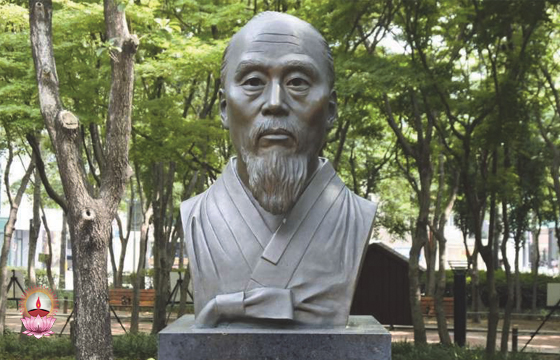
Patriot and pioneer: Seo Sang-don, a hero of Korean Church
A bust of Seo Sang-don greets visitors at the office of Daegu Archdiocese in Daegu, the third-largest city in South Korea and a Catholic stronghold. Archbishop Thaddeus Cho Hwan-kil unveiled the bust in 2011 as part of activities to pay tribute to Seo ahead of the 100th anniversary of his death.
When Seo died in Seoul on June 30, 1913, Bishop Demange attended his funeral and paid homage by calling him “a great fellow and extraordinary craftsman who remained an ordinary man despite being rich.” “He served the Church and the Church also helped him. He accomplished a lot of good things. He donated the sites of Daegu Cathedral Church, bishop’s house, office, seminary and houses from missionaries. We should live up to his great virtues. We are very grateful to him,” Bishop Demange wrote in his diary, according to an article in Catholic Times by Andrew Lee Kyung-gyu, an emeritus professor at Daegu Catholic University.
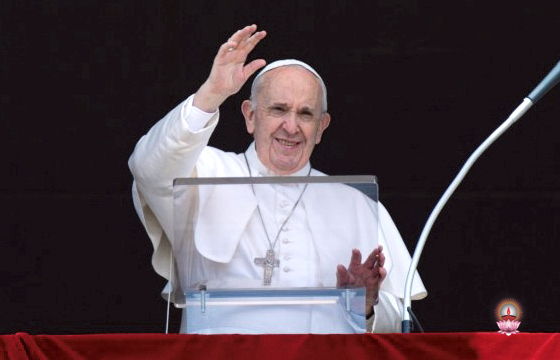
Pope, recovering well, had ‘severe’ narrowing of his colon
Pope Francis’s recovery from intestinal surgery continues to be “regular and satis-factory,” the Vatican said Wednesday, as it revealed that final examinations showed he had suffered a “severe” narrowing of his colon.
The Vatican’s daily update indicated there was no evidence of cancer detected during an examination of the tissue removed Sunday from Francis’ colon. Doctors said that was a good sign and evidence that the suspected condition of a narrowing of the colon due to inflammation and scarring had been con-firmed.
The Vatican spokesman, Matteo Bruni, said the 84-year-old pope was continuing to eat regularly following Sunday’s surgery to remove half his colon, and that intravenous therapy had been suspended.
“The fact that he is eating means his intestinal tract is working as it should,” said Dr. Walter E. Longo, professor of surgery and colon and rectal surgery at the Yale University School of Medicine and Yale-New Haven Health, who was not involved in Francis’s care. “The fact that infusion therapy has been discontinued means the amount of fluid he needs for sustaining his everyday functions is now being met by his oral intake.”
Bruni said final examination of the affected tissue “confirmed a severe diverticular stenosis with signs of sclerosing diverticulitis,” or a hardening of the sacs that can sometimes form in the lining of the intestine.
Dr. Manish Chand, an associate professor of surgery at University College London who specializes in colorectal surgery, said the hardening of the tissue would have occurred as a result of repeat inflammation and infection, resulting in scarring that makes the colon less elastic.
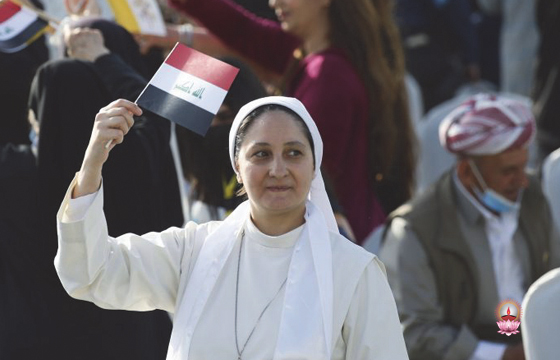
Experts say Iraqi government struggling to secure Christian future
In March, Pope Francis made history by becoming the first Roman pontiff to visit Iraq. His visit was a sign of solidarity with one of the Middle East’s oldest Christian communities, a small minority in the Muslim-majority country.
Some even credit the mere scheduling of the trip as an agent for change in Iraq. After the trip was announced, the Iraqi Parliamentary Assembly voted unanimously to declare Christmas an annual national holiday, and Salih ratified a law benefitting Yazidi survivors of the 2014-2017 ISIS genocide.
However, months after the trip, experts say nothing has changed.
“I have not seen any changes with the Iraqi government that would give any indication that they’ve made any shifts in the way that they are dealing with Christians,” said Nadine Maenza, chair of the United States Commission on International Religious Freedom.
Maenza and Ed Clancy, director of outreach for Aid to the Church in Need, said security concerns and a lack of economic opportunity are the most significant issues Iraqi Christians
face.
“Christians, when they live in the cities, are in a very difficult situation because they don’t have a large enough community to protect themselves,” Clancy said.
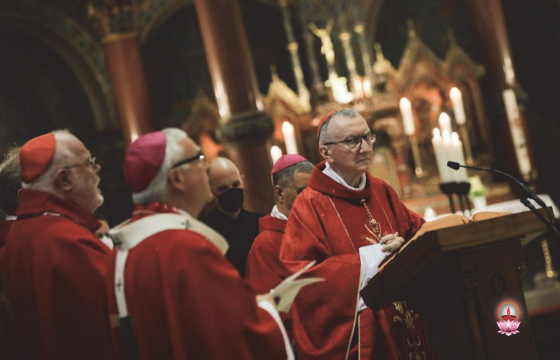
Vatican secretary of state urges Catholic Church in Germany to unite
Cardinal Pietro Parolin, Vatican secretary of state, urged German Catholics to put aside visions and individual needs, noting, “the community must take precedence.”
Addressing several German bishops during a church service June 29, Parolin referred to
Pope Francis’ 2019 letter on the Synodal Path of the Catholic Church in Germany, reported the German Catholic news agency KNA. This reform dialogue deals with controversial issues such as Catholic sexual morality, priestly life, power and the separation of powers as well as the role of women in the church.
Parolin urged the church in Germany “to return to a unity that does not depend on agreeing to common orientations, as is usual in politics, but on being rooted in God.” He opposed “reducing togetherness to only one particular part, however relevant and significant it may be.”
KNA reported that among those attending the service were Limburg Bishop Georg Bätzing, president of the German bishops’ Conference; Cardinals Reinhard Marx of Munich and Freising and Rainer Maria Woelki of Cologne; Berlin Archbishop Heiner Koch; and several other German bishops.
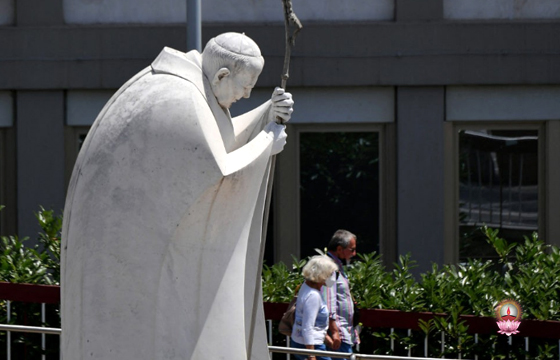
Vatican Insider: Pope Francis ‘Will Never Be the Same’ After Colon Operation
Luis Badilla, editor of the semi-official Vatican news aggregator Il Sismografo, said that Pope Francis’ health situation is “severe” and when he returns from hospital he “will never be the same again.” In his sobering blog post, Badilla declares that journalists and commentators are not doing the pope any favours when they downplay the seriousness of his illness.
There is a very significant detail that many “underestimate, ignore, or manipulate,” he writes, namely that “the disease that has affected Pope Francis is severe and degenerative” and “could also be chronic.” “The Holy Father will certainly return to the Vatican to resume his path in the footsteps of Peter but he will never be the same again,” Badilla insists. “All the rhetoric about a Jorge Mario Bergoglio ‘superman’ damages his image and charisma.” In his post, Badilla notes several details of the pope’s recent surgical operation to treat his diverticulitis that give cause for concern. As cited by numerous authoritative press sources, on Sunday evening the pope underwent general anesthesia and was administered powerful sedatives, Badilla observes, after which he was “subjected to laparoscopic surgery (almost a sort of scouring of the lower part of the abdominal cavity, with small, very sophisticated probes) and immediately afterwards to an ‘open’ or ‘open sky’ surgical intervention to allow hands-on work with full visibility.”

Vatican suppresses Italy-based lay movement founded by alleged visionary
With the approval of Pope Francis, the Vatican has ordered the dissolution of an Italy-based lay movement, citing problems with the group’s origins, catechesis, governance, respect for members’ consciences, handling of donations and with the divisions it allegedly has created among clergy of the Archdiocese of Catanzaro-Squillace, where it is based.
The decree ordering the suppression of the “Apostolic Movement” founded 40 years ago by Maria Marino was dated June 10 and signed by Cardinals Luis Ladaria, prefect of the Congregation for the Doctrine of the Faith; Beniamino Stella, prefect of the Congregation for Clergy; and Kevin J. Farrell, prefect of the Dicastery for Laity, the Family and Life.
“The presumed revelations that gave birth to the Apostolic Movement through its founder, Mrs. Maria Marino, are to be considered not of supernatural origin — ‘constat de non super-naturalitate,’” the decree said.
While Marino has not been public about what she says were apparitions of Mary to her, she said they inspired her to establish the movement in 1979 and form the basis of the two key texts used to educate members.