
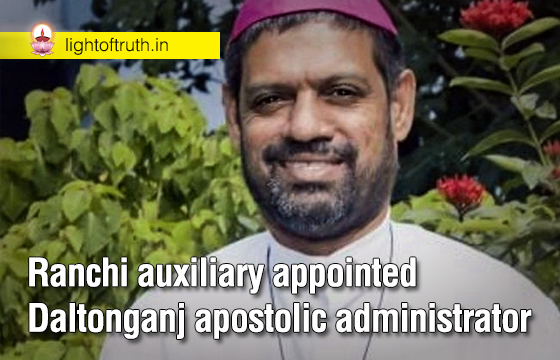
Pope Francis has appointed Auxiliary Bishop Theodore Mascarenhas of Ranchi as the apostolic administrator of the diocese of Daltonganj.
The appointment was announced on December 8 in Rome. “This appointment is an additional to his present office as Auxiliary Bishop of Ranchi,” says a press release from Father Stephen Alathara, deputy secretary general of the Conference of Catholic Bishops of India (Latin rite).
Category Archives: From The States
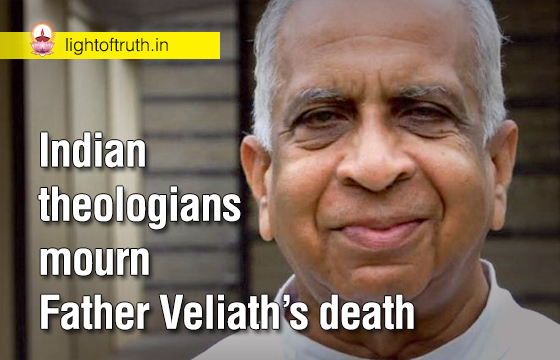
Indian theologians mourn Father Veliath’s death
The national forum of Catholic theologians in India on November 28 mourned the death of Salesian Father Dominic Veliath as a great loss for the Church in the country.
The 79-year-old internationally reputed theologian died November 27 in Bengaluru.
The Church in India has lost “a great theologian who lived Christian faith with deep commitment” in the death of Father Veliath, says a condolence message from the Indian Theological Association. Father Veliath was the executive secretary of the Doctrinal Commission of the Indian bishops that organized annual dialogues between theologians and prelates.
The message also noted with gratitude Father Veliath’s long association with the theologians’ forum. He was its secretary during 1989-1992 and the president from 1992 to 1995. “It is a great loss for the members” of the association, says the message issued by the forum president and executive board members.
Kerala High Court reduces former priest’s jail term
The Kerala High Court on December 1 reduced the duration of jail term of a former Catholic priest, who was convicted for raping and impregnating a teenager.
The bench of Justice Narayana Pisharoty heard the appeal of Robin Vadakkumchery against the 20-year rigorous imprisonment awarded to him February 16, 2019, by a court dealing with POCSO (Protection of Children Against Sexual Offences Act) cases.
The 54-year-old former priest was convicted for raping and impregnating a teenage parishioner when he was the parish priest of St Sebastian’s Church of Kottiyoor under Mananthavady diocese.

Abp Kariyil CMI Dispenses the Archdiocese of Ernakulam-Angamaly from the Synod Decision
In a pastoral letter from Vatican Arch-bishop Antony Kariyil CMI has asked all the priests and faithful to keep the status quo as regards the orientation of the Holy Mass from November 28 which the date to start to new mode of celebration of the Holy Mass as directed by the Synod, Using the provision of CCEO 1538 he is dispensing the archdiocese from the decision of the Synod on uniform celebration of the Holy Mass. On November 25 and 26 he had audiences with Pope Francis and the Prefect of the Congregation for Oriental churches respectively and had consultation with them. He is using the canonical provisions as directed by the church authorities. “In virtue of your office as Vicar of the Major Archbishop for the Archeparchy of Ernakulam-Angamaly, Your Grace can apply the faculty of dispensation for those cases, which; in your prudential judgment, would result in grave consequences with the entry into force on 28 November 2021 of the Synodal Decisions concerning the Holy Qurbana” Says the letter of the Prefect cardinal Leonardo Sandri of Oriental Congregation.
In 1990 the Syro-Malabar Synod had made a unanimous decision for a uniform celebration of the Holy Mass but could not put the decision into practise because of the opposition from the priests and faithful. At that time Abp Jacob Thoomkuzhy and Abp Varkey Vithayathil used the same provision to dispense with the decision. The law says the local Ordinary can judge “that a dispensation will contribute to the spiritual good of the Christian faithful who are subject to him according to the norm of the law, the eparchial bishop can dispense from both the common law and the particular laws of his own Church sui iuris in a special case…”. Msgr Antony Nariculam followed to assist the Archbishop. Bp Pauly Kannokadan has done the same thing in the diocese of Irinjalakuda.
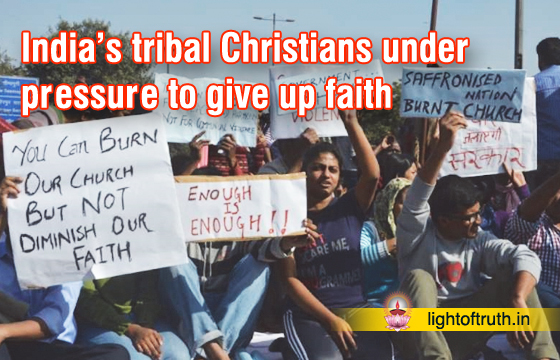
India’s tribal Christians under pressure to give up faith
Indigenous Christians in the central Indian state of Madhya Pradesh say they are under increasing pressure to give up their faith due to mounting pressure from Hindu activists.
“Our people are being forced to give up Christianity and join the Hindu religion,” said Patrick Ganava, a Catholic from the predominantly tribal Jhabua district. He said Hindu activists and organizations were conducting special drives in villages to pressurize Christians, which was a cause for worry.
“There is propaganda against Chri-stians in the district but come what may we will not give up our faith in Jesus,” he told on November 16. The anti-Christian campaign, coupled with police arrests of 10 Christians including six pastors on Nov. 10 for alleged religious conversion, has emboldened right-wing Hindu groups, Ganava said.
“It is unfortunate that we are being portrayed as people working only for converting people to Christianity,” said Father Rocky Shah, public relations officer of Jhabua Catholic Diocese.
The priest said he took the initiative and wrote in local newspapers explaining Christian worship and baptism, trying to clarify common misconceptions. “But nothing changed. The situation is such that our prayer services are being falsely depicted as religious conversion activity,” Father Shah told.
He recounted how a mob of over 1,000 tried to demolish a more than a century old grotto of Mother Mary on Nov. 10 in Thandla in their diocese, but the timely intervention of the police saved it. But the mob persisted with their demand for demolishing the grotto, alleging it was serving as a spot for conversion activities.
“Earlier, in September, they threatened to demolish churches that were built illegally at the district headquarters. They are now moving into the interiors. Timely intervention by the police saved us so far, but we are not sure what will happen tomorrow,” the priest said.
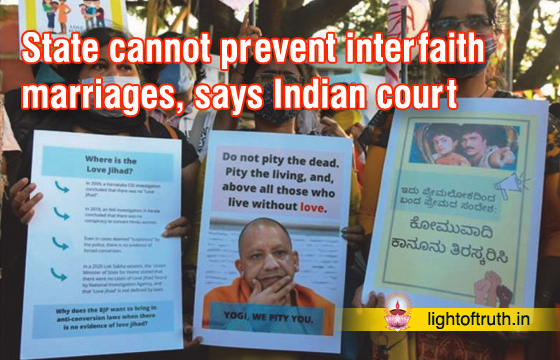
State cannot prevent interfaith marriages, says Indian court
Christians in India have welcomed a recent court order saying interfaith marriages need not wait for the nod from authorities as required under the new anti-conversion law in the northern state of Uttar Pradesh. Allahabad High Court directed that the marriages of 17 interfaith couples in the state be registered without insisting on or waiting for approval from the competent district authority with regard to the couples’ conversion of faith.
The court said the Uttar Pradesh Prohibition of Un-lawful Conversion of Religion Act, 2021, does not prohibit interfaith marriages, but indi-viduals marrying outside their religion “can be subjected to harassment” while dismissing the government’s contention that the couples had not got mandatory approval from the district authorities under the provisions of the law.
The Nov. 18 order, passed by Justice Suneet Kumar in a batch of petitions filed by interfaith couples who had entered wedlock after changing their religion, said that “freedom of religion and belief is a basic human right across civilized states, and the state cannot inquire into or take notice of a person’s religious or moral belief.”

Indian Catholic Forum to prepare for 2023 Synod
The Indian Catholic Forum, a collective of Catho-lics in the country, plans to meet next year to seek the Church’s reform and renewal.
The February 5-6, 2022, program in Bengaluru, known as the Vatican of India, will stress sharing, praying, listening and dialoguing. The two-day deliberations would be recorded and synthesized, says a press note from the forum convener Kanpur-based chho-tebhai.
The meet on “Journeying Together – the Path Ahead” is expected to come up with a 10-page synthesis that would be sent to the Vatican by April 2022, it adds.
The program, the press note says, will have no chief guests, ceremonials or keynote speakers in the spirit of the Synod. “Jesus will be the chief guest and every participant will be a guest of honor,” the press note says.
Pope Francis has called the Synod during 2022-2023.
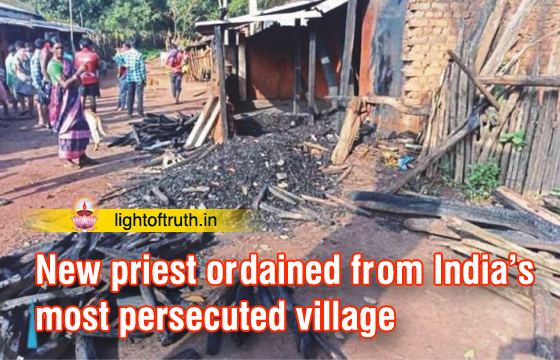
New priest ordained from India’s most persecuted village
Catholics in the eastern Indian state of Odisha are celebrating the ordination of a priest who was a victim of India’s worst anti-Christian violence. Fr Vikash Nayak, 29, who hails from Tiangia village in Kandhamal district, was ordained on November 6 by Archbishop Emeritus William D’Souza of Patna, the apostolic administrator of Buxar Diocese in the neighboring state of Bihar.
He visited his village on Nov. 13 and concelebrated his first Eucharist with local people amid much joy and happiness.
In 2008, Father Nayak’s village witnessed seven casua-lties including a Catholic priest, Father Bernard Digal, during violence that followed the murder of Hindu leader Swami Laxmanananda Saraswati, who was shot dead by Maoist rebels on Aug. 23, the day Janmashtami or the birth of Lord Krishna was being celebrated.
Local Christians including a 13-year-old boy were cornered by irate Hindu mobs, beaten and abandoned at the police station. Then a leader of Vishwa Hindu Parishad (VHP), or World Assembly of Hindus, made public their names and declared them accused in the killing of the Hindu leader.
The murder was declared as a “Christian conspiracy” and violence was unleashed against the minority community.
Nuns demand independent probe amid allegations against hostel
The National Commission for Protection of Child Rights (NCPCR) that made a surprise search of a girls’ hostel in the central Indian state of Madhya Pradesh has demanded action against Catholic nuns who manage it.
The nuns have appealed the district collector of Raisen district to conduct an impartial probe into the allegation.
The NCPCR is a statutory body established in 2005 with the mandate “to ensure that all laws, policies, programs, and administrative mechanisms are in consonance with the child rights perspective as enshrined in the Constitution of India and the UN Convention on the Rights of the Child. A child for the commission is all those under 18 years. It functions under the federal Ministry of Women and Child Development.
Priyank Kanoongo, the commission chairperson, led a team of officials on November 8 to inspect the hostel at Intkheri village in Raisen district, some 50 km northeast of Bhopal, the state capital.
The team entered the girls’ hostel without a female official and searched the dormitory and bags of the girl children.
They also found a copy of the Bible in the possession of Christian students and alleged the hostel was promoting religious conversion. The following day another team inspected the hostel and the students told them they were staying in the hostel on their free will as they did not have facility to attend school.
The officials also asked the students if they were being forced to learn Christianity or involved in Christian prayers.
The hostel houses 19 students who attend regular classes in a nearby government high school. Among them five are Christians, who came from northeastern India.
The commission’s November 9 letter to the district collector ordered sending the students to their homes alleging some serious lapses in their care at the hostel.
The students, however, certified to the officials that they were well taken care, with proper food and facilities for studies. The Christian children said they had brought the copies of the Bible from their homes and they read it as part of their routine life.
Meanwhile, the nuns also demanded the district collector to inspect the hostel, refuting the commission’s finding.
The commission chairman had shared the video of the raid on social media apparently to target the nuns for providing facilities to the poor girl children to get education.
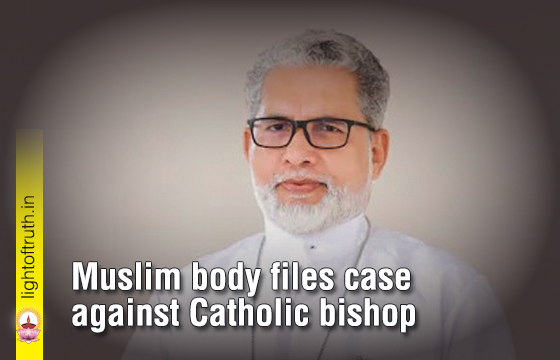
Muslim body files case against Catholic bishop
A Muslim body in Kerala has filed a case against a Catholic bishop for allegedly promoting disharmony, enmity and hatred between two religious communities in the southern Indian state.
The police in Kuravilangad town in Kottayam district November 1 registered the case against Bp Joseph Kallarangatt of Palai for his controversial remarks on “narcotic jihad” almost two months ago.
The Police said the case was registered following a complaint from the All India Imams Council. “The case follows a direction in this regard by the Pala [Palai] magistrate court,” said Shilpa Dyavaiah, district police chief in Kottayam. Palai is a major town in Kottayam district.
Abdul Asees Moulavi, district president of the Muslim council, alleged that the police had initially refused to register a case against the bishop, even after making formal complaints at the Kuravilangad station and to the district police chief.
So, he approached the Palai magistrate court that in turn ordered the police to register a First Information Report against the prelate and probe the alleged charges against him.