
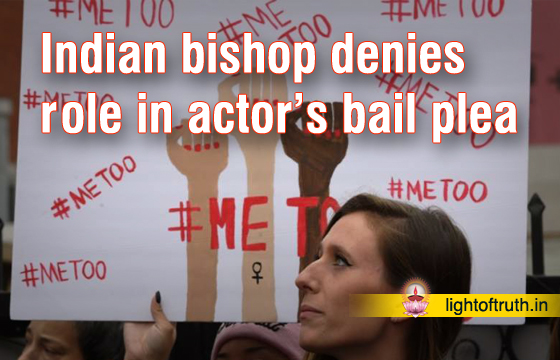
A Catholic bishop in India has denied media reports that he had a hand in securing bail for a film actor charged with sexual abuse and assault on an actress in the southern state of Kerala.
Local media reports said Bishop Vincent Samuel of Neyyattinkara helped actor Gopalakrishnan Padmanabhan, better known by his stage name Dileep, to secure bail.
The reports quoted the affidavit Dileep had furnished in Kerala High Court during the hearing of a petition filed by the prosecution seeking cancellation of his bail. Police wanted him in judicial custody for further questioning in the three-year-old case.
Dileep, 54, claimed in his affidavit that a film director named Balachandra Kumar had told him that Kumar had used the influence of Bishop Samuel to secure the bail.
“It is totally a false and manipulated story and there is no iota of truth in it,” Father Christudas, vicar general of Neyyattinkara Diocese, told on Jan. 26.
“The prelate neither knows the actor nor the director, nor ever had any interaction with them,” he added.
Category Archives: From The States
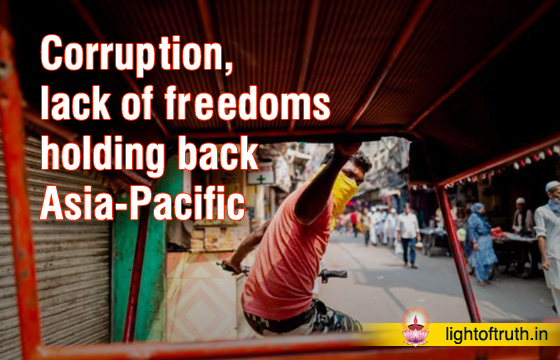
Corruption, lack of freedoms holding back Asia-Pacific
Perceptions of corruption among Asia-Pacific countries remained almost unchanged in 2021, with New Zealand, Singapore and Hong Kong among the world’s best performers but Cambodia, Afghanistan and North Korea again ranked with the worst.
Transparency International (TI) said “grand corruption” and a lack of freedoms were holding back progress in the Asia-Pacific region.
While Asia-Pacific countries have made great strides in controlling bribery for public services, an average score of 45 out of 100 on the 2021 Corruption Perceptions Index shows much more needs to be done to solve the region’s corruption problems.
“Some higher-scoring countries are even experiencing a decline as governments fail to address grand corruption, uphold rights and consult citizens,” TI said in its annual report.
Of the 180 countries ranked by TI, it said weak scores were recorded among the world’s most populous nations, with China and India ranked 66 and 85 respectively and Indonesia, Pakistan and Bangladesh coming in at 96, 140 and 147.
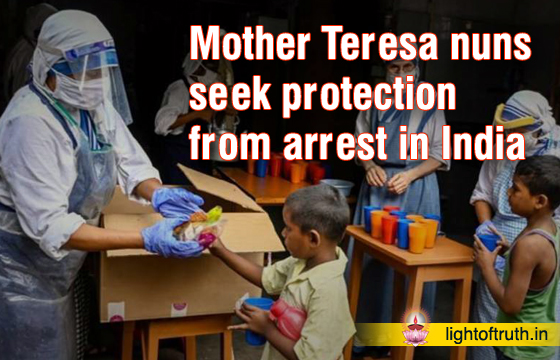
Mother Teresa nuns seek protection from arrest in India
Missionaries of Charity (MC) nuns accused of attempting to convert girl inmates at a shelter home in Vadodara city in the western Indian state of Gujarat will be hoping for protection from likely arrest when a local court hears their plea on Jan. 19.
The two nuns, who did not want to be named, had filed for anticipatory bail after police initiated a probe on December 13 following a complaint of a violation of the Gujarat Freedom of Religion Act 2003, a law that curbs religious conversion through allurement, force and coercion, at the MC-run Nirmala Shishu Bhavan.
The complaint was registered by Mayank Trivedi, a district social defence officer who claimed to have visited the shelter home on Dec. 9. The inmates were made to wear a cross around their necks and keep the Bible in a storeroom they used regularly, he alleged.
These actions, according to the complainant, hurt the religious sentiments of Hindus.
The court had restrained the police from arresting the nuns until Jan. 10 but has yet to decide their plea for anticipatory bail. The Jesuit priest said that having a textbook in one’s possession or sharing it with someone for reading is not a crime and hoped that the court will uphold the Indian constitution and the law of the land to ensure justice.
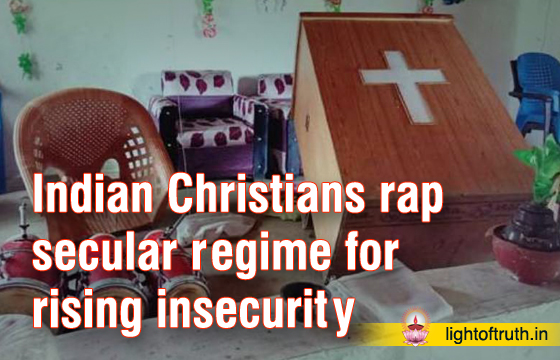
Indian Christians rap secular regime for rising insecurity
A Christian leader in the central Indian state of Chhattisgarh has squarely blamed the provincial government for failing to check attacks on the minority community after a spate of recent incidents. “Reports of Christian persecution are nothing new in this part of the country, which is very unfortunate. More than 10 attacks targeting Christians were reported from five different places during the past two weeks. It is a complete failure of the state government,” Arun Pannalal, president of Chhattisgarh’s Christian Forum, told. He said more than 200 incidents were documented in the past two years, the latest one on Jan. 9.

Dalit Christian activist bags European award
A social activist from Tamil Nadu, southern India, has received this year’s Raoul Wallenberg Prize, a prestigious award given by the European Council.
The ceremony took place in France and Arokiasamy Vincent Raj, popularly known as Evidence Kathir, received the award online on January 19. The award, given every two years, carries a cash prize of 10,000 Euros equivalent of 842,770 rupees, besides a citation.
“I am happy for Evidence Kathir. I wish him good luck for what he is doing for the Dalits and the Tribals,” said Tamil Nadu Chief Minister M. K Stalin in his congratulatory message.
Kathir runs a 25-year-old non-profit organization in Madurai that works mainly for Dalits and the Tribals in Tamil Nadu.
He and his team reach out when atrocities against Dalits and Tribals take place. He trains human rights defenders especially the youth in Tamil Nadu.
The award is seen as “a great honor” for all Dalit activists and the human defenders in Tamil Nadu.
Kathir says he has been committed to the human rights issue for the past 25 years. “It is a challenging job and I feel its great recognition for my work,” he adds.


Indian ‘prophet’ stuns politician with surprise gift
A self-proclaimed prophet in the north-eastern Indian state of Mizoram has caused a stir by presenting a black shawl – a symbol of mourning – to Chief Minister Zoramthanga at a Sunday prayer service.
The episode took place at Zarkawt Presbyterian Church in the state capital Aizawl on January 2. Eyewitnesses said Zoramthanga was seated behind the church elders near the altar. At the conclusion of the service, he was approached by local prophet Lal Rinwama, who was seated in the back row with two men, and presented with a traditional Puandum or black shawl.
Zoramthanga did not resist as the shawl was being wrapped around him. However, he quickly put it down on the pew, they added. Mizoram is a predominantly Christian and mostly Presbyterian state, but the tribal roots of its people ensure some superstitions continue, including the belief in local “prophets.”
It is not known why Lal Rinwama, also known as Awmtea, chose to offer the symbol of mourning to Zoramthanga, a former insurgent leader who surrendered in 1986 to join mainstream Indian politics. One person present inside the church later said that the chief minister looked “calm and not much disturbed.”
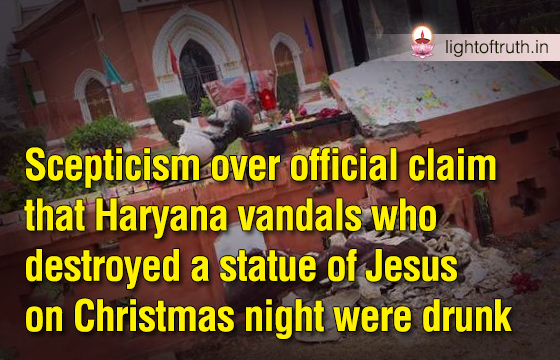
Scepticism over official claim that Haryana vandals who destroyed a statue of Jesus on Christmas night were drunk
Christian leaders in India have sought an impartial probe into the destruction of a cent-ury-old statue of Jesus Christ at a British-era Catholic church in Ambala in the northern state of Haryana.
Two men were seen on CCTV footage scaling the church compound on Christ-mas night and destroying the statue after breaking open the casket.
Police arrested two suspects after three days and a court remanded them into judicial custody. But church leaders suspect the case may get diluted with the investigating officer saying the suspected vandals were drunk.
“The police officers tasked with the investigation is siding with the suspects and trying to dilute the crime on the plea that they acted under the influence of liquor,” said Father Patras Mundu, parish priest of the Holy Redeemer Church in Ambala Cantonment in the Diocese of Simla-Chandigarh.
The police did not charge the arrested suspects for viola-ting the curfew orders imposed in the city, he said, adding that one of the arrested is a government employee and hence familiar with the laws of the land.
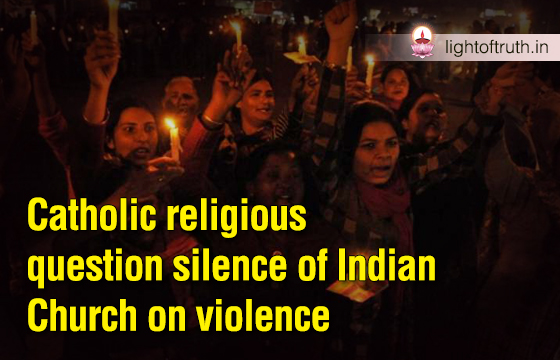
Catholic religious question silence of Indian Church on violence
A group of progressive Catholic religious in India have questioned the silence of the official Catholic Church over the continued violent attacks on Christians and other mino-rity communities across the country.
They want the Catholic Bishops’ Conference of India (CBCI) to take up the issue with Indian Prime Minister Narendra Modi and Home Minister Amit Shah to ensure immediate action against the perpetrators of hate crimes against minorities.
They also want regional bishops’ conferences to raise the issue of Christian persecution with respective state governments.
The Forum of Religious for Justice and Peace, in a letter dated Jan. 10 addressed to Cardinal Oswald Gracias, expressed shock over the silence of the CBCI even as targeted violence against Christians continued unabated in the country.
“During the two days, Dec. 24-25, the media reported seven well-planned attacks on Christian institutions across the country,” while “in the year 2021, there were 486 incidents of violence against the Chris-tian community in India, accor-ding to the United Christian Front,” the forum said.
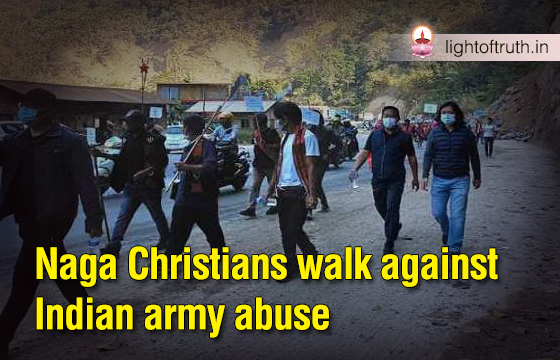
Naga Christians walk against Indian army abuse
Thousands of people, mostly Christians, in India’s north-eastern state of Nagaland took part in a two-day walkathon from commercial hub Dimapur to capital Kohima demanding the repeal of the draconian Armed Forces (Special Powers) Act (AFSPA) and justice for Naga Christians killed by the Indian army last month. Protesters including civil society activists and women and children took to the streets on Jan. 10-11 and carried placards demanding the repeal of the controversial law which was enforced in Nagaland to curb secessionist groups and armed rebellion in 1956.