
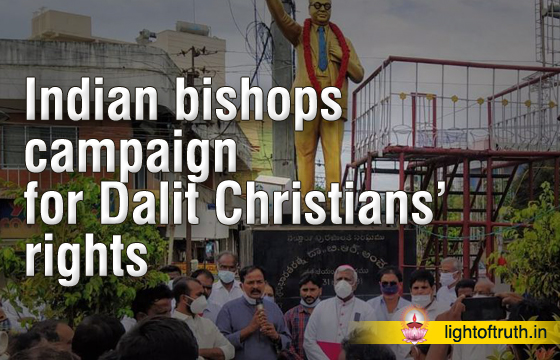
Catholic bishops in a southern Indian state have launched a campaign to mobilize political support to end discrimination against Dalit Christians in the country.
“We have already handed over memoranda to all federal ministers, parliamentarians and state legislators from Kerala state seeking their support to end discrimination against Dalit Christians,” Aux. Bishop Jacob Muricken of Pala told on Feb. 23.
Kerala’s bishops want India’s political leadership to help them improve the conditions of Dalit Christians who still bear the brunt of social discrimination and economic back-wardness.
“We know our Dalit Christian brothers and sisters are discriminated on the basis of their faith despite the fact that the Indian constitution is religion-neutral,” Bp Muricken said.
Dalits (formerly untouchables), who constitute the lowest stratum of the Hindu caste system, have converted to various other religions including Buddhism, Sikhism, Christianity and Islam. They are officially categorized as scheduled castes (SCs) and entitled to special welfare benefits.
However, Dalits among Christians and Muslims are denied SC status and are thus deprived of welfare schemes such as reservations in government jobs, educational institutions and electoral politics.
Category Archives: From The States

India’s tribal Christians wary of marrying, converting outsiders
The Christian-majority state of Mizoram in northeast India has been rocked by a marriage leading to a religious conversion and granting of tribal status to an outsider.
At the center of the heated controversy is the scheduled tribe (ST) certificate issued by the Aizawal district administration in 2018 to Kamrul Islam Laskar, a non-tribal man who married a local Mizo woman. Laskar converted to Christianity and even adopted a local name – Kamlova Chhangte – but the nativist organizations who are dead against outsiders marrying into the predominantly Christian tribes want nothing of it.
The Mizo people are known to be inseparably knitted together by their strong ethnic, familial and religious bonds.
A coordination committee steered by the Young Mizo Association (YMA), arguably the most influential student body in the state, now wants state authorities to cancel the ST certificate issued to Laskar.
The YMA has long demanded a law to ensure that Mizo women who marry a non-tribal man should lose their ST status, robbing them of special privileges guaranteed in the Indian constitution including reservations in education and employment.
It has been joined by other influential student organizations like the Mizo Zirlai Pawl (MZP), known for administering an oath to school students across the state to not marry outside the Mizo tribes.
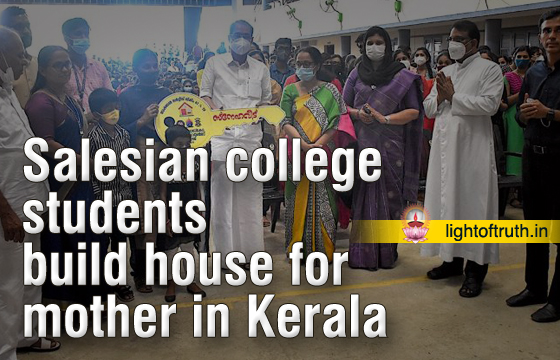
Salesian college students build house for mother in Kerala
A homeless mother with two children received a new house, thanks to the volunteers of Don Bosco Arts and Science College at Angadikadavu in Kerala’s Kannur district.
The project began when Lucy George, a Salesian cooperator, heard during a bus journey Jessy talk about her problems of being homeless.
George mentioned this to the students at Don Bosco Arts and Science College, who along with their teachers and management took up the challenge of constructing a house.
The 600-square-feet house has two bedrooms, a kitchen, a living room and a work area. The cost was provided for by donations from students, staff, management and well-wishers. It is the fourth house constructed by the college’s volunteers, reports Salesians Mission “Newswire.”
Indian Catholics seek legal action against defamation
Catholic officials in the southern Indian state of Kerala have begun lodging police complaints against what they call a rising trend in media to defame the Church, particularly priests and nuns. “Our priests and nuns have lodged more than 160 police complaints across the state against certain online, mainstream and social media platforms for portraying Catholic priests and nuns in a poor light,” said Father Michael Pulickal, secretary of Kerala Catholic Bishops’ Council’s commission for social harmony and vigilance.
Bishop Mulakkal to hold exclusive classes for priests
Bishop Franco Mulakkal of Jalandhar will take classes during an exclusive seminar for Catholic priests in Kerala, southern India.
Christeen, a Catholic Charismatic movement for children, is organizing the February 24 seminar in Kottayam, a major town in Kerala. The seminar will address issues and problems faced by the Church, especially in Kerala.
Bishop Mulakkal on February 22 confirmed to Matters India his participation in the program.
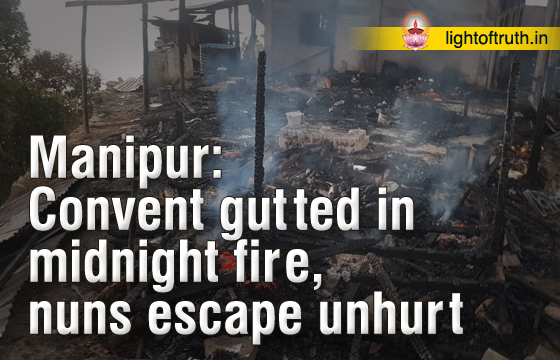
Manipur: Convent gutted in midnight fire, nuns escape unhurt
A convent was gutted in a fire accident February 22 in the north-eastern Indian state of Manipur.
All three sisters in the Daughters of St Francis de Sales convent managed to come out of their rooms when the fire broke out at 00:15 am. The convent was situated at Laii village in Senapati district.
“It is fortunate that there was no loss of life,” Father Solomon Thezii, chancellor of Imphal archdiocese, told Matters India.
The convent was in an isolated area. However, villagers rushed to the convent hearing the noise and prevented the fire from spreading to an adjacent school.
Kerala policeman praised for saving man from mob
Unknown persons become heroes overnight through their self-less service to humanity or their quick action to save someone from danger.
One such person is Kiran Shyam, sub inspector of Aruvikkara in Kerala’s Thiruvananthapuram district.
His brave act that saved a person from an angry mob has brought him accolades and stardom.
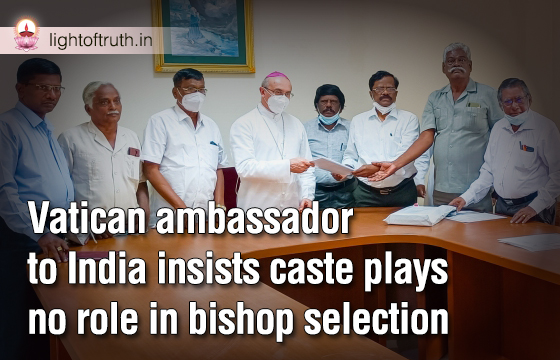
Vatican ambassador to India insists caste plays no role in bishop selection
In a statement sent to Crux, the Apostolic Nunciature in India said it wanted to make “clarifications” about a February 2 meeting of the Dalit Christian Liberation Movement (DCLM) with the Apostolic Nuncio, Italian Archbishop Leo-poldo Girelli.
Dalits were formerly known as “Untouchables,” the lowest level on the Hindu caste system. In India, it is common for caste discrimination to exist even in non-Hindu religions, including Christianity.
The DCLM had said it was “highly disappointed” with the meeting, which touched on the situation of the Church in the jurisdictions of Tamil Nadu and Pondicherry, a former French colony that was taken over by India in 1954. Dalit Catholics comprise about 70 percent of the Catholics in Tamil Nadu and Pondicherry, but there is only one Dalit bishop now among the 18 dioceses in this region. During their meeting with the nuncio, the DCLM stated that much progress was made in the appointment of bishops between 1993-2007, when four Dalit bishops were appointed in Pondicherry and Tamil Nadu.
“It all happened only because of the conscious decisions and efforts of then Apostolic Nuncios and the Vatican Dicasteries concerned. It was a historical moment for the Dalit Catholics,” the Dalit group said in a letter given to the nuncio.
“But unfortunately, in the next fifteen years from 2007, even this progress initiated was reversed by the two Nuncios during this period and so we are now left with only one Dalit Bishop representing the Dalit Catholics who comprise more than 70 percent of the Catholics here. Your Excellency, we recall to you that historical moment, only to appeal that this progress initiated is continued now during your tenure,” the letter continued.

Thousands join campaign against anti-conversion laws in India
Thousands of people cutting across religions have demanded the repeal of all anti-conversion laws in India.
The demand comes ahead of February 14 when the Karnataka government plans to table the Anti-Conversion Bill in the state’s Upper House.
Prominent signatories of the petition to the Indian president of India included among others Admiral L Ramdas, former Chief of Naval Staff of the Indian Navy, Mallika Sara-bhai, accomplished dancer and choreographer, Medha Patkar, social activist, Anand Patwardhan, film Maker and Mani Shankar Aiyar, former federal minister.
They assert the new anti-conversion law is unnecessary, since the Indian Constitution has enough provisions to curtail fraudulent religious convers-ions. ‘Wherever the anti-con-version law, ironically officially called Freedom of Religion Act, was passed, it became a justification for the persecution of the minorities and other marginalized identities” the petitioners explain.
They also say the attacks on the minorities has grown sharply in recent years since this law was used as a weapon targeting the dignity of Christians and Muslims particularly belonging to Adivasis, Dalits and women.
The petition urged people to join the campaign to defend the values enshrined in the Indian Constitution and protect human rights of the minorities and other marginalized sections in India.
Indian minorities laud court order on interfaith marriage
An order by a top court in the central Indian state of Madhya Pradesh upholding an interfaith marriage has been welcomed by minority communities.
The Jabalpur bench of Madhya Pradesh High Court confirmed the rights of a Hindu woman married to a Muslim man while preventing the government from criminalizing the marriage by invoking the anti-conversion law.
The order delivered on Jan. 28 was welcomed by Father Maria Stephen, public relations officer of the Catholic Church in Madhya Pradesh, and Maulana Umar Quasim, a Muslim cleric.
Judge Nandita Dubey’s order came in response to a habeas corpus petition by Gulzar Khan seeking custody of his wife who had been con-fined in a house by her parents and other relatives after they were informed of their marri-age and her religious conversion.
The court in its order held the young woman was a grown-up and had willingly married a person after converting to Islam. “She has made a categorical statement that she was never forced into conversion and whatever she has done was as per her own wishes,” it said.
The government’s lawyer had sought that the marriage should be declared “null and void” as it was not legally tenable under the provisions of the Madhya Pradesh Freedom of Religion Act, 2021.