Medak Diocese Bishop Reverend AC Soloman said Chief Minister K Chandrashekhar Rao was safeguarding the secular fabric in Telangana by according equal importance to all communities.
The Medak Diocese Bishop along with MLC Rajeshwar Rao laid the foundation stone for a new church coming up at the new State Secretariat complex on April 28. Bishop Solomon participated in the ground-breaking ceremony of the new church and performed special prayers.
Category: From The States
-
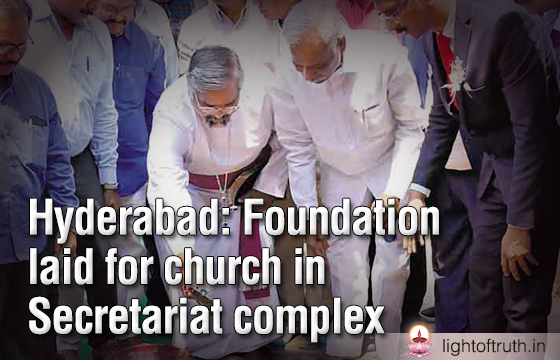
Hyderabad: Foundation laid for church in Secretariat complex
-
First women’s college on west coast turns coed
Come September, the first women’s college on India’s western coast will admit young men as students. The Apostolic Carmel congregation started St Agnes College in Mangaluru more than a century ago to exclusively educate women.
After its centenary celebrations in 2021, the college decided to start co-education, says principal Apostolic Carmel Sister M Venissa. “The college wished to extend its legacy of a century to male students at the undergraduate level. Finally, we are able to make it and admissions will commence from next academic year,” she told reporters. The principal also said they would admit about 30 percent male students in the first year. The number will be increased according to the demand. -

Indian court settles row over interfaith marriage
A top court’s refusal to intervene in the marriage of a Christian woman to a Muslim man has brought the curtain down on a snowballing controversy in the southern Indian state of Kerala.
The father of Jyotsna Mary Joseph, who worked as a nurse in Saudi Arabia, had filed a habeas corpus petition in Kerala High Court seeking a probe into his daughter’s “dis-appearance” after she walked out on her family and married Shejin, a communist youth leader belonging to the Muslim community, without their con-sent. The family leveled charges of suspected “love jihad,” a conspiracy theory that accuses Muslim men of targeting women from other religions for conversion to Islam by means of marriage, deception and force.
But the high court division bench of Justice V.G. Arun and Justice C.S. Sudha on April 19 declined to interfere in the couple’s decision to marry and disposed of the father’s petition. The court arrived at a decision after Jyostna appeared before it and categorically stated that she had married Shejin of her own free will and not under any compulsion. -
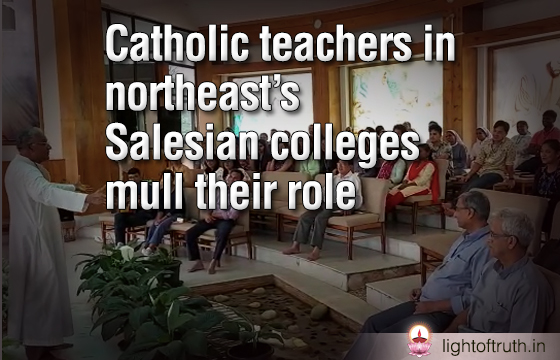
Catholic teachers in northeast’s Salesian colleges mull their role
More than 90 Catholic faculty members from 10 Don Bosco colleges in northeastern India spent four days reflecting on their role in higher education institutions. The ten participating Salesian colleges were Assam Don Bosco University Guwahati, Don Bosco Colleges of Maram, Bongaigaon, Gola-hat, Kohima, Siliguri, Sonada, Shillong, Tura and Government College Cherapunjee.
The program was held at Siloam Centre on Barapani Lake near Shillong, capital of Meghalaya state. Director of Siloam center Salesian Father George Palamattam complimented two principals and two vice-principals accompanying faculty members to the the program
Among the facilitators of the program were eminent resource persons from all over India including Archbishop emeritus Thomas Menamparampil of Guwahati, Archbishop Victor Lyngdoh of Shillong as well as youth leaders from Shillong.
The largest contingent of 27 participants came from Don Bosco (Autonomous) College, Maram, in Manipur.
The participants had immersion experience of major Holy Week liturgy. -

Christians want Easter declared public holiday in Bangladesh
The Bangladesh Christian Association (BCA) has urged authorities not to allow educational institutions to hold examinations on Easter Sunday. The organization also called on the government to declare Easter a public holiday.
In a press statement on April 4, BCA president Nirmol Rozario and secretary Hemanta Corraya called on educational institutions not to hold examinations on April 17.
“Easter Sunday is one of the major religious festivals of the Christian community all over the world. The day is an optional holiday in the official calendar but we have heard that some educational institutions will conduct exams on that day. Our demand is for students to be given leave to observe the holiday,” the statement said.
Shojib Minj, a 22-year-old Oran Catholic student at a private university, was unhappy about exams being slated for Easter Sunday.
“We are now third-year students and our exams are ongoing. According to the routine, our course exam is on April 17, the day of Easter. But my wish is to go to the village and celebrate with my relatives and parents,” Minj told.
He also urged educational institutions not to hold exams on that day and said the government should declare Easter a public holiday.
“We have been campaigning for a public holiday on Easter Sunday for almost two decades, but there has been no response from the government.”
Christians form a tiny minority in Bangladesh — less than half a percent of 160 million people in the Muslim-majority country. Of an estimated 600,000 Christians, the majority, about 400,000, are Catholics.
The Christian community in Bangla-desh has long demanded a public holiday on Easter Sunday, but the government has yet to comply. -
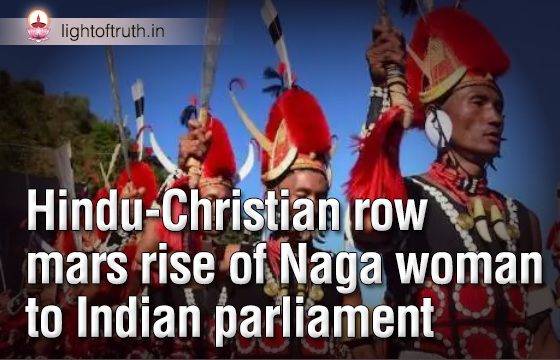
Hindu-Christian row mars rise of Naga woman to Indian parliament
Religion is back in business in India’s Nagaland state. The strongly perceived Christian identity of the indigenous Na-gas is making headlines.
Nagaland is a Christian and tribal-dominated province in the northeast where guerrillas are still seeking independence.
S. Phangnon Konyak, a Naga Christian woman who heads the local women’s wing of the pro-Hindu Bharatiya Janata Party (BJP), was recently elected to the Rajya Sabha or upper house of parliament by her party. As expected, BJP leaders called it revolutionary and empowering for women, especially in the context of a state that has so far not elected a single woman legislator to the local legislature.
Phangnon is only the second woman parliamentarian from the state and the first female among Nagas to be elected to the Rajya Sabha.
However, the episode has gradually become a Hindu-versus-Christianity issue, at least for some individuals and political players. Curiously, one church leader has jumped on the bandwagon.
“The people’s government with Christian votes has shamed and destroyed the image of every Christian and that of the Christian state.” -
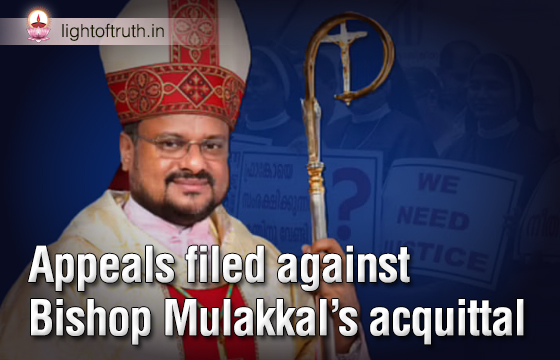
Appeals filed against Bishop Mulakkal’s acquittal
The January 14 acquittal of Bishop Franco Mulakkal in a rape case involving a Catholic sister has been challenged in an appellate court by both the accuser and the prosecution.
Bishop Mulakkal confirms that the government and the nun have appealed to the high court against his acquittal. “Yes. It is their right. We respect it,” he told GSR.
Under Indian law, acquittals in criminal cases may be appealed.
The accuser filed the appeal March 28 in the Kerala High Court online, but it was not officially listed because of some defects in the filing. The nun’s supporters told Global Sisters Report on March 30 that they will fix the problems and the case should be listed in a day or two.
Meanwhile, the home department of the Kerala state government on March 29 sanctioned the prosecution to appeal Mulakkal’s acquittal.
The government move ended the speculation that the Communist-led government in Kerala was not serious about appealing the acquittal. -
Nun’s murderer admits killing another elderly nun
The man held in connection with the murder of a 69-year-old nun in Pala allegedly had killed another elderly nun at a convent near Erattupetta in April this year, police said on Tuesday. Satheesh Babu, who has been remanded in police custody for the probe into the murder of Sister Amala in Lisieux Carmel Convent at Pala, has “confessed” to having attacked 83-year-old Jose Maria Iruppakkad at her room in the Sacred Heart Convent in Chettuthodu in Erattupetta in April this year, they said.
-
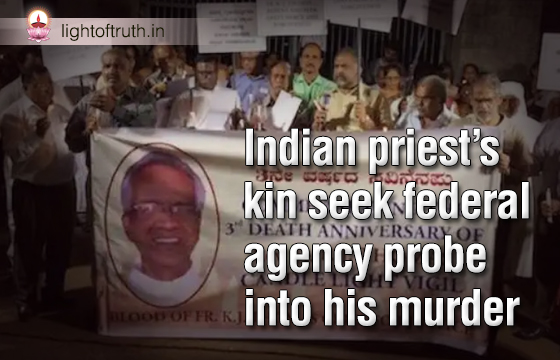
Indian priest’s kin seek federal agency probe into his murder
A close relative of a Catholic priest found dead under suspicious circum-stances inside a major seminary in southern India has demanded a federal agency probe to establish the truth. Father K.J. Thomas, 62, the then rector of St. Peter’s Pontifical Institute, Bangalore (now Bengaluru) in Karnataka state, was found dead with multiple injuries outside his room at the seminary on April 1, 2013.
“My uncle was physically tortured and murdered in the most inhuman way,” Joyson Mathew claimed in a March 27 communiqué addressed to Archbishop Peter Machado of Bangalore, blaming ethnic rivalry within the archdiocese for the suspected murder.
The nephew of the deceased priest said his family was not happy with the tardy investigations conducted by the state’s police and urged the Arch-bishop to pursue the Karnataka state government to hand over the probe to the Central Bureau of Investigation (CBI), a premier federal agency. -
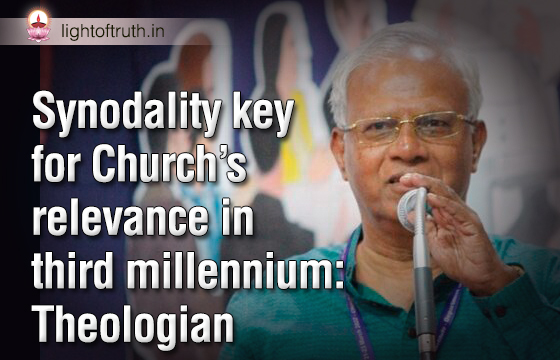
Synodality key for Church’s relevance in third millennium: Theologian
A renowned Asian theologian says the synodal process now underway in the Catholic Church should prepare it to become relevant in the third millennium and respond to modern challenges.
Synodality reflects how the Church’s life and mission should adapt to the modern world. It flows from the Christian value of upholding hu-mans as unique reflection of God’s mystery and image, asserts Father Felix Wilfred, emeritus professor at the State University of Madras, and the founder director of the Asian Centre for Cross-Cultural Studies in Chennai.
The 74-year-old priest was the keynote speaker at a national conference on the theme “Church in India on the Path of Synodality” organized by the department of missiology of Bengaluru’s St Peter’s Pontifical Institute.
The March 21-23 conference was held to help the Church in India reflect on synodal theme, explained Fr Antony Lawrence, who head the department.
Father Wilfred expects the synodal process to lead a tran-sition from the Bishops’ synod to the synodal Church. For this, drastic structural changes are required, a major theological issue synodal process should address, he asserted.
He said when the Church really practices synodality it would become an inverted pyramid. For this, the canon law that now vests the governance on the clergy, has to change to allow all baptized Catholic to share in the exercise of power.