

Father Subhash Anand, a renowned philosophy professor who challenged Catholics in India to become Christ’s authentic disciples, died of a massive heart attack May 23 in Udaipur, Rajasthan. He was 78.
Bishop Devprasad Ganawa of Udaipur has informed that the funeral begins at 10 am on May 24.
Father Anand, a priest of the diocese of Udaipur, was born Benedict Alvarez on Nov. 15, 1943. He was ordained a priest on Oct. 28, 1967.
He was a resident of St Paul’s School in Udaipur’s Bhupalpura area.
Father Anand was part of Pune’s Jnana Deepa Vidyapeeth (JDV) semi-nary as a student and professor of Indian Philosophy and Religion for more than 30 years.
Father Subhash Anand “deeply loved the Church and his path took unusual twists and turns. He wouldn’t tolerate hypocrisy, be it among scholars or the Church’s officials,” says Jesuit Father Stanislaus Alla, a theology professor in Delhi’s Vidyajyoti College of Theology.
According to him, Father Anand “loved to go to the root of the Gospel that invites and challenges the faithful to be authentic disciples rather than get struck in the infantilizing traditionalism.”
Category Archives: From The States
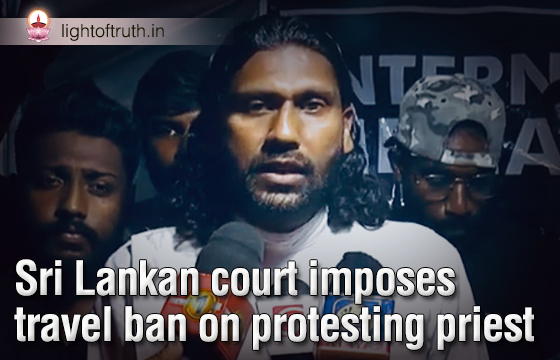
Sri Lankan court imposes travel ban on protesting priest
A Sri Lankan court has ordered a travel ban on a Catholic priest for being part of the “GotaGoGama” protests demanding President Gotabaya Rajpaksha’s resignation over the nation’s worsening economic situation.
Officials from the Criminal Investigation Department in-formed Father Amila Jeewantha Pieris about the travel ban on May 23.
The activist priest has been involved with the month-long protests in the open space opposite the presidential secretariat in Colombo.
“The government is sending another message that they will make the victims more vulnerable,” said Fr Pieris while asserting that the struggle can-not be stopped by such intimidation. He said the protests will end only when the president and Prime Minister Ranil Wickramasinghe resign.
The court order was reportedly passed to allow further investigations into the com-plaint lodged by Father Pieris and others regarding attacks by pro-government supporters on peaceful protesters at the Galle Face on May 9.
“The successor president and the new prime minister should not be part of the Rajapaksa family regime. They should also not be accused of financial corruption or crime.”
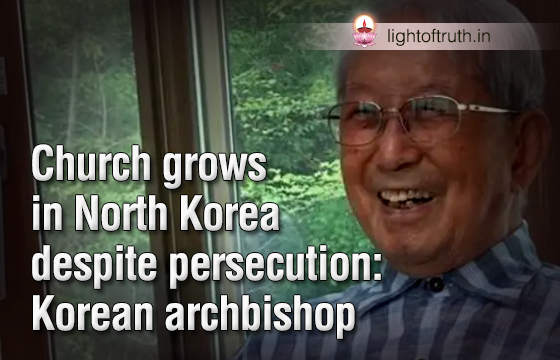
Church grows in North Korea despite persecution: Korean archbishop
One of South Korea’s most senior clergymen says he believes Catholic Church in communist North Korea is growing although Catholics live in hiding and endure persecution. Archbishop Victorinus Yoon Kong-hi, the former head of the Archdiocese of Gwangju in South Korea, has made the remarks in a recently published book on the history of the North Korean Church.

Faith, fortitude, martyrdom, miracles: Pope canonizes Devasahayam Pillai and 9 more new saints
After a long pandemic pause, Pope Francis is scheduled to celebrate a Mass May 15 for the canonization of Blessed Devasahayam Pillai and 9 men and women: Five from Italy, three from France, one from India and one from the Nether-lands. Blessed Devasahayam Pillai an Indian layman and father who was born to an upper-caste Hindu family in 1712 and converted to Christianity in 1745. The Vatican said his refusal to participate in Hindu ceremonies and his preaching about “the equality of all people,” denying the Hindu caste system, led to his arrest, torture and his death in 1752
The last canonization ceremony was celebrated Oct. 13, 2019, and included St. John Henry Newman.
The “big names” – globally – in the newly recognized heavenly host are soon-to-be St. Charles de Foucauld, who lived as a hermit in North Africa, and soon-to-be St. Titus Brandsma, a Dutch Carmelite martyred at the Dachau concentration camp.
Those canonized will bring to 909 the saints Pope Francis has recognized officially during his pontificate; the figure includes the 813 “Martyrs of Otranto,” who were killed in the southern Italian city in 1480 and declared saints in 2013.
In view of the canonization ceremony, the Congregation for Saints’ Causes has published a brief biography of each of the 10 new saints and information about the miracle attributed to their intercession needed for their canonizations. While the church does not require the recognition of a miracle for the beatification of a martyr, it generally requires one for all blesseds to be declared saints. The 10, listed in the order the congregation lists them, are: Blessed César de Bus, Blessed Luigi Maria Palazzolo, Blessed Giustino Maria Russolillo, Blessed Charles de Foucauld, Bless-ed Anna Maria Rubatto, Blessed Maria Domenica Mantovani, Blessed Titus Brandsma, Blessed Marie Rivier, Blessed Carolina Santocanale.
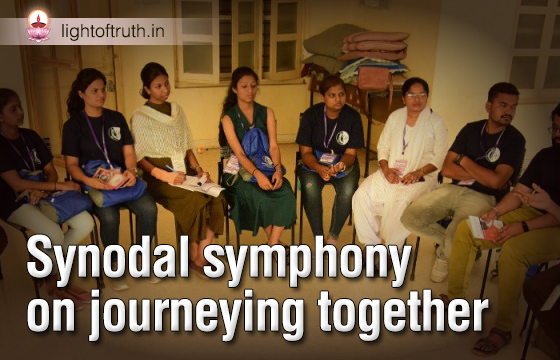
Synodal symphony on journeying together
Since its launch in all dioceses worldwide in October 2021, the synod 2021-2023 entitled ‘For a Synodal Church: Communion, Participation, Mission’ has evoked mixed responses ranging from excitement and optimism to indifference and cynicism.
The Synod inaugurations in the Indian dioceses of the Conference of Catholic Bishops of India (CCBI, Latin rite) were followed by consultations of cross-sections of people: lay faithful, youth, children, diocesan clergy, religious men and women, the elderly and infirm, seminarians, the poor and peripheral, lapsed Catholics and so on.
“The synod is an ecclesial event and its protagonist is the Holy Spirit. If the Spirit is not present, there will be no synod,” said Pope Francis during his ‘moment of reflection’ while launching the synodal consultations on October 9, 2021. Viewing how processes have unfolded in diverse dioceses, there is no doubt that the omnipresent Spirit “blows where it wills” (Jn 3:8).
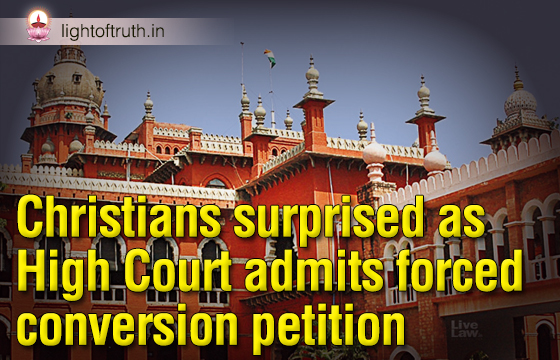
Christians surprised as High Court admits forced conversion petition
Christians in Tamil Nadu have expressed surprise that the state’s high court has admitted a public interest litigation to stop forcible conversion of students in schools.
The bench of Justices R. Madhavan and S. Ananthi of the Madras High Court on May 6 admitted the petition and posted the matter to a regular bench on June 6 after the summer vacation ends.
Jesuit Father Arockiasamy Santhanam, spokesperson for the National Lawyers Forum of Religious and Priests, says the vacation court should not have entertained the petition. “One wonders what urgency is found in this petition,” he added.
Father Devasagayaraj M Zackarias, a former secretary of the Office for Scheduled Castes and Backward Classes under the Catholic Bishops’ Conference of India, says he was surprised the High Court admitted the petition when the incidents it has quoted are still under investigation.”
The case, Father Zackarias laments, is nothing but a way to create unnecessary disturbance in the state where schools impart quality education, especially to the poor and the marginalized.

Nobel laureate and physicist Wilczek wins Templeton Prize
Frank Wilczek, the Nobel Prize-winning theoretical physicist and author renowned for his boundary-pushing investigations into the fundamental laws of nature, was honored Wednesday with this year’s prestigious Templeton Prize, awarded to individuals whose life’s work embodies a fusion of science and spirituality.
In a statement, the John Templeton Foundation praised the 70-year-old Wilczek for transforming “our understanding of the forces that govern our universe,” while also applying “the insights of his field to the great questions of meaning and purpose pondered by generations of religious thinkers.”
Established in 1972 by the late philanthropist Sir John Templeton, the prize is one of the world’s most lucrative individual awards, currently more than $1.3 million. Past winners include Jane Goodall, Mother Teresa, the Dalai Lama and Archbishop Desmond Tutu.
“It’s encouragement in a direction that I’ve really only taken up in a big way quite recently, although I’ve been building up to it for many years,” he said, “which is thinking about not just what the world is and how it came to be this way but what we should do about it.”
Over a long career, Wilczek has recorded many distinguished achievements. That includes the 2004 Nobel Prize in Physics, along with David J. Gross, and H. David Politzer, for their 1973 breakthrough explaining the unusual properties of the strong force, which binds fundamental particles known as quarks into protons and neutrons.
He has also authored several books that are informed by science but delve into the spiritual and philosophical. They include “ A Beautiful Question,” in which he asks, “Does the universe embody beautiful ideas?”; “ The Lightness of Being,” an examination of what humans are made of; and “ Fundamentals,” an exploration of radical life ex-tension, the longing for immortality, the limits of science and other topics.
“In studying how the world works, we are studying how God works, and thereby learning what God is,” he writes in “Fundamentals,” released this year. “In that spirit, we can interpret the search for knowledge as a form of worship, and our discoveries as revelations.”
Growing up Catholic, he embraced the idea that there was a grand plan behind existence. But as he learned more about science, he eventually lost faith in conventional religion and, in his words, “jettisoned detailed dogmas.”
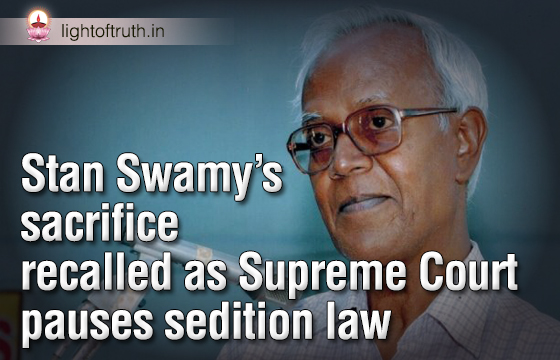
Stan Swamy’s sacrifice recalled as Supreme Court pauses sedition law
Christian activists in India on May 11 recalled “the sacrifice” of Jesuit Father Stan Swamy while welcoming the Supreme Court order to keep the country’s sedition law on abeyance. Father Stan, as he was popularly known, died July 5, 2021, in a Mumbai hospital as an undertrial prisoner.
A three-judge Bench led by Chief Justice of India N V Ramana also directed that an accused in a fresh case could seek bail and the court that deals with it would provide relief taking into account the apex court order.
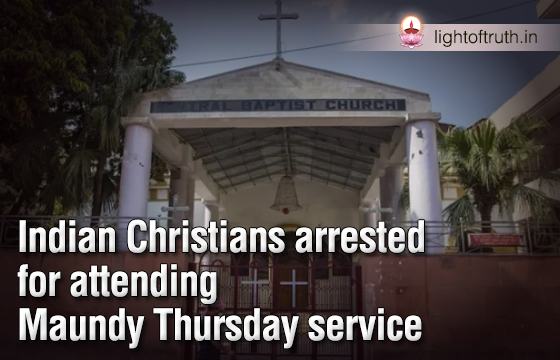
Indian Christians arrested for attending Maundy Thursday service
Police in northern India’s Uttar Pradesh state charged 55 Christians who took part in a Maundy Thursday service with violating a law that criminalizes religious conversion following complaints by right-wing Hindu groups.
Among them, 26 people were arrested and later released on bail, but police say they are searching for others included in the first information report (FIR).
Christian leaders denied the allegations and said the Maundy Thursday service on April 14 was “portrayed as a religious conversion activity and those who attended it were harassed for no fault of their own.”
Some 70 believers of the Evangelical Church of India gathered at their church in Fatehpur in Harihar Ganj district for the service to commemorate the Last Supper of Jesus with his disciples before he was crucified.
One Christian said right-wing Hindu activists who gathered outside the church locked its two main gates. “They then began to shout slogans like ‘Stop conversion’ among other things,” he said.
When police arrived at the scene after being alerted about the incident, they questioned the Christians about their details and kept them inside the church for close to three hours.
“We were told that we were kept in the police station for our own safety, but when we were taken for a medical examination we realized that we were being charged”
Hindu leaders also entered the church and demanded the personal details of the Christians.
Officers then took the Christians, including women and children, to the police station on the assumption that they were being taken to their homes.
Later that night, the women and children were allowed to go home while 26 males were kept in custody.
“We were told that we were kept in the police station for our own safety, but when we were taken for a medical examination we realized that we were being charged,” said one of the Christians.

Church opens Indian state’s first palliative care centre
The Catholic Church has set up the first-ever palliative care centre in Nagaland, a Christian-majority state in northeast India.
The St. Joseph Pain and Palliative Care Centre at Chumukedima, near the state’s commercial hub of Dimapur, was inaugurated by Chief Minister Neiphiu Rio, a Baptist Christian, on April 24.
The centre is an initiative of the Diocese of Kohima and will be run by the Medical Sisters of St Joseph, Nirmala Province from Kerala, known for their dedicated service to the sick, the poor and the least of the brethren irrespective of caste and creed.
“This first fully fledged palliative care centre in Nagaland intends to provide service free of cost. The state government will extend all possible help to carry out this gratuitous service to the people,” announced Rio.
Nagaland, a predominantly Baptist Christian stronghold, along with the southern state of Tamil Nadu has the highest percentage of elderly people living alone without a spouse, children or any other support, according to the first Longitudinal Ageing Study in India released in 2021.