
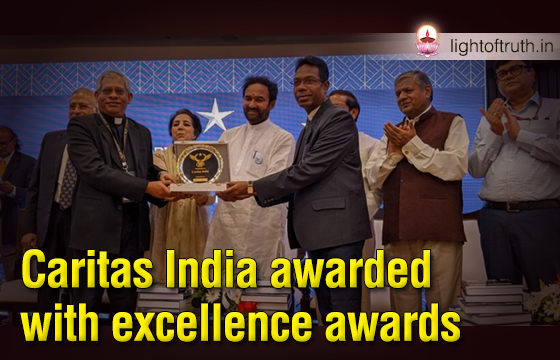
Caritas India, the social development arm of the Catholic bishops in India, has been awarded for its excellent work in humanitarian aid and disaster risk reduction, community health, climate-adaptive agriculture and food sovereignty.
Category Archives: From The States
Book on nuns’ valiant struggle against archdiocese released
A book on the unusual struggle of a group of Catholic nuns against an archdiocese and their congregation was launched June 26 during a virtual function.
The book, “My Prophetic Struggle, The Narakkal Story,’ written jointly by Carmelite Sister Annie Jaise and feminist theologian Kochurani Abraham, was released by Sister Elsa Muttathu, the national secretary of the Conference of Religious of India. The first copy was received by Jesuit Father T K John, a veteran theologian.
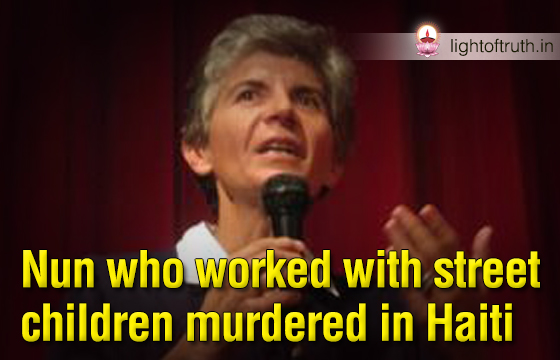
Nun who worked with street children murdered in Haiti
An Italian missionary who dedicated herself to working with street children in Haiti for more than 20 years, was murdered.
Sister Luisa Dell’Orto, a Little Sister of the Gospel of Saint Charles de Foucauld, was shot during a robbery attempt on June 25.

Indian Catholics slam silence over Nigerian massacre
Catholics in India have questioned the silence of the global community over the brutal mass killing of Christians in southwest Nigeria recently and want it to take a strong stand against such atrocities. Scores of Catholics belonging to the Catholic Congress based in Kerala state in southern India staged a rally in Kottayam district, a Christian stronghold, and condemned the massacre.On June 5, Pentecost Sunday, gunmen believed to be Islamic extremists associated with Islamic State West Africa Province (ISWAP) entered St. Francis Xavier Catholic Church in Owo, Ondo state. They fired weapons, detonated explosives and killed at least 40 people, government agencies said. “We appeal to the global community to stand up against the mass murders in Nigeria,” said Catholic Congress president P.P. Joseph of Changanaserry Archdio-cese. “Unless the global conscious rises up against such murders, humanity will not survive in this world.”
Archbishop Joseph Perumthottam of Changanassery Archdiocese in Kerala wrote an editorial for Deepika (Light), a church-run daily, in Malayalam, the official language of the southern state.
“When it comes to the killing and persecution of Christians, certain media houses maintain silence. What sort of media ethics is this?” he wrote in a June 13 article.
The prelate claimed that in 2021 alone at least 6,000 Christians were slaughtered in Nigeria by Islamic terrorist groups such as Boko Haram among others. Since 2009, at least 40,000 Christians were killed by Boko Haram in Nigeria, he added.
The prelate also expressed concern over the spread of Islamic terror in other African countries and other parts of the world, noting that Christians are “the worst victims of persecution” and questioned why global powers could not protect human beings from the onslaught of Islamic terrorists.
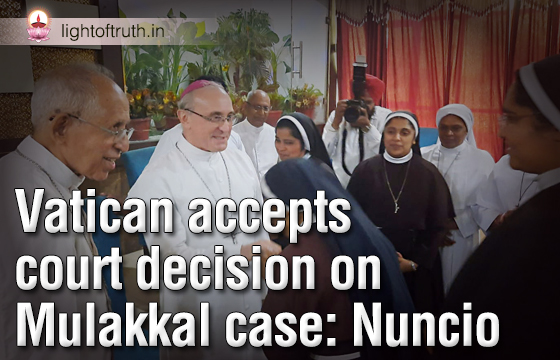
Vatican accepts court decision on Mulakkal case: Nuncio
Archbishop Leopoldo Girelli, apostolic nuncio to India and Nepal, on June 11 said the Vatican has accepted the Indian court decision about Bishop Franco Mulakkal of Jalandhar.
The nuncio, who was on a two-day pastoral visit to Jalandhar, said this June 11 while addressing the priests of the diocese of Jalandhar.
The nuncio said Bishop Mulakkal is an Indian citizen and the Vatican goes by the decision of the local court.
“Accordingly, Bishop Franco [Mulakkal] is innocent and free of all charges. With regards to the future, it is not in my hands but with Rome. Let us wait for it patiently,” Archbishop Girelli told the priests.
The Vatican on September 20, 2018, accepted Bishop Mulakkal’s request to relieve him from his duties until the case was over. It then appointed Bishop Agnelo Gracias as the diocesan administrator. Meanwhile a report in the Indian Express said the nuncio was told that all was not well in Jalandhar diocese. A delegation of the Catholic Union, senior citizens and members of the Diocesan Pastoral Council reportedly met the nuncio June 11 at the Bishop’s House and submitted a memorandum stating their grievances against local officials of the diocese.
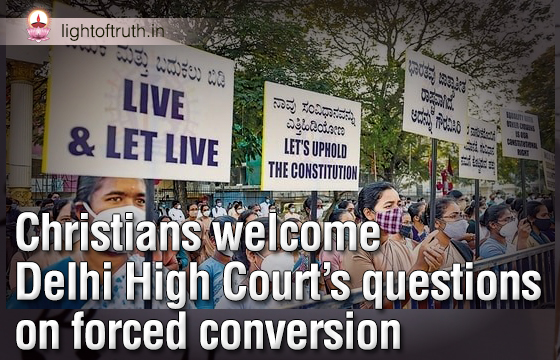
Christians welcome Delhi High Court’s questions on forced conversion
Christian groups in India have welcomed the Delhi High Court questioning the basis for filing petitions on forced conversion.
The bench of Justices Sanjeev Sachdeva and Tushar Rao Gedela on June 3 pointed out that conversion is not prohibited in India.
“It’s a right of an individual to profess any religion, religion of his birth, or religion that he chooses to profess. That’s the freedom our Constitution grants,” the court said while hearing a petition by a lawyer seeking direction to the federal and Delhi governments to prohibit religious conversion by intimidating, threatening, and deceivingly luring through gifts and monetary benefits and by using black magic and superstition.
“An excellent move by the Delhi High Court,” says Sister Manju Devarapalli, secretary of the National Dalit Christian Watch.
The Carmelite Missionaries nun says the court’s stand co-mes at a time one was losing faith in the judiciary. “The High Court ruling comes as a soothing balm on seeming wounds, enforcing the sacredness of Indian Constitution,” she told.
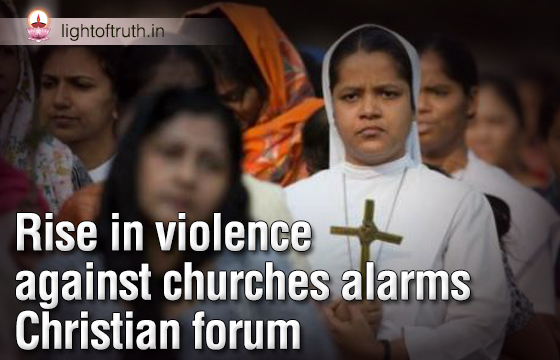
Rise in violence against churches alarms Christian forum
The United Christian Forum (UCF), an ecumenical group, has demanded urgent judicial and government intervention to check what it says is the rapid rise in incide-nts of violence, coercion and false arrests that traumatize the community.
The persecution is most acute in states such as Uttar Pradesh, Madhya Pradesh, Chhattisgarh and Karnataka; the UCF said June 13, citing data collected from its National Helpline Number 1800-208-4545 and human rights groups.
Although 2022 is not even halfway over, the helpline has received 207 cases of violence. Just in May, it recorded 57 cases. In 2021, the forum documented 505 cases, with Christ-mas seeing 16 acts of violence, including desecration and breaking of statues of Jesus Christ at a historic church in Haryana.
“This data flies in the face of statements by government functionaries and leaders of the ruling parties at the center and in the states that there is no persecution, and that there are only a few stray incidents by fringe elements,” the forum’s national president Michael Williams said.

Diocesan Synod renews Church in Tripura
Nine months of the in-tense synodal meetings at different levels ended June 11 with the diocesan pre-Synodal meeting in Agartala, capital of the northeastern Indian state.
As many as 92 representatives of laity, catechists, women’s groups, youth religious and priests attended the day-long prayer, reflection, discernment and planning for the future of the Church in Tripura.
The participants have resolved to make the spirit of Synodality, “Journeying together” beyond the diocesan synod meeting into their daily lives. “The meeting provided an opportunity for diverse members of the diocese to come together for a liturgical celebration, pray together, and reflect on their experience of the Synodal process,” said Jesuit Father Irudhaya Jothi, the contact person for the Synodal preparation in the diocese of Agartala.
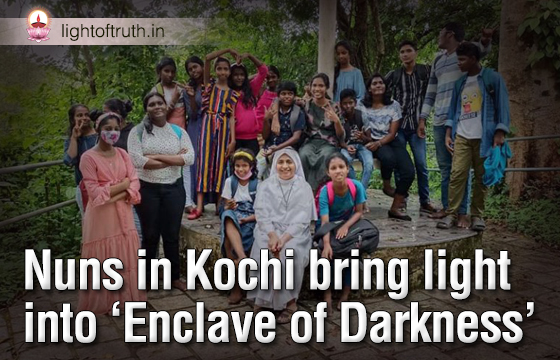
Nuns in Kochi bring light into ‘Enclave of Darkness’
A slum in this southwestern Indian city was once known as the “Enclave of Darkness” be-cause it was the den of thugs, alcoholics, drug runners and psychopaths.
It is now called Udaya Colony (Sunrise Enclave) after Catholic nuns dared to enter it 33 years ago as part of their mission to reach people in the peripheries.
What now welcomes visitors to the enclave in the middle of Kochi, the commercial capital of Kerala state, are buildings of two and three floors, paint-ed with attractive colors, that were once one-room, cramped tenements.
“The sisters faced stiff resistance in the beginning but people relented when they realized the sisters meant them good,” Anil Kumar, vice president of the Udaya Colony Residents Welfare Association, told Global Sisters Report.
Sister Anisha Arackal, who led the Sisters of the Destitute to turn the place into an upmarket residential area, recalls the slum’s notoriety.
Her congregation’s 1979 general chapter decided to help impoverished people and the marginalized on the peripheries, but it took 10 years for the first nuns to enter the Kochi slum. Sisters Redempta Alapp-at and Naveena Pulickal, the pioneers, started living in the slum in 1989, the year the congregation received pontifical status.
Alappat, 83, recalls reading an article in a magazine asking who will spread light in the enclave of darkness.

The rise of priestly vocations in Southeast Asia
An average of one priest ministering to 8,000 souls is a sad picture of the priestly vocation unable to cope with the growing population. The 2021 Catholic Directory of the Philippines counted more than 120 active bishops and 10,470 priests serving 85 million Catholics. It’s the same number of clergy as 10 years ago while the Catholic population has grown since then.
Recent international conferences about the clergy and religious vocation, particularly in the West, have identified the priest shortage as the most urgent problems facing the Church. Priestless parishes, empty altars and empty pews are sad realities in some parts of North America and Europe — a crisis caused by retiring senior clergy, added to those leaving the priesthood and the ever-decreasing sacerdotal vocation.
Sexual abuse scandals, coupled with the not-so-good examples set by bi-shops along the corridors of power in the Vatican and elsewhere, were not unlike a tsunami wiping out the Church’s credibility for more than decade or so until Pope Francis assumed the Chair of Peter in 2013 and began the radical reform of the Roman Curia.
Change has come and the Church in Asia is gradually overcoming the crisis of priestly vocations. In Bangladesh, Catholics saw 12 young men ordained as deacons in 2022. In this predominantly Muslim country with 500,000 Catholics or about 0.4% of the total population, the Church celebrates with the gift of new laborers in the vineyard of the Lord.