
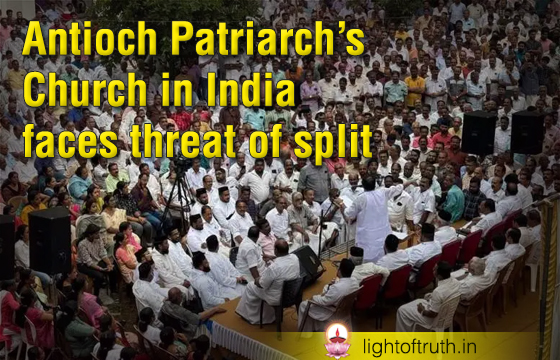
An India-based Church group under the Patriarch of Antioch, the Malankara Syrian Orthodox Church, faces the threat of a split after the patriarch suspended one of its archbishops for alleged disobedience. Christians in the Church’s archdiocese based in Kottayam district in southern Kerala state are divided after Patriarch of Antioch Ignatius Aprem-II suspended their Archbishop Severios Kuriakose, accused of defying the orders of the patriarch. The suspension order of May 17 has divided around 50,000 Christians of the Malankara Syrian Knanaya Archdiocese at Chingavanam in Kottayam district, according to T. O. Abraham, the archdiocesan Knanaya Association secretary. At a May 21 emergency meeting, the archdiocesan members declared the suspension of their Metro-politan illegal.
“The Patriarch has only spiritual powers and no power to deal with temporal matters, including dismissing our Metropolitan,” said Abraham, secretary of the supreme body that manages the archdiocese’s temporal matters. Some Church leaders told that Kuriakose’s consent to convene a special session of the Knanaya Association to amend their constitution, allegedly to curtail the patriarch’s powers, provoked the suspension.
Category Archives: From The States
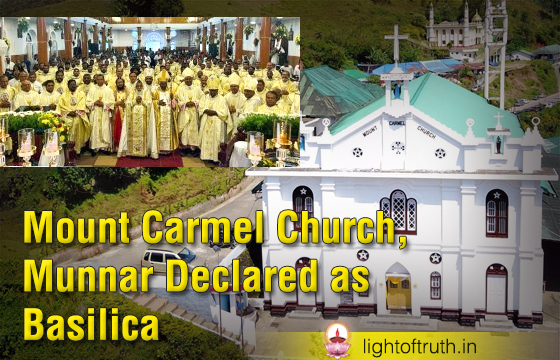
Mount Carmel Church, Munnar Declared as Basilica
Mount Carmel Church in Munnar was elevated to the status of Minor Basilica during the Eucharistic celebration held on Saturday 25 May 2024. The declaration was solemnly announced by Most Rev. Sebastian Thekethecheril, Bishop of Vijayapuram, marking a historic milestone, as the first basilica in the high ranges of Kerala in the Western Ghats. The formal decree of declaration, issued by the Dicastery for Divine Worship and the Discipline of the Sacraments, was read in Latin by Most Rev. Justin Madathiparambil, Auxiliary Bishop of Vijayapuram, with its translation into Malayalam presented by Msgr. Joseph Navaz, the Chancellor of the diocese.

Archbishop Thumma Bala Passes Away
Most Rev Thumma Bala, (80), Archbishop Emeritus of Hyderabad, passed away on Thursday, May 30, 2024, at Karuna Puram, in Warangal, due to old age ailments. He made a visit to his own sister at Karuna Puram and breathed last. He was the Archbishop of Hyderabad (2011–2020) and Bishop of Warangal (1987–2011). He was born on 24 April 1944, in Narimetta, Warangal Diocese. He was ordained priest on 21 December 1970.
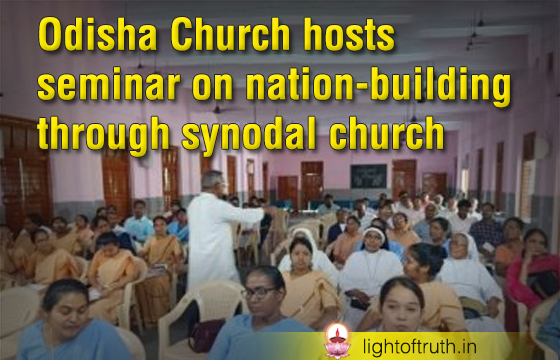
Odisha Church hosts seminar on nation-building through synodal church
A seminar on hope-filled nation-building from a synodal church perspective was held in Bhubaneswar capital of the eastern Indian state of Odisha. The May 18 event was organized by the Odisha Region Catholic Religious of India (CRI) in collabo-ration with church leaders and human rights activists. As many as 85 religious clergy, church leaders, advocates, and human rights activists from various dioceses attended. The seminar started with a keynote address by Sr Helen Saldana, the director of Streevani (the voice of women), Pune. She emphasized the significant role that faith communities can play in nation-building by shaping the moral and ethical framework of society. Sister Saldana’s address set the tone for the day’s discussions, highlighting the intersection of faith, ethics, and civic responsibility. The main resource per-sons for the seminar were Jesuit Fr Prakash Louis and civil and human rights activist Dhirendra Panda.
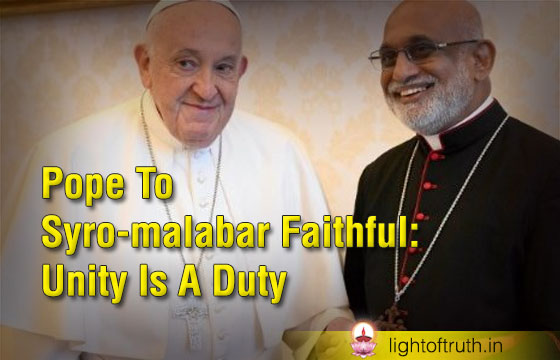
Pope To Syro-malabar Faithful: Unity Is A Duty
Pope Francis met on May 13 with Major Archbishop Raphael Thattil, the head of Syro-Malabar Catholic Church. The Pope’s address to Archbishop Thattil ranged over a number of topics, from the ancient history of the Church in Kerala to the liturgical dispute which has been raging there for a number of years.
Pope Francis began his address by reflecting on the ancient faith of the Syro-Malabar Church. “The faithful of your beloved Church”, he said, “are known not only in India, but throughout the whole world, for the ‘vigour’ of their faith and piety.” Referring to the fact that, for many years, Western missionaries attempted to force Kerala’s Christians to conform to European traditions, Pope Francis said that “some members of the faith” committed “unfortunate acts against you”, because of their “insensitivity” to the history of India’s ancient churches. The Syro-Malabar Church, the Pope added, is particularly important today, in times where it is common to “sever the roots connecting us to the past.” “The Christian East”, he said, “allows us to draw from ancient and ever new sources of spirituality; these become fresh springs that bring vitality to the Church.”
Referring to the ongoing liturgical controversy, the Pope said, “let us meet and discuss without fear, this is fine, but above all, let us pray, so that the light of the Spirit, which reconciles differences and brings tensions back into unity, may resolve disputes. There is one certainty: pride, recriminations and envy do not come from the Lord and never lead to concord and peace. Showing a grave lack of respect for the Blessed Sacrament – the Sacrament of charity and unity – by arguing about the details of how to celebrate the Eucharist, the pinnacle of his presence among us, is incompatible with the Christian faith. The guiding criterion, the truly spiritual one that derives from the Holy Spirit, is communion: this requires us to do a self-examination of our dedication to unity and our faithful, humble, respectful and obedient care for the gifts we have received.”

The Goa Bench Of The Bombay High Court Grants Relief For Protestant Pastor, Wife
The top court in a western Indian state has revoked an official order that prohibited a Protestant pastor and his wife from living in their village home following allegations of religious conversion. The Goa bench of the Bombay High Court on May 8 set aside the district collector’s order, which banished Pastor Dominic D’Souza and his wife Joan Mascarenhas D’Souza from their residence in Siolim village in north Goa. The couple runs an independent Church called the Five Pillars Church. The North Goa district collector, the highest government official in the district who also has executive magisterial powers, issued the order against the couple on March 14 under the Goa Maintenance of Public Order and Safety Act. He ordered them to leave North Goa for six months. They were accused of using black magic and converting B Vadivel, a Hindu and native of southern Tamil Nadu state, who currently lives in Goa. The conversion incident happened in January and Vadivel filed a police complaint against the couple. The police filed multiple cases against the couple based on which the order was issued.

Hailstorm Wreaks Havoc In India’s Manipur
One person was killed and over 15,000 houses, including churches, were destroyed after a hailstorm struck strife-torn Manipur state in northeast India on May 5. Initial reports reveal a man had died and 15,425 houses were destroyed, said state Chief Minister N Biren Singh. The state government has sanctioned a financial package to arrange relief materials, he told reporters on May 6. The government has opened 42 relief camps to accommodate the people whose houses were damaged. At least six churches were damaged in the hilly areas after their roofs flew away in the storm, said a Church official who did not want to be named. “We are now taking stock,” he said and added that the situation was not conducive to undertaking relief works. “We will, however, try our best to help our people who already lost everything in the ethnic violence,” the Church official told on May 7. The worst-hit places are Imphal West and Imphal East districts in the valley where up to 11,000 houses were damaged, the chief minister noted. Valleys in the state are inhabited by the majority Meitei community while indigenous Kuki-Zo Christians live in the hilly districts. In Churachandpur, a tribal stronghold and the nerve center of sectarian strife, 540 houses perished in the hailstorm.
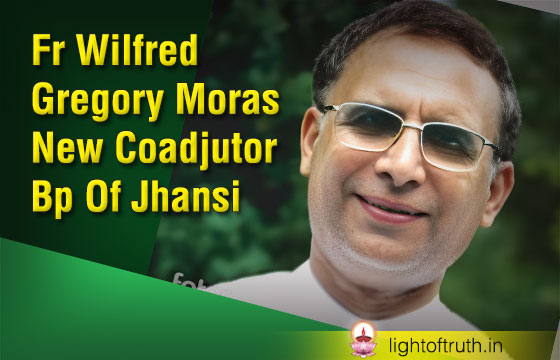
Fr Wilfred Gregory Moras New Coadjutor Bp Of Jhansi
The Holy Father Pope Francis has appointed Fr Wilfred Gregory Moras (55), of the clergy of Lucknow, as the Coadjutor Bishop of the Diocese of Jhansi, Uttar Pradesh. Currently he is the ector of the St. Joseph’s Regional Seminary, in the diocese of Allahabad. Fr Wilfred Gregory Moras was born on 13 February 1969 in Neerude, in the diocese of Mangalore and studied Philosophy and Theology at St. Joseph’s Regional Seminary in the Diocese of Allahabad. He was ordained priest on 27 April 1997 for the Diocese of Lucknow.

Christians Decline India’s Ruling Party’s Offer To Clean Church Premises
The pro-Hindu Bharatiya Janata Party, which runs the government in the Christian-majority Nagaland state, has offered to clean church premises to mark the death anniversary of a Hindu leader, but Chri-stians have declined the offer. The BJP offered to clean church compounds on May 11 as a build-up to mark the 70th death anniversary of Syama Prasad Mookerjee. A prominent Hindu leader from the colonial-era Bengal region, Mookerjee died on June 23, 1953.”We feel obligated to politely decline the kind gesture offered to clean church compounds on May 11,” said the Nagaland Baptist Church Council (NBCC), the largest denomination in Nagaland where Christians account for 87.93 percent of the state’s 1.97 million people.”We may as well direct your good office to pursue another avenue of service,” the council said in a statement on April 30.The council alleged that Christians have been facing unprecedented violence after Prime Minister Narendra Modi came to power in New Delhi, leading the BJP victory in the 2014 national elections. The council urged the party to exercise caution while issuing such directions. The BJP is sharing power in Nagaland. Mookerjee was one of the founders of Bharatiya Jana Sangh, a precursor of the BJP, and a minister in the interim government from 1947 to 1950. Its state chief, Benjamin Yepthomi, had directed party members to clean church compounds to mark Mookerjee’s death anniversary. The influential Baptist council warned against political parties championing religious subjects. The Nagaland Christian Revival Church Council (NCRCC) also issued a statement on May 1 urging parties to refrain from “politicizing sacred spaces for partisan gains.” “Let us uphold the values of tolerance, respect, and religious freedom that are fundamental to our society,” it stated. India’s seven-phased polls to elect 543 members of the Lok Sabha (lower house) started on April 19 and will conclude on June 1. The results will be declared on June 4. Nagaland, one of India’s eight northeastern states, sends one lawmaker to the Lok Sabha. In neighboring Manipur, the sectarian strife involving tribal Christians has been going on since May 3 last year. The death toll in the communal conflict has reached 220 and more than 500 places of worship have been set on fire. Earlier Reverend N. Paphino, president of the NCRCC, asked the pro-Hindu party to prioritize “protecting persecuted Christians across India instead of focusing on Nagaland for the sake of a campaign.”
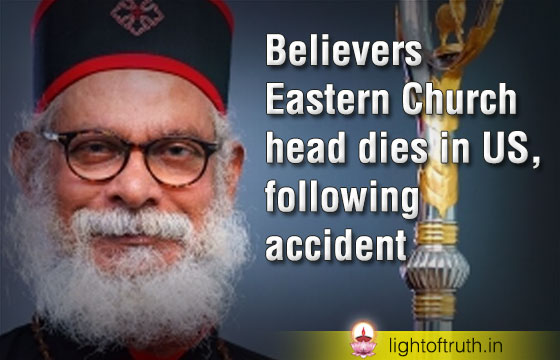
Believers Eastern Church head dies in US, following accident
Moran Mor Athanasius Yohan (formerly known as K P Yohannan), head of the Bishop of Believers Eastern Church, died on May 8 at Dallas in the US. He was 74. The Church leader was hospitalized after he sustained serious wounds in a car accident. A press statement from the Church headquarters said the death occurred due to a sudden cardiac arrest.
He was born on March 8, 1950, in a Mar Thoma Syrian Church family in Kerala, India. He was the founder and president of the Gospel for World, earlier known as Gospel for Asia, a large non-profit missions organization with a focus on India and Asia. He was also the founding Metropolitan Bishop of Believers Eastern Church (Earlier Believers Church) with the religious title and name of Moran Mor Athanasius Yohan I.